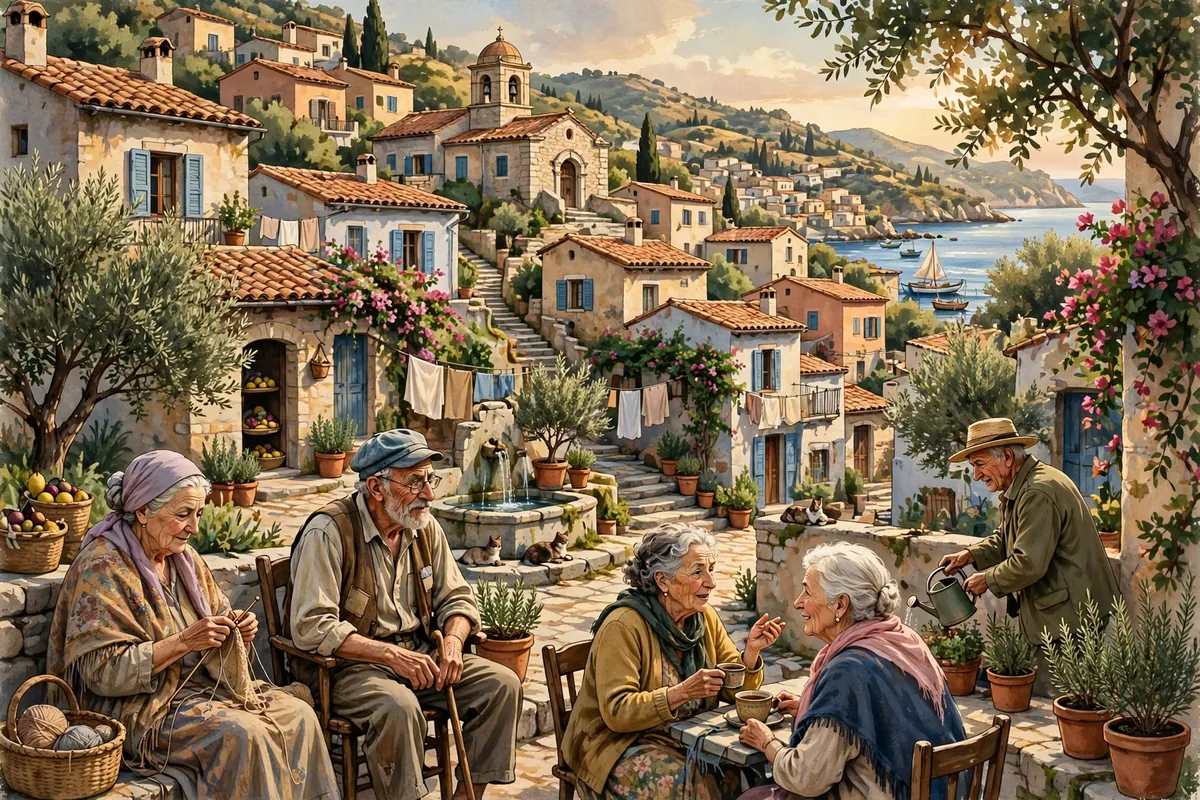
You've probably seen the stories: a sunny Mediterranean village where grandparents tend gardens at 100, sip local wine, and climb steep hillsides every day. It's an appealing picture, and it has inspired books, diets, and even a TV series. But do whole villages really live to 100?
Not exactly. Certain places, called blue zones, have been reported to have unusually high numbers of very old people, including mountain villages in Sardinia, Italy, and the Greek island of Ikaria. But no village sees everyone reach 100, and the blue zone idea is hotly debated. Some claims have held up under careful checking, while others have been contradicted.
A Blue Pen on a Map
The idea began in Sardinia. A 1999 study found 13 centenarians per 100,000 people there, which would mean unusual longevity, if accurate. A 2004 follow-up found the long lives concentrated in the mountains of Nuoro province.
The name came from a simple habit: researchers marked the villages with long-lived residents on a map using a blue pen. Starting in 2005, the list grew to include Okinawa in Japan, the Nicoya Peninsula in Costa Rica, and Ikaria in Greece. Later, Martinique, Loma Linda in California, and Singapore were discussed as possibilities, too.
Life on Ikaria
Ikaria is often described as a place where about one in three people reach their 90s. Explanations include a diet of olive oil, red wine, herbal tea, fruits, and vegetables, with limited meat, sugar, and dairy, along with low stress, everyday physical activity, and a busy social life. Genes may play a part, too. A project called the Ikaria Study, published in 2011, set out to understand what helps islanders live so long.
The island's traditions add to its charm. Its panigyria, festivals full of music, dancing, and local food, are still some of the largest in the Aegean islands.
Why Scientists Are Skeptical
Counting centenarians is harder than it sounds. Early estimates could be thrown off by unverified ages, unreliable interviews, or missing birth records. In Okinawa, the family registry was largely destroyed during the Battle of Okinawa in 1945 and later rebuilt, which has raised doubts about some age claims.
Some blue zones have also faded. In Okinawa, people born before World War II included many centenarians, but those born after 1945 showed no special longevity. In Nicoya, people born after 1930 didn't live notably longer than other Costa Ricans. Okinawa also saw a substantial drop in life expectancy during the 21st century, and Costa Rica's place on the list appeared to have lapsed by 2023.
A 2024 review argued there's no scientific evidence tying community lifestyle to exceptional longevity, and noted the concept had spawned books, diets, a multimillion-dollar company, and a Netflix series. A 2021 review pointed out that there were no controlled studies of elderly people in the blue zones.
What Still Holds Up
That doesn't mean these places are ordinary. A 2025 study of Sardinia, Okinawa, Ikaria, and Nicoya cross-checked civil records, church archives, and family trees to weed out false age claims. It suggested these regions could still serve as natural laboratories for studying healthy aging, with diet, activity, social ties, and environment among the possible factors.
So there's no magic village where everyone turns 100. But eating well, staying active, and keeping friends close are sensible habits anywhere you live. If you're wondering which changes would help you most, talk to your doctor.