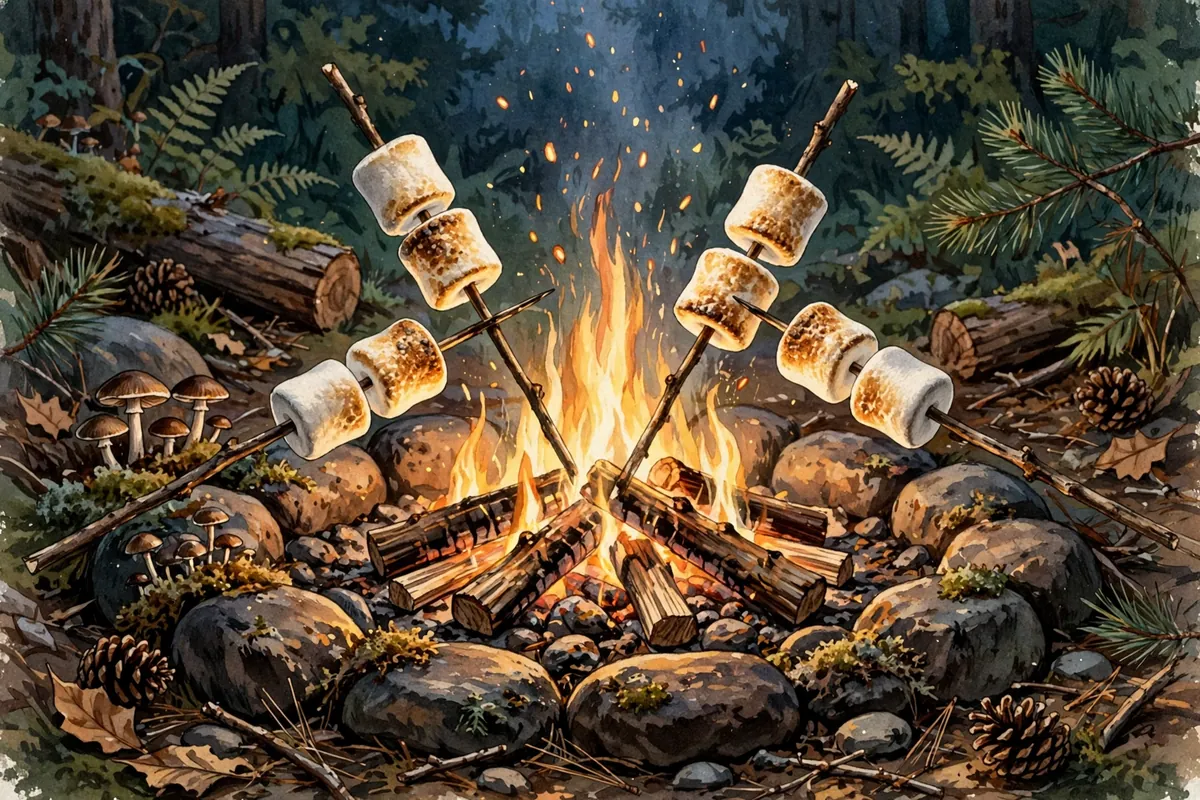
Few smells say summer like a marshmallow toasting over a campfire. Squish it between two graham crackers with a square of chocolate, wait a second for the chocolate to soften, and you've got a s'more. But where did that odd little name come from?
It's a shortened version of the phrase some more. In the mid-1920s, newspapers described Girl Scouts making "some-mores" at campfires, and by the end of the 1930s the name had been squeezed down to s'mores. Considering how hard it is to stop at one, the name is pretty accurate.
The S'more's Fancy Ancestor
Before the s'more, there was the Marshmallow Marguerite. This dainty treat was a saltine cracker spread with butter and marshmallow, then toasted and served with hot chocolate or tea. It became popular in the early 1900s, spread by cookbooks and magazines from the Boston Cooking School.
Cooks kept experimenting. A 1910 version used a graham cracker as the base, and a 1913 version added a layer of melted chocolate under the marshmallow. The pieces were falling into place.
Store-bought cousins appeared too. In 1913, the National Biscuit Company released Mallomars, and in 1917 the Moon Pie hit the market as another marshmallow-and-chocolate treat.
The marguerite didn't vanish right away, either. Through the 1930s it stayed popular at women's luncheons and teas, served open-faced and without chocolate, sometimes with a candied cherry placed in the center as it came out from under the broiler.
Girl Scouts at the Campfire
Roasting marshmallows over a fire was already a well-loved pastime. The New York Times wrote about "marshmallow parties" as early as 1902.
Then, in 1925, a Connecticut newspaper described Girl Scouts eating "some-mores." The recipe was a graham cracker, a piece of Hershey chocolate, a toasted marshmallow, another piece of chocolate, and a second graham cracker. That's very close to what we eat today.
The Scouts tried other versions too, swapping apple slices for the crackers or peanut butter for the chocolate. Food writer Stella Parks has pointed out that a campfire is the perfect place for a crumbly, sticky, dripping treat that can be eaten with abandon. Nobody worries about the mess outdoors.
A Cracker With a Surprising Backstory
The graham cracker has its own unusual history. It was inspired by Sylvester Graham, a nineteenth-century preacher in the temperance movement. He believed that a simple vegetarian diet based on coarsely ground wheat bread kept people healthy and was how people were meant to live.
His first graham wafer was a plain, dull biscuit made from unsifted flour that he baked himself. It's safe to say he never pictured it wrapped around melted chocolate and marshmallow.
From Campfire to Cocktail Menu
In the 1990s, s'mores became trendy among American adults. Restaurants served fancy versions with raspberry sauce, meant to be eaten with a knife and fork, and someone even invented a s'mores martini.
For many Americans, s'mores are tied to childhood summers, and some food writers admit the nostalgia matters more than the flavor. One Los Angeles Times writer described them as waxy chocolate, stale graham crackers, and bits of gooey carbon. People still can't resist them, though. Just keep an eye on your fingers, since campfire s'mores can lead to burned hands.
Today the United States marks National S'mores Day every August 10, and the treat is a favorite of Canadian campers too. Fancy or simple, a s'more still tastes best by a crackling fire, with someone nearby reaching for some more.