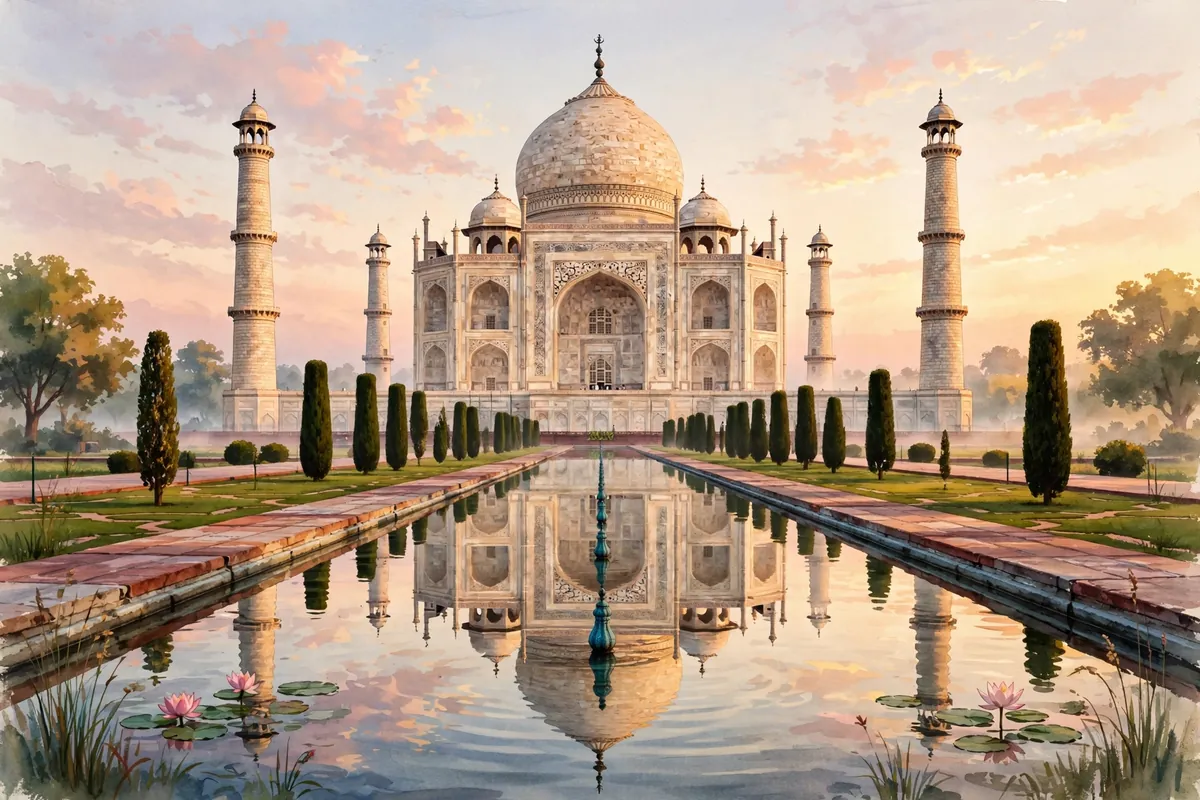
Few buildings on Earth are as instantly recognizable as the Taj Mahal. Its white marble dome glows over the river in Agra, India, and millions of people come to see it every year. But behind all that beauty is a very human story about losing someone you love.
The Taj Mahal is a tomb. Mughal emperor Shah Jahan ordered it built in 1631 to honor his wife, Mumtaz Mahal, who died that year while giving birth to their 14th child. The main mausoleum was finished in 1648, and the whole complex around 1653. Today, the emperor rests there beside her.
A Grief That Stopped an Empire
Historians of the time wrote that Shah Jahan did not show the same affection for anyone else that he had shown Mumtaz. After she died on June 17, 1631, he stayed away from royal business for a week. For two years, he gave up listening to music and wearing fine clothes.
He chose a beautiful stretch of land south of Agra for her tomb. It belonged to a nobleman, Raja Jai Singh I, who agreed to trade it for a large palace in the center of the city. Construction began in 1632.
20,000 Workers and a 9-Mile Ramp
Building the Taj took an enormous team. More than 20,000 artisans, laborers, and painters are believed to have worked on it, led by the court architect Ustad Ahmad Lahori. Sculptors came from Bukhara, calligraphers from Syria and Persia, and stone cutters from Baluchistan.
The engineering was just as impressive. Instead of wooden scaffolding, workers built a huge brick scaffold around the tomb. A ramp about 9 miles long carried marble and materials to the site, hauled in special wagons by teams of oxen and elephants. A system of pulleys lifted the heavy blocks into place.
The total cost was estimated at around 32 million rupees at the time, which would be roughly $827 million in 2015 money.
Love Written in Stone
Inside, the decoration is breathtaking. The walls are inlaid with precious and semiprecious stones, and Mumtaz's marble cenotaph is covered in inlaid flowers, fruit, and Quranic inscriptions. Her epitaph calls it the illumined grave of Mumtaz Mahal.
There's a touching detail about the layout. Mumtaz's tomb sits in the exact center of the chamber. Shah Jahan's was placed beside her after his death, off to one side, an unusual lopsided touch in a building known for its careful symmetry.
A Bittersweet Ending
Shah Jahan's final years were not happy. In 1658, his son Aurangzeb overthrew him and kept him under house arrest in the nearby Agra Fort. From there, the old emperor could see the Taj Mahal. When he died in 1666, he was buried next to his wife.
Even a wonder of the world needs repairs. In December 1652, Aurangzeb wrote to his father that the tomb, the mosque, and the assembly hall had developed serious leaks during the previous rainy season.
You may have heard he planned a matching Black Taj Mahal across the river. That's a myth that traces back to a European traveler's fanciful writings. Archaeologists later found a more likely source: a reconstructed pool across the river shows a dark reflection of the white tomb.
Nearly four centuries later, more than five million visitors a year still come to see what one man built for the woman he loved. Not a bad way to be remembered.