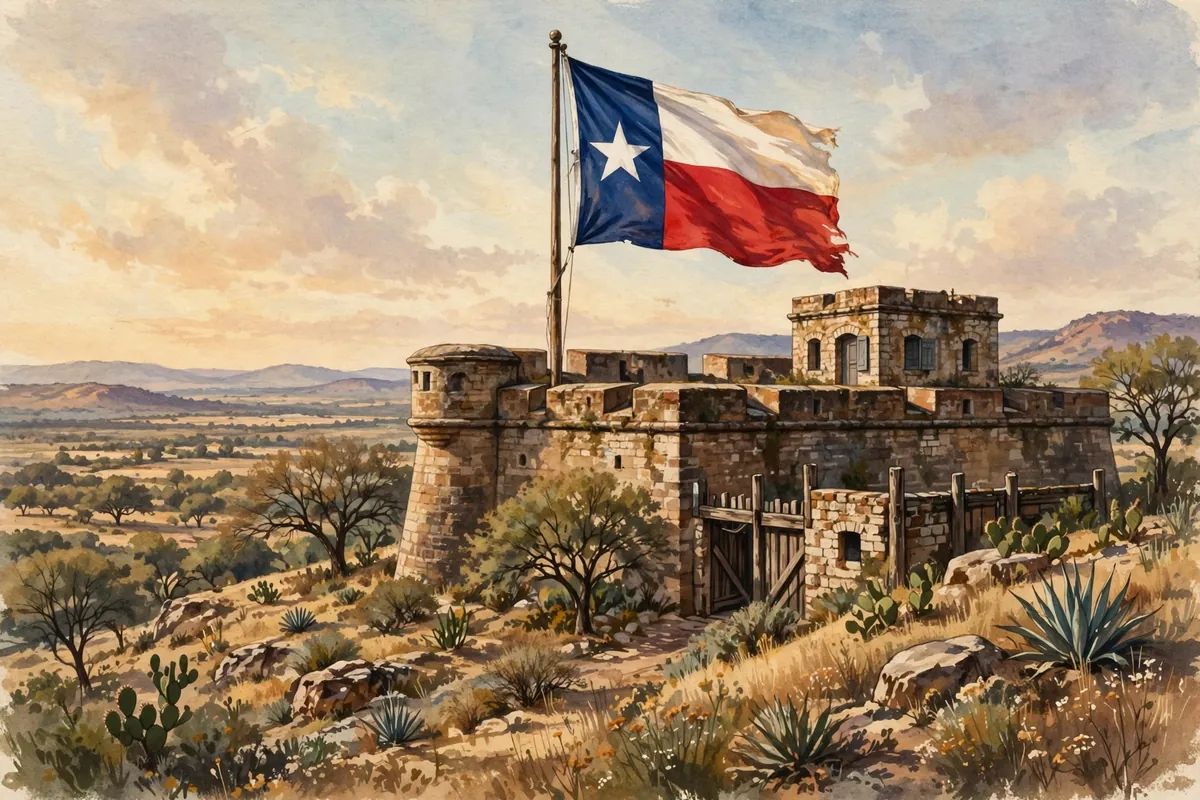
Texans are famously proud of their state, and some like to remind everyone that Texas used to be a country of its own. It sounds like a tall tale told over barbecue. But it's true, and the story is even more colorful than most people realize.
From March 2, 1836, to February 19, 1846, the Republic of Texas was a sovereign nation in North America. It had its own presidents, its own congress, and diplomats in Europe. Then, after nearly ten years of independence, it joined the United States as the 28th state.
Breaking Away From Mexico
In the 1820s and early 1830s, Texas was part of Mexico, and many American settlers had moved there. Tensions grew between those settlers and the Mexican government. Fighting broke out on October 2, 1835, around the time Mexican President Antonio López de Santa Anna's government adopted a new constitution that stripped the states of their power.
On March 2, 1836, delegates declared Texas independent. The war that followed was brutal. Santa Anna's troops defeated the Texian defenders at the Battle of the Alamo, killing almost all of them. Then, on April 21, 1836, Sam Houston's army launched a surprise attack at the Battle of San Jacinto and quickly routed the Mexican force. Santa Anna himself was captured.
In exchange for his life, Santa Anna ordered his army to retreat and signed the treaties that gave Texas its independence. Mexico's Congress, however, never accepted them, since he had signed as a prisoner. Mexico considered Texas a rebellious province for the republic's entire existence.
A Nation With Seven Capitals
The young country moved around a lot. In 1836 alone, five different towns served as temporary capitals, including Washington-on-the-Brazos and Galveston. President Sam Houston then moved the capital to the new city of Houston in 1837.
The next president, Mirabeau B. Lamar, picked a small pioneer settlement on the Colorado River in 1839. It was called Waterloo, but it was soon renamed Austin, in honor of Stephen F. Austin, the "Father of Texas." It became the republic's seventh and final capital.
Embassies in London and Paris
Texas acted like a real nation on the world stage. The United States officially recognized it in 1837, and France followed in 1839. The French built a legation in Austin in 1841, and it still stands as the oldest frame building in the city.
Texas also had diplomatic offices overseas. In Paris, its embassy was in what is now the Hôtel de Vendôme. In London, the old Texas embassy across from the gates of St. James's Palace is now a hat shop, marked with a large plaque.
Why Texas Joined the Union
Independence was expensive. The Republic of Texas ran up huge debts, which was one of the reasons for joining the United States. It also faced ongoing conflict with Mexico and with the Comanche nation.
On October 13, 1845, Texas voters overwhelmingly approved the American offer of statehood and a new state constitution, which also explicitly protected slavery. Texas became a state on December 29, 1845, skipping the usual step of first being a territory, and power formally passed to the new state government on February 19, 1846. Because Mexico had never accepted Texas independence, the move led to the Mexican-American War.
So the next time a Texan tells you their state was once a country, you can nod along. It's not bragging. It's history, complete with presidents, embassies, and seven capitals.