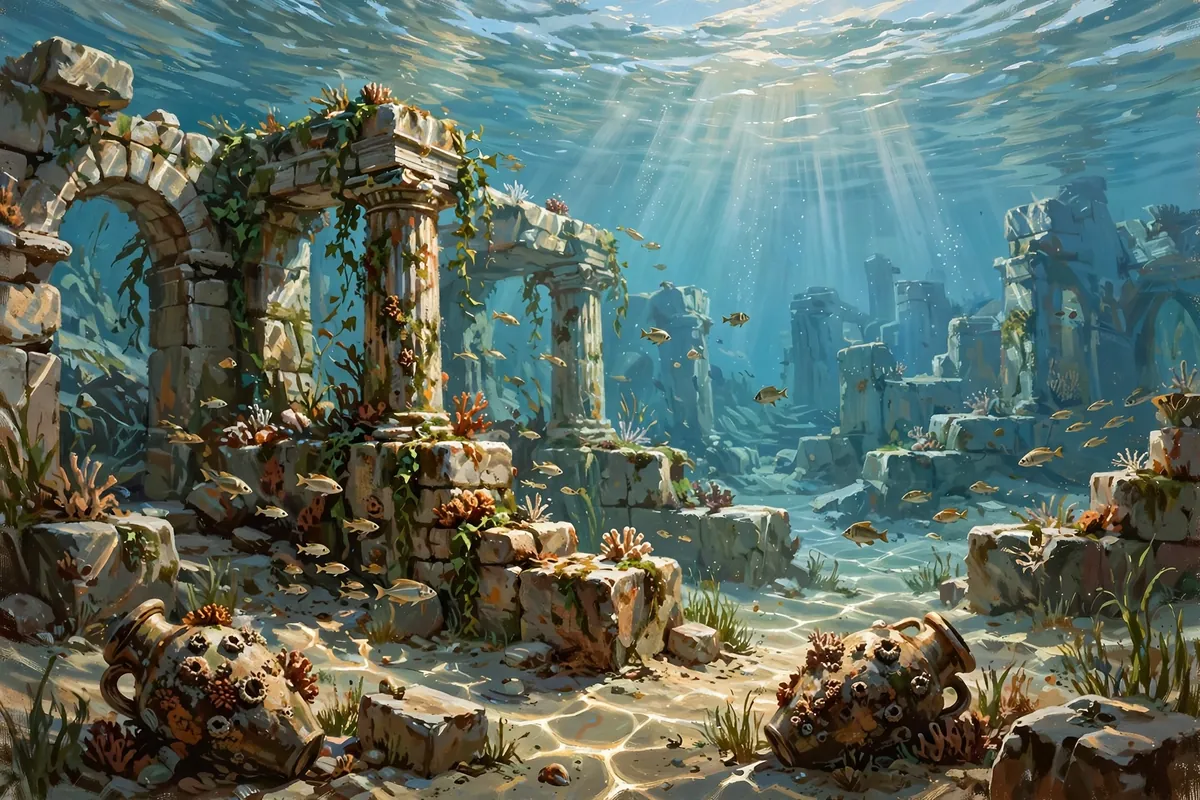
Most lost cities are buried under jungle, desert sand, or a modern town. Pavlopetri is different. It sits just a few feet under the clear, calm water of a bay in southern Greece, close enough to the surface that a snorkeler can look right down on it.
Here's what makes it special. Pavlopetri is about 5,000 years old, making it the oldest submerged city known in the world. And unlike most underwater ruins, it has an almost complete town plan, with streets, buildings, and tombs still laid out on the seafloor.
Found, Forgotten, and Found Again
The ruins lie in Vatika Bay, off the coast of Laconia on Greece's Peloponnese peninsula, near the island of Elafonisos. A geologist named Fokion Negris first noted underwater walls there in 1904, but little was reported about them.
The site was rediscovered in 1967 by Nicholas Flemming, and in 1968 a team of archaeologists from Cambridge mapped it. The name means "Paul's stone," a reference to St. Paul.
How a Town Ends Up Underwater
When Pavlopetri was built, it stood a few feet above sea level. Back then, the island of Elafonisos was likely connected to the mainland, with Pavlopetri sitting on that link. Over thousands of years, two forces worked against it: the sea slowly rose, and earthquakes pushed the land down.
Exactly when it finally slipped under is still discussed. One view is that the town went under around 1000 BC, after the first of three earthquakes to hit the area. Another study suggests a later earthquake, sometime between about AD 480 and 650, dropped the site roughly 10 feet, finishing the job.
Either way, being underwater turned out to be a gift for archaeologists. The town was never built over or plowed for farming, so its layout survived much as it was thousands of years ago.
What Life Was Like There
At first, experts dated the ruins to the Mycenaean era, about 1600 to 1100 BC. Later work showed people lived there much earlier, starting around 3500 BC.
Archaeologists have identified at least 15 buildings, some with up to 12 rooms. They found two kinds of graves, which hints at differences in social status. Many loom weights point to a thriving cloth-making industry, and large storage jars from Crete show it was a busy trading port with links to the Minoans.
In 2009, Pavlopetri became the first submerged town to be digitally surveyed in three dimensions. Teams from the University of Nottingham worked with robotics experts from Australia, using sonar and custom underwater robots to map the ruins.
A Fragile Treasure
Being so close to the surface also makes Pavlopetri vulnerable. Dragging boat anchors, shifting sediment, ship pollution, and souvenir hunters have all threatened the site. Supporters have pushed for protections like a ring of buoys to keep ships away, and guided underwater tours led by archaeologists now help visitors understand what they're seeing.
The town also enjoys international protection. Under a UNESCO convention, traces of human life that have been underwater for 100 years or more are considered underwater cultural heritage, and Pavlopetri more than qualifies. Since 2016, an annual Watch Day each summer has drawn attention to the dangers it faces.
So if you ever find yourself swimming off the southern tip of Greece, take a moment to look down. Those quiet lines of stone were once doorways and streets, where people wove cloth and traded goods 5,000 years ago.