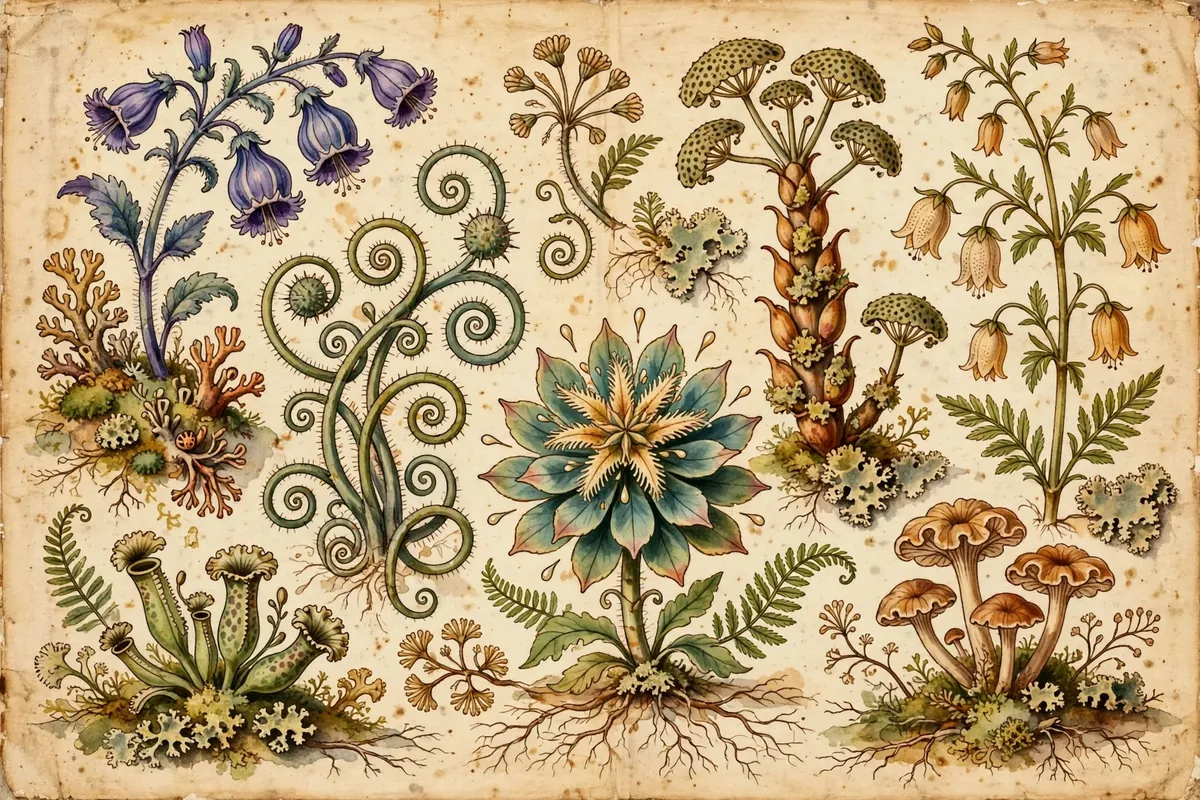
Somewhere in a library at Yale University sits a small, battered book about the size of a paperback. It's packed with drawings of odd plants, circular star charts, and tiny figures bathing in pools. Every page is covered in neat, flowing handwriting. The problem is that nobody on Earth can read a single word of it.
This is the Voynich manuscript. Its parchment has been carbon-dated to the early 1400s, and it may have been made in Italy. It's written in an unknown script nicknamed Voynichese, and despite centuries of effort by scholars, amateurs, and professional codebreakers, it has never been convincingly deciphered. Who wrote it, and why, is still a mystery.
A Book Full of Puzzles
The manuscript has about 240 pages, though evidence suggests some are missing. Because no one can read the text, researchers sort it into sections based on the pictures. The largest part, 126 pages, looks like an herbal, the kind of plant guide common in Europe at the time. Yet none of the plants can be identified for certain, though a few look like a wild pansy and a maidenhair fern.
Other sections show circular diagrams with suns, moons, and zodiac signs. One strange section shows small women bathing in pools linked by a network of pipes. There's even a foldout that spans six pages and looks like a map of nine islands connected by causeways.
Emperors, Alchemists, and a Book Dealer
The first confirmed owner was Georg Baresch, a 17th-century alchemist in Prague. He called it a Sphinx that was taking up space uselessly in his library, and he sent samples to a famous Jesuit scholar in Rome, hoping for help.
A later letter claimed the book had once been bought by Rudolf II, the Holy Roman Emperor, for 600 gold ducats. That's never been proven, but a faint name on the first page belongs to the man who ran Rudolf's botanical gardens.
The book gets its name from Wilfrid Voynich, a Polish book dealer who bought it in 1912. It has been at Yale's Beinecke Rare Book and Manuscript Library since 1969, and in 2020 Yale put the entire manuscript online for anyone to see.
Language, Code, or Hoax?
The text has some features of a real language. The most common word appears about twice as often as the second most common, a pattern seen in natural languages. Different sections favor different words, just as chapters on different subjects would. But it also has strange quirks, like the same word repeated up to five times in a row.
Some experts think it's a lost language or a clever cipher. Others suspect a medieval hoax. In 2003, a computer scientist showed that text much like Voynichese could be produced with a table of word parts and a paper overlay with holes cut in it. Some people even suspected Voynich of faking it, though the old parchment makes that harder to argue.
The Codebreakers Who Tried
Some of the greatest codebreakers of the 20th century tackled the manuscript, including American and British experts from both World Wars. William and Elizebeth Friedman, a famous American codebreaking couple, were among those who came up empty.
Over the years, many people have announced that they've finally solved it, claiming the text is everything from an early Romance language to Medieval Hebrew. None of these claims has been independently verified, and some have been strongly disputed by experts.
Maybe one day someone will crack it. Or maybe its author, whoever they were, is still enjoying the last laugh. Either way, the Voynich manuscript remains one of the world's great unsolved puzzles, and you can look through it yourself online.