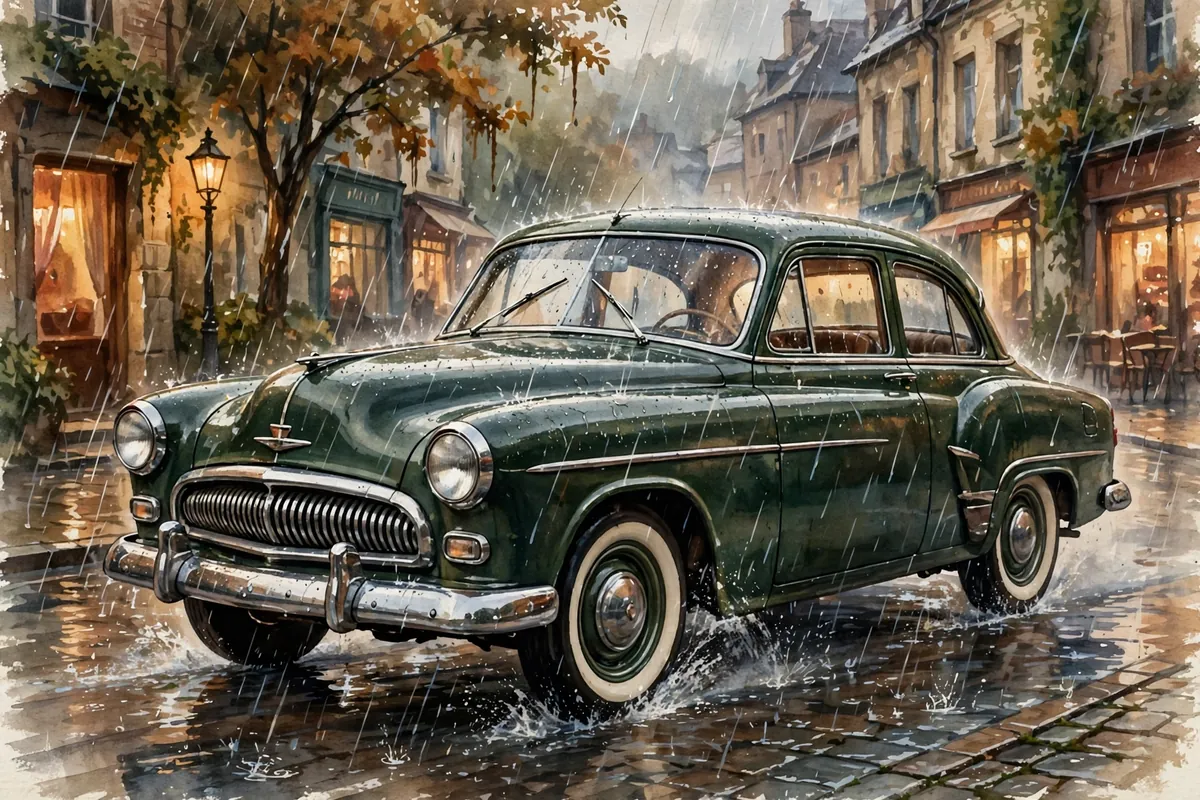
Flip a lever, and the rain disappears from your windshield. It's so ordinary that we barely think about it. But for the earliest drivers, a storm meant squinting through streaks or stopping again and again to wipe the glass by hand. So who finally solved the problem?
The short answer is Mary Anderson, a real-estate developer from Alabama. In 1903, she received a U.S. patent for a hand-operated device with a rubber blade that cleared snow, ice, and sleet from a vehicle's windshield. She's credited with inventing the first working windshield wiper. Her idea was rejected at first, but within about two decades, wipers had become standard on many cars.
An Idea on a Snowy Streetcar
Mary Anderson was born in 1866 on a plantation in Greene County, Alabama. As an adult, she helped build and run an apartment building in Birmingham and spent some years operating a cattle ranch and vineyard in Fresno, California.
According to the story usually told, her big idea came while riding a streetcar in New York City on a snowy day. She watched the driver repeatedly open the window or stop the car to clear the glass so he could see. There had to be a better way, and she set out to design one.
Patent No. 743,801
Her solution was a lever inside the vehicle connected to an arm with a rubber blade on the outside of the windshield. The driver could swing the blade across the glass without ever stepping into the weather. She described it as a "window cleaning device for electric cars and other vehicles."
The U.S. Patent Office granted her Patent No. 743,801 on November 10, 1903. It was a clever, simple fix for a problem most people had simply accepted as part of driving. Back then, drivers usually just stopped every so often and scraped the moisture off by hand.
"No Commercial Value"
Anderson tried to sell or license her patent, including to a Canadian manufacturing company. Buyers turned her down, saying the device had no commercial value. At the time, automobiles were still fairly rare, and few people saw the need.
Her 17-year patent expired in 1920 without the device ever being mass-produced. The timing was painful. By the early 1920s, mechanical wipers had become standard on many passenger cars. By 1922, Cadillac was installing them as standard equipment, using designs that followed the basic principles of Anderson's device.
Other Inventors Who Kept It Going
Anderson wasn't the only woman in the story. In 1917, Charlotte Bridgwood patented the first automatic electric wiper arms. Decades later, in 1963, engineering professor Robert Kearns invented a type of intermittent wiper, inspired by the way the human eye blinks only every few seconds. Ford turned down his design at first but later offered a similar one, and Kearns won a long patent fight against the company. His story became the 2008 movie Flash of Genius.
Mary Anderson died in 1953, before most people knew her name. Recognition finally came in 2011, when she was inducted into the National Inventors Hall of Fame for her contribution to transportation safety.
So the next time you're driving through a downpour and your wipers sweep the glass clear, give a quiet nod to Mary Anderson. She saw a problem everyone else ignored, and she was right.