You never have to remember to do it. Whether you're asleep, watching TV, or climbing stairs, your heart keeps thumping along, around 70 times a minute when you're at rest. It's easy to assume the brain is sending out a command for every single beat.
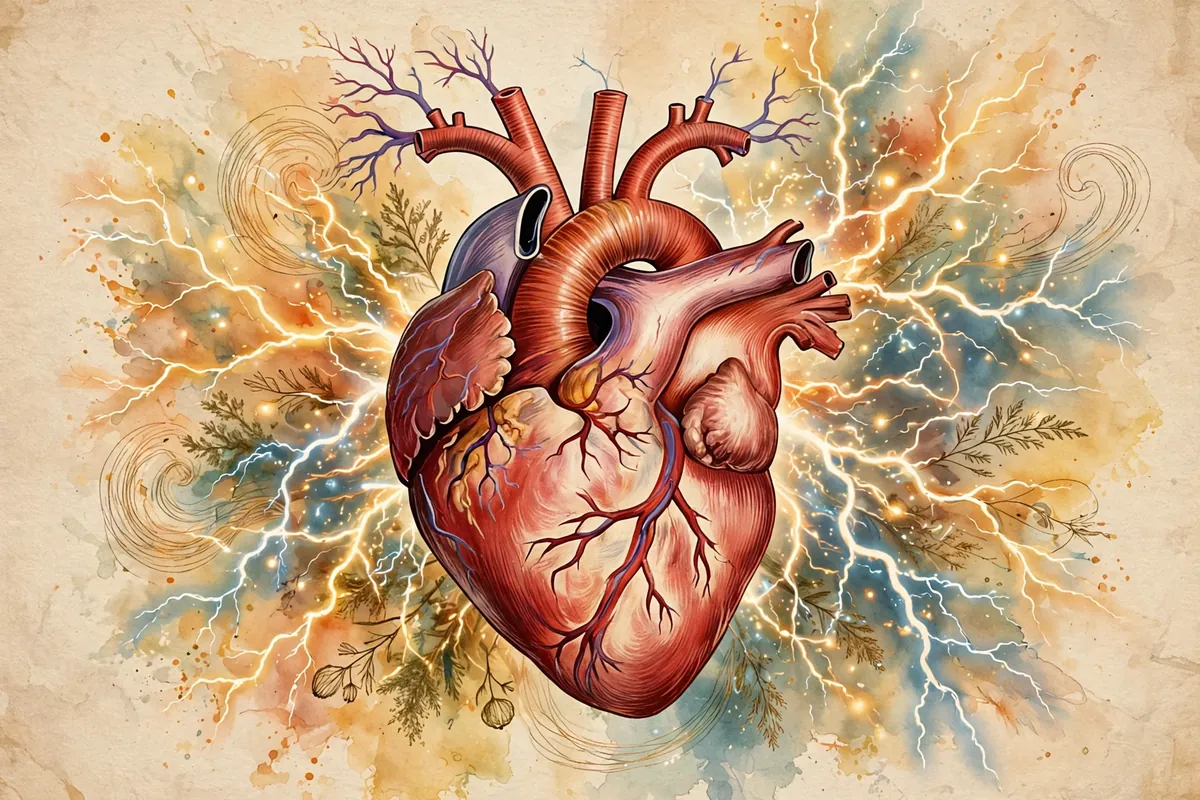
It isn't. Your heart starts its own beat. A small patch of special muscle called the sinoatrial node, or SA node, sits in the upper wall of the heart's right chamber and fires off a tiny electrical signal again and again. Each signal spreads through the heart and makes it squeeze. Doctors call it the heart's natural pacemaker.
A Spark Plug Smaller Than a Fingernail
The SA node is small, roughly 15 millimeters long, 3 millimeters wide, and 1 millimeter thick. It's made of pacemaker cells, and they behave differently from ordinary heart muscle.
Most heart cells sit quietly at rest until a signal reaches them. Pacemaker cells never really rest. Right after each beat, their electrical charge starts creeping up again all by itself. When it reaches a certain threshold, the cell fires, and the next heartbeat begins. Then the cycle repeats.
So What Does the Brain Do?
Left completely alone, the SA node would fire about 100 times a minute. Nerves from your brain adjust that pace. One set of nerves speeds it up when you're excited or exercising. Another set, including the vagus nerves, slows it down when you're calm.
That steady braking is why the average adult's resting heart rate is about 70 beats per minute instead of 100. Think of the brain less as the driver and more as someone working the gas and brake pedals on a car that's already running.
A Built-In Pause and Backup Generators
Once the signal leaves the SA node, it travels across the upper chambers and reaches a relay station called the atrioventricular node, or AV node. Here it pauses for about nine hundredths of a second.
That tiny delay matters. It gives the upper chambers time to push their blood into the lower chambers before those bigger chambers contract. Without it, the heart's timing would be thrown off.
The heart also has backups. If the SA node stops working, the AV node can take over at a slower 40 to 60 beats a minute. If that fails too, fibers deeper in the heart can produce their own beat at around 30 to 40 a minute. Normally the SA node fires fastest, so it sets the rhythm for everyone else. When the natural system can't keep up, doctors can implant an artificial pacemaker to help.
Discovered in a Mole's Heart
The SA node has a charming origin story. It was first spotted by a young medical student named Martin Flack while he was studying the heart of a mole. His mentor, Sir Arthur Keith, was out on a bicycle ride with his wife at the time.
The two worked in a makeshift lab in a farmhouse in Kent, England, and published their discovery in 1907. That's why the SA node is sometimes called the Keith-Flack node.
So the next time you feel your pulse, give a little credit to that tiny patch of tissue. It has been quietly keeping time since before you were born, and it doesn't need a single reminder from you.