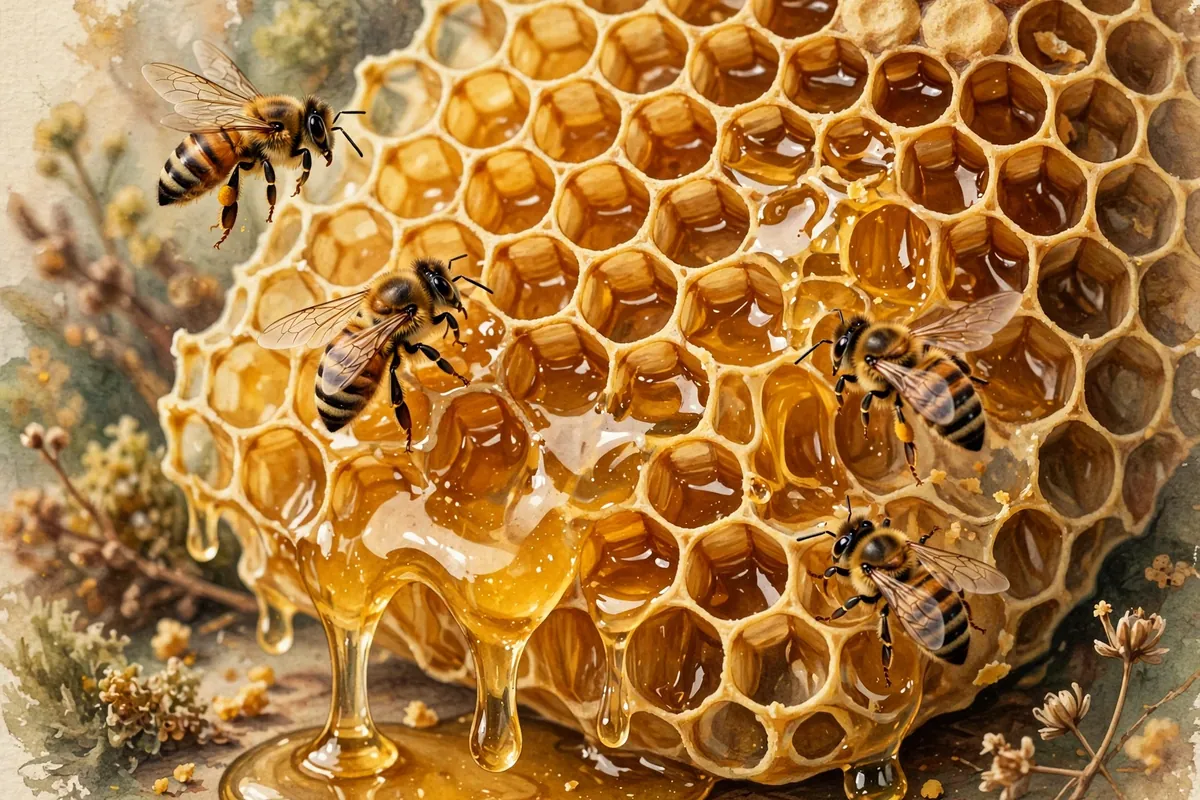
Look closely at a honeycomb and you'll see something that seems almost too neat for nature: row after row of six-sided cells, fitted together with barely a gap. Bees don't have rulers or blueprints. So why hexagons, and not circles, squares, or triangles?
The short answer is efficiency, though scientists have offered two explanations. Hexagons divide a space into equal cells using the least total wall length, so bees get the most storage for the least wax. A second idea is that the hexagons form more or less on their own as bees build cells side by side, a bit like soap bubbles pressing together.
Wax Is Expensive
To see why efficiency matters, consider what wax costs a bee. Honey bees consume about 8.4 pounds of honey to produce just 1 pound of wax. Every bit of wall they don't have to build is honey they get to keep.
The honeycomb does a lot of work, too. Its cells hold the colony's young, from eggs to larvae to pupae, along with stores of honey and pollen. A shape that packs the most space into the least material is a real advantage.
A Math Puzzle 2,000 Years in the Making
People have wondered about this for a very long time. The first record of the idea dates back to 36 BC, from the Roman writer Marcus Terentius Varro. It's often credited to Pappus of Alexandria, a mathematician who lived a few centuries later.
The idea became known as the honeycomb conjecture. It says that a grid of regular hexagons has the smallest total perimeter of any way to divide a flat surface into equal-sized areas. In the 1600s, Jan Brożek used a similar argument to explain why bees build hexagons.
Proving it took ages. László Fejes Tóth proved a special case in 1943, and mathematician Thomas C. Hales finally proved the full theorem in 1999. The bees, of course, had been doing it the efficient way all along.
Or Maybe It Just Happens
Not everyone thinks bees are aiming for a perfect shape. The biologist D'Arcy Wentworth Thompson suggested the hexagons simply result from many bees putting cells together, much like the boundary shapes that form when soap bubbles crowd into a cluster.
He had a clever piece of evidence. Queen cells, which bees build one at a time instead of in a packed group, are irregular and lumpy, with no apparent attempt at efficiency. If bees followed a built-in hexagon plan, you might expect those cells to look tidy, too.
Real honeycomb isn't flawless, either. Individual cells can be off from a perfect hexagon by a few percent, and shapes get distorted where bigger drone cells meet smaller worker cells or where bees run into an obstacle.
Built With Body Heat
Bees shape their comb with their antennae, jaws, and legs, warming the wax as they work. While they build hexagonal cells, the wax stays at about 92 to 100 degrees Fahrenheit, well below the roughly 104 degrees at which it's thought to turn liquid. The bees' own body heat helps keep it just right.
There's one more smart detail. The cells aren't perfectly level. They tilt upward about 13 degrees from horizontal, which helps keep the honey from dripping out.
So the next time you drizzle honey on your toast, spare a thought for the tiny builders behind it. Whether they're natural mathematicians or just very good at working shoulder to shoulder, they solved a puzzle that took people two thousand years to prove.