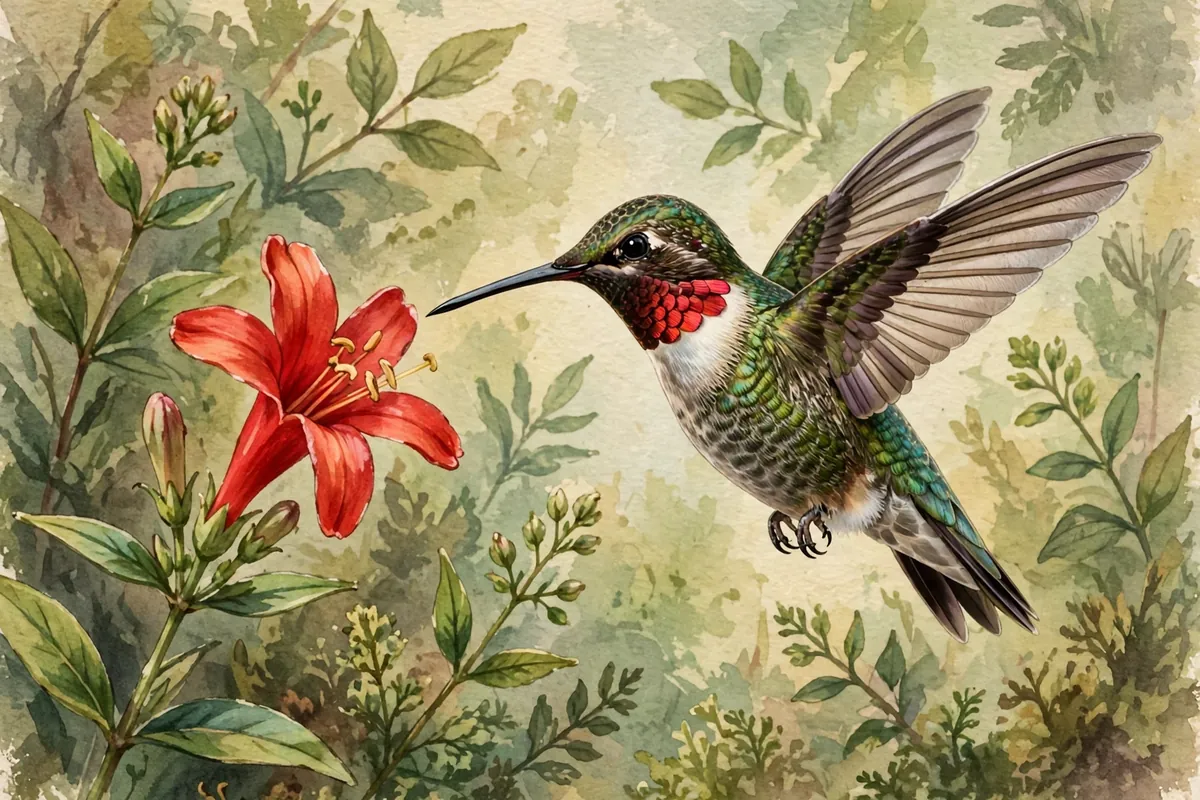
Watch a hummingbird at a feeder and you'll notice something odd. It doesn't land, sip, and fly off like other birds. It hangs in the air like a tiny helicopter, drinks, and then simply backs away before darting off.
That's right: the bird that can fly backward is the hummingbird. Their long, blade-like wings are built for helicopter-like flight in any direction, including hovering in one spot. Forward, sideways, up, down, or in reverse, a hummingbird can handle it.
Wings That Work Like Rotors
Most birds get nearly all their lift by pushing their wings down. Hummingbirds are different. Scientists who filmed rufous and Anna's hummingbirds in wind tunnels found that the birds got about 75% of their support on the downstroke and about 25% on the upstroke.
Their wings trace a figure-eight pattern through the air. Because the wing does useful work in both directions, the bird has unusually fine control over its flight. That control lets it hold perfectly still at a blossom, then reverse neatly away without bumping its long bill.
The speed is hard to picture. Wingbeats range from about 12 per second in the largest species to 99 per second in the smallest. The highest hovering rate on record, 99.1 beats per second, was measured in male woodstars, and during courtship displays some males go even faster.
Where the Hum Comes From
Those rapid wingbeats are what give the birds their name. The downstrokes and upstrokes create a humming sound that scientists have compared to a musical instrument. It's different from the whine of a mosquito or the buzz of a bee.
The hum isn't just noise, either. It works as a kind of signal, letting other hummingbirds know that a fellow forager or a possible mate has arrived.
Running on Sugar
Hovering takes an enormous amount of energy. Hummingbirds have the highest mass-specific metabolic rate of any warm-blooded animal. To keep going, they expend what would be the human equivalent of 150,000 calories a day, about 10 times what a marathon runner burns during a race.
Their fuel is mostly flower nectar. Hummingbirds are unusual among animals with backbones because they can use freshly swallowed sugar almost right away, powering up to all of their energy needs with it. They also eat small insects for protein.
At night, or when food runs short, they save energy by slipping into torpor, a state similar to hibernation. Their metabolism can drop to about one-fifteenth of its normal rate until morning.
The Backyard Champion
The ruby-throated hummingbird is the most common hummingbird in eastern North America, with an estimated 35 million birds in 2021. It spends winter in places like Florida, Mexico, and Central America, then heads north to breed in the eastern United States and southern Canada.
Some of them make a remarkable trip. An adult weighs only about 3 grams, roughly a tenth of an ounce, yet part of the population flies about 500 miles nonstop across the Gulf of Mexico. To manage it, the birds can double their fat before leaving and then burn through that reserve during a crossing of about 20 hours.
They don't last forever, but some live surprisingly long lives. The oldest banded ruby-throated hummingbird on record was 9 years and 1 month old, and most birds that reach 7 or older are females.
Small Bird, Big Talents
Hummingbirds are the smallest mature birds in the world. The tiniest, the bee hummingbird, is about 2 inches long and weighs less than 2 grams. Even so, these birds pack in some extraordinary features, including a heart rate that has been measured as high as 1,260 beats per minute.
So the next time one hovers at your feeder and then slips away in reverse, you'll know you're watching one of nature's best pilots. Not bad for a bird that weighs about as much as a penny.