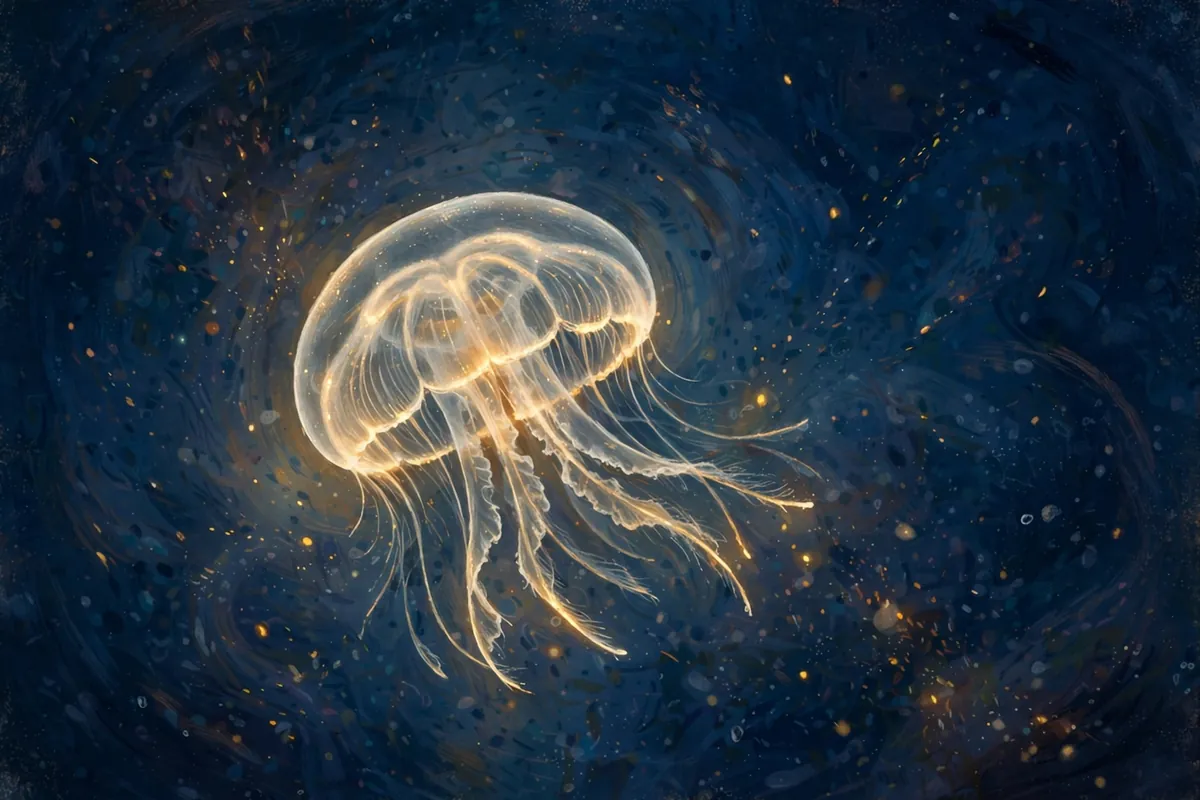
Every living thing has a life story that runs in one direction. A puppy becomes a dog, a seedling becomes a tree, and a baby becomes a grandparent. But somewhere in the ocean there's a little jellyfish that doesn't seem to have read the rules.
Its name is Turritopsis dohrnii, better known as the immortal jellyfish. When it gets sick, old, hurt, or stressed, it can turn itself back into an earlier, baby-like stage of life and start over. In theory, it can do this again and again, which is why scientists call it biologically immortal. The catch is that it can still be eaten or killed by disease.
A Jellyfish Smaller Than Your Fingernail
Don't picture a giant glowing blob. The adult jellyfish, called a medusa, has a bell only about 4.5 millimeters across at most, roughly the size of a pencil eraser. It's see-through, with a bright red stomach in the middle and up to 80 or 90 thin tentacles around the edge.
It was first found in the Mediterranean Sea and was named in 1883 after Anton Dohrn, who founded a famous marine research station in Naples, Italy. Today it turns up in temperate and tropical waters all over the world, in places like marinas, docks, and even on the hulls of ships.
How the Rewind Button Works
To understand the trick, it helps to know how this jellyfish normally grows up. It starts as a tiny swimming larva. The larva settles on the sea floor and grows into a colony of polyps, small stalk-like forms attached to the bottom. Those polyps then bud off free-swimming jellyfish, which grow up and become able to reproduce.
For most jellyfish, that's the end of the line. But when Turritopsis dohrnii runs into trouble, its bell and tentacles break down and the animal settles back to the bottom. There it transforms into a new polyp colony, as if a butterfly could turn itself back into a caterpillar.
The process behind this is called transdifferentiation. In plain terms, the jellyfish's cells change what kind of cells they are, turning into new types that the younger form needs.
What Sets It Off
Lab experiments have shown that jellyfish at every stage, from newly released to fully mature, can make this switch. Triggers include starvation, a sudden change in water temperature, lower salt levels, and damage to the bell. In one experiment, some even made the transformation without any change or injury at all.
Keeping these jellyfish alive in a tank turns out to be hard work. One scientist, Shin Kubota of Kyoto University, has kept a group going for a long stretch, checking daily that they've properly digested their food. He reported that over a two-year period, his colony rebirthed itself 11 times. He also likes to sing songs he wrote about them at the end of his talks.
So Does It Ever Die?
Yes, and quite often. Being able to reset doesn't protect it from hungry fish or illness. In the wild, scientists think most of these jellyfish are eaten or die of disease while they're still in the free-swimming stage, before they ever get the chance to rewind.
That's why researchers are careful with the word immortal. It means the jellyfish doesn't seem to have a built-in maximum lifespan, not that it can't be harmed. Even so, that makes it a popular subject for scientists who study aging. A 2022 study comparing its genome with a similar jellyfish that can't rejuvenate pointed to processes like DNA repair and stem cell renewal as part of its secret.
It isn't the only animal that seems to dodge old age. Tiny freshwater creatures called hydras, distant cousins of jellyfish, showed no rise in death rates with age in a four-year study.
So the next time someone says nothing lives forever, you can mention a jellyfish the size of an eraser that, at least on paper, could. It just has to stay out of the way of everything that wants to eat it.