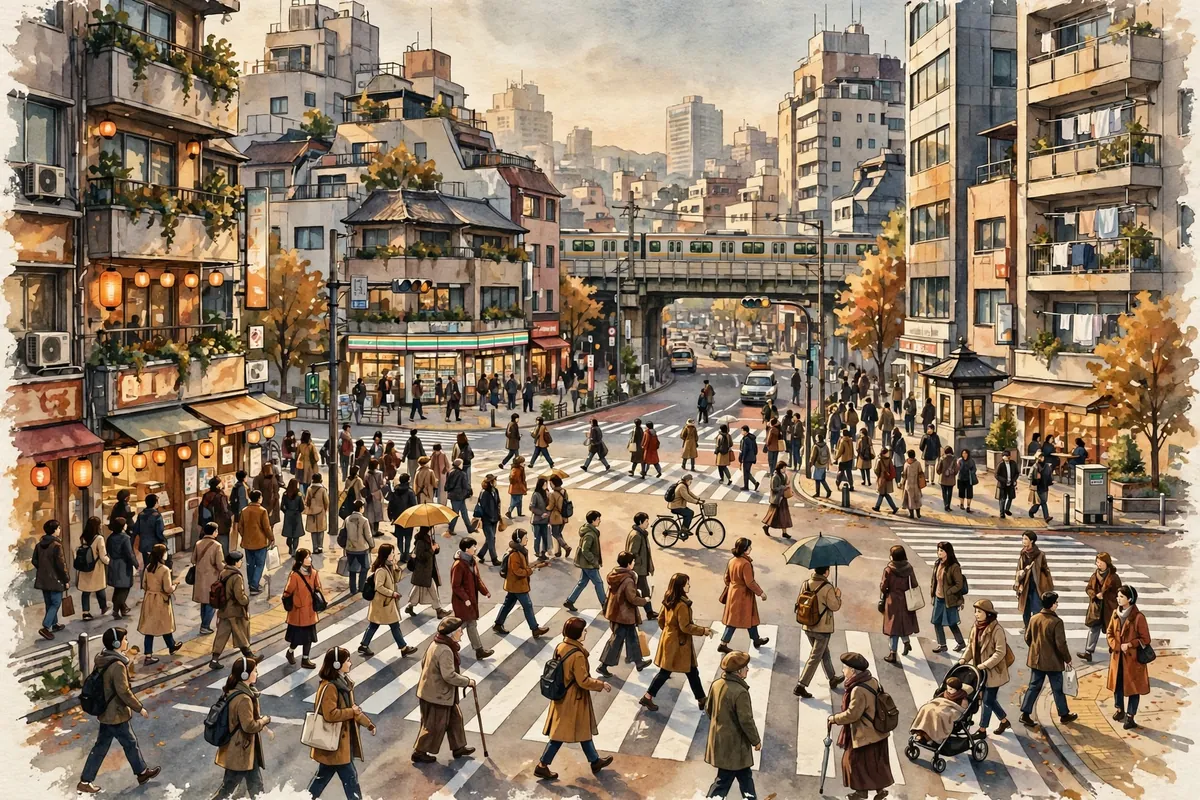
The lights change, and for a moment the whole intersection holds its breath. Then the cars all stop, and from every corner a wave of people steps off the curb at once, crossing straight, sideways, and corner to corner. Seconds later the street is a sea of umbrellas, shopping bags, and phones held high.
Here's the short answer: that's Shibuya Crossing in Tokyo, often described as the busiest pedestrian crossing in the world. Somewhere between 1,000 and 2,000 people cross during a single green light, and one 2016 count put it as high as 3,000. It's a scramble crossing, meaning all vehicle traffic stops so pedestrians can cross in every direction, including diagonally, at the same time.
By the Numbers
The crossing sits beside Shibuya Station in one of Tokyo's major shopping and entertainment districts, and foot traffic barely drops off even at midnight or in the early morning. A 2014 survey estimated about 260,000 people cross on a typical weekday and around 390,000 on days off. Some estimates go as high as 500,000 on the busiest days.
Remarkably, road traffic jams rarely build up there, even at rush hour. The lights cycle about every two minutes, letting cars and crowds take turns.
An American Idea
Shibuya Crossing opened in 1973, but the scramble idea started decades earlier in North America. In the United States, it's sometimes called the Barnes Dance, after traffic engineer Henry Barnes. He didn't claim to have invented it, but he became its biggest champion after seeing how hard it was for his daughter to cross streets on her way to school.
Barnes introduced it in Denver in the late 1940s, while similar crossings were being tested in Kansas City and Vancouver. When he became New York City's traffic commissioner in 1962, he installed one at Vanderbilt Avenue and 42nd Street just ten days after taking office. The playful nickname plays on the old-fashioned barn dance.
Scrambles later fell out of favor with many traffic engineers because they could slow things down for drivers and walkers alike. But their benefits for pedestrian flow and safety have led many cities to bring them back.
A Movie Star Intersection
Shibuya Crossing has become a symbol of Tokyo itself. It shows up in films such as Lost in Translation and The Fast and the Furious: Tokyo Drift, along with countless news broadcasts and video games. It even appeared in the closing ceremony of the 2016 Summer Olympics to promote the Tokyo Games.
Its popularity has brought challenges, too. Large Halloween and New Year's crowds led local officials to restrict public drinking in the area, and in 2024 the ban was extended to every night of the year.
A Famous Dog Next Door
Right beside the crossing stands a statue of Hachikō, an Akita dog famous for his loyalty. In 1924, a Tokyo Imperial University professor named Hidesaburō Ueno brought him to live in Shibuya, and Hachikō met him at Shibuya Station every day after his commute home. Ueno died suddenly in 1925, yet Hachikō returned to the station almost every day for nearly ten years to wait for him.
So if you ever find yourself in Tokyo, take a moment at Hachikō's statue, then wait for the light. When it turns, step off the curb and join the most famous crowd in the city.