When someone looks exactly like somebody else, we call them a dead ringer. It's a funny phrase when you think about it. Who's dead, and what's being rung? There's a famous spooky story that claims to explain it, and it's been shared countless times.
The story says the phrase comes from coffins fitted with bells, so that anyone buried alive could ring for help. It's a good yarn, but experts call it a folk etymology, meaning a made-up explanation. Dead ringer actually comes from 19th-century slang for swindlers and racehorse cheats, with dead meaning exact.
Con Artists and Swapped Horses
In criminal slang, swapping a cheap item for a valuable one was called ringing the changes, and those who did it were known as ringers. In horse racing, a ringer was someone who secretly substituted one horse for another, and the word also meant the substitute horse itself.
For the trick to work, the stand-in had to look just like the real horse. Over time, ringer came to mean anything that closely resembled something else. Add the word dead, used here in the sense of exact, as in dead center or dead on, and you get a dead ringer: an exact look-alike.
By the early 20th century, Americans used dead ringer for to mean the exact image of. The phrase has been with us ever since.
So Where Do the Bells Come In?
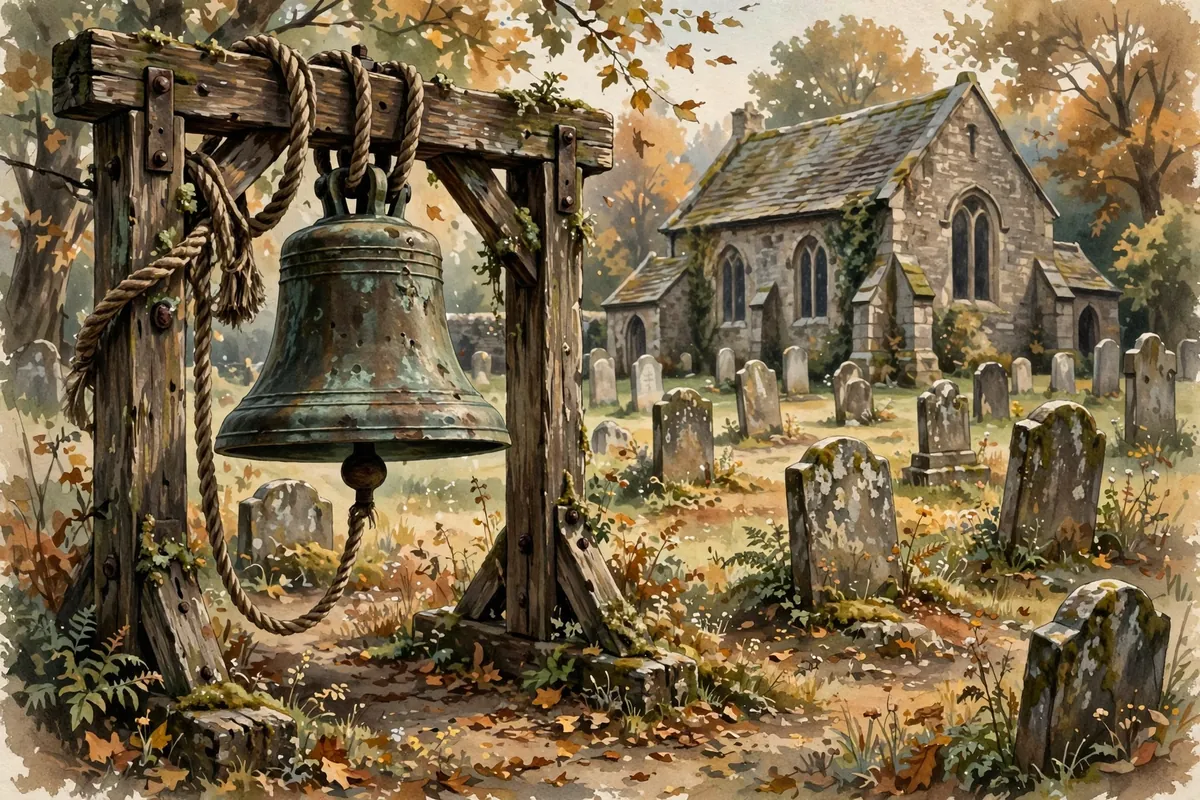
Ironically, bells do play a part, just not the spooky way. The phrase ringing the changes comes from the art of church bell ringing. Starting in the early 1600s, English bell ringers learned to swing their bells in nearly full circles, which let them control exactly when each bell sounded.
That allowed a team of ringers to switch the order of their bells, playing a series of different patterns called changes. For example, bells ringing in the order 123456 might switch to 214365. Changing the order of bells became a handy way to describe swapping one thing for another.
The Coffin Bells Were Real, Though
Here's what makes the myth so believable: safety coffins really existed. Fear of being buried alive peaked during the cholera epidemics of the 1800s, when people were sometimes buried quickly. Many safety coffin designs were patented in the 18th and 19th centuries.
The first recorded one was ordered by Duke Ferdinand of Brunswick before he died in 1792. It had a window, an air tube, and a lock instead of nails, with keys tucked into a pocket of his burial clothes. Later designs often included a cord tied to a bell that a person could ring if they woke up.
Still, no evidence links these coffins to the phrase dead ringer. The same goes for saved by the bell, which is also sometimes tied to the coffin story, and which experts likewise treat as a folk etymology.
Why Myths Like This Stick
A spooky story is simply more fun to tell than one about racetrack swindlers. That's why tales like this spread so easily, especially when they contain a grain of truth. This one even has two real ingredients, church bells and safety coffins, which makes it extra convincing.
So the next time someone says you're a dead ringer for a movie star, take the compliment. You're not a ghost story. You're just an exact match, like a perfectly swapped racehorse.