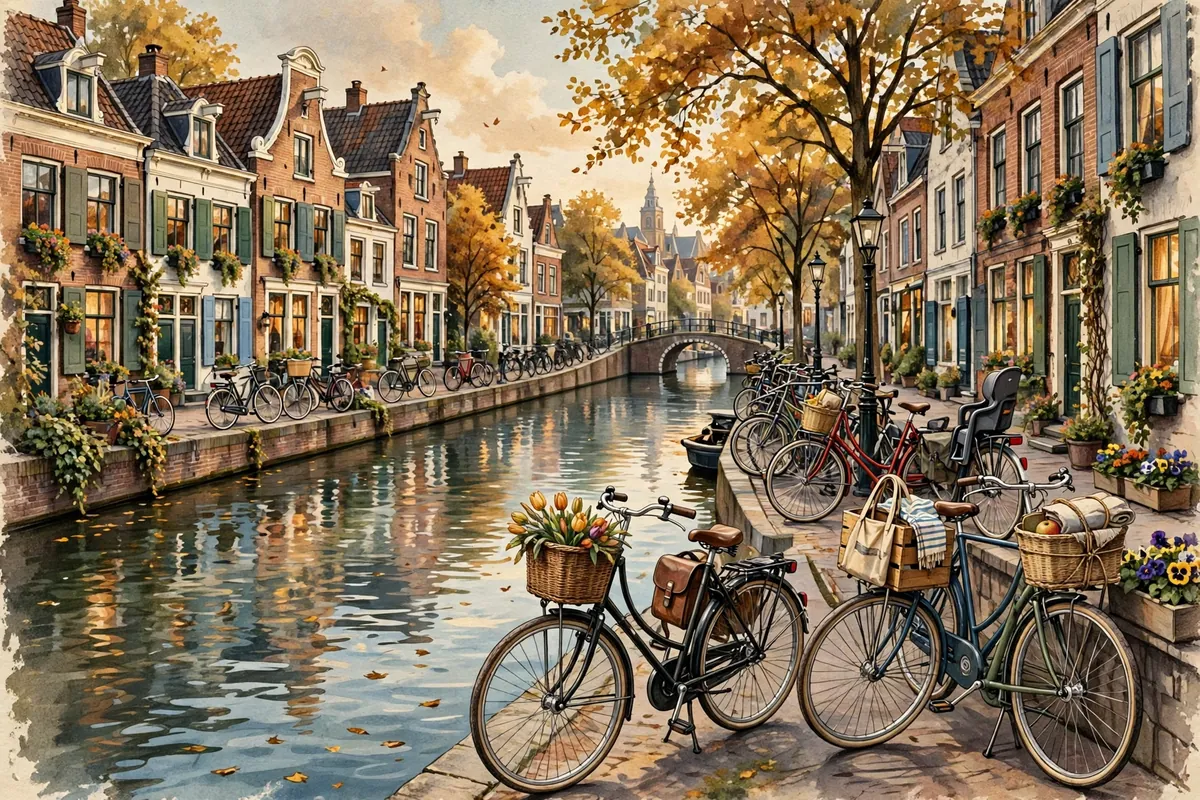
Ask anyone about Amsterdam and bicycles will come up fast. Picture canal bridges lined with bikes, cyclists of every age pedaling past, and racks overflowing at every corner. It's often said the city has more bikes than people. Is that true?
It's very close, but the official figures show a near tie rather than a clear win. According to the Dutch national statistics office, Amsterdam's roughly 850,000 residents owned about 847,000 bicycles in 2015. Across the whole Netherlands, though, there are about 18 million bicycles, or 1.3 for every person old enough to ride, so bikes do outnumber riders nationally.
A Country Built for Bikes
The Dutch love affair with cycling goes back a long way. The Netherlands caught the bike craze a little after the United States and Britain, but by the 1890s it was already building dedicated cycle paths. By 1911, the Dutch owned more bicycles per person than any other country in Europe.
In 1940, the country had around four million bicycles for eight million people. Half of them disappeared during the German occupation in World War II, but cycling bounced back quickly after the war.
Today, about 27 percent of all trips in the Netherlands are made by bicycle. In Amsterdam it's 38 percent, and in the city of Zwolle it's 46 percent.
Why It Works So Well
Part of the secret is design. Dutch roads are planned to keep bikes and cars apart wherever possible, with separate bike paths, protected intersections, and plenty of parking. Bike routes are often shorter and more direct than car routes, which makes pedaling the quicker choice.
Amsterdam has about 250 miles of bike paths, painted red so they stand out from roads and sidewalks. The city is small and flat, and driving is discouraged by expensive parking and streets that are one-way or closed to cars but open to cyclists.
Groningen, in the north, calls itself the World Cycling City. Around 57 percent of residents use a bike to get around town. Utrecht has the country's busiest cycleway, with about 32,000 cyclists on an average weekday.
Traffic Jams and Bikes in the Canals
So many bikes create their own problems. Bicycles sometimes clog the busiest streets, and train stations overflow with parked bikes. Since 2000, parking for 450,000 bicycles has been built or modernized at more than 400 Dutch train stations.
Theft is a constant headache too, which is why cyclists are advised to use two locks. In 2005, about 54,000 bikes were stolen in Amsterdam. And every year, somewhere between 12,000 and 15,000 bicycles are fished out of the city's canals.
Grandma's Bike
The most iconic ride is the omafiets, which means grandma bike. Dutch people have used the name since the 1970s, and despite it, plenty of men ride one too. The men's version is called the opafiets, or grandpa bike.
The classic omafiets has barely changed since 1911. It has a single gear, big 28-inch wheels, a black frame and fenders, and a guard over the back wheel to keep skirts and coats out of the spokes. It's so beloved that it's considered a national icon.
So Amsterdam may not quite have more bikes than people, but it comes remarkably close. And in a country where bike traffic jams are a real problem, that's a tie most cities would envy.