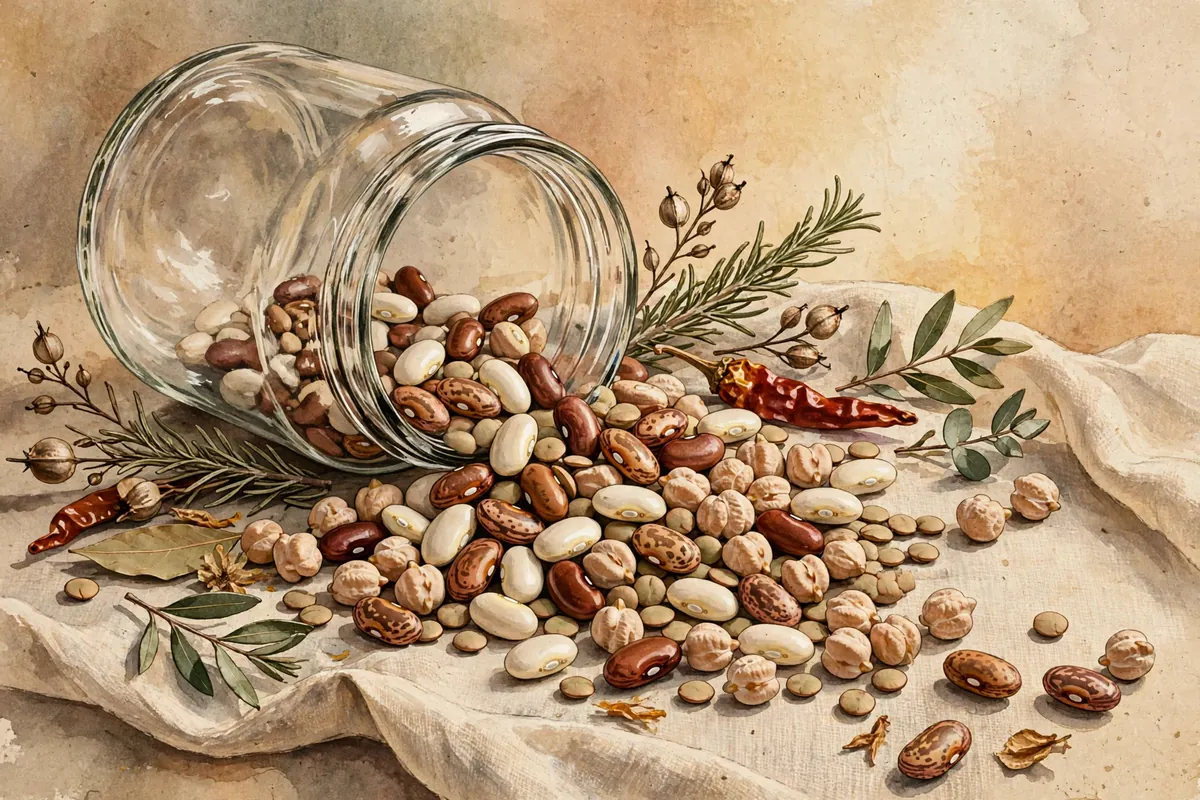
Someone leans in and says, "Come on, spill the beans." We all know what it means: tell the secret. But why beans? Why not spill the milk, or spill the cookies? The phrase is so familiar that we rarely stop to wonder where it came from.
Here's the honest answer. Nobody knows for sure. The phrase "spill the beans," meaning to reveal a secret, is first attested in 1919. You'll often hear that it comes from an ancient voting method in which beans were dropped into jars, and spilling a jar revealed the results too early. But language experts treat that tale as an example of folk etymology, a colorful story invented to explain a phrase after the fact.
The Story Everyone Tells
The popular version goes like this. In ancient times, people voted by dropping beans into jars, one color for yes and another for no. If someone knocked over a jar, the beans spilled out and everyone saw the result before the count was official. The secret was out.
It's a satisfying explanation. The trouble is the gap in time. If the phrase came from the ancient world, you'd expect to find it in writing long before the 20th century. Instead, the earliest known use is from 1919, which makes the ancient connection look more like a clever guess than history.
What Is Folk Etymology?
Folk etymology happens when people reshape or reinterpret a word or phrase so it seems to make more sense. The term itself was coined in German in 1852. It's a natural part of how languages change.
Many idioms really did start out literal, but over time their original meaning drifted away. When the true origin is forgotten, a tidy backstory often appears to fill the gap. That seems to be what happened with spill the beans.
How the Greeks Really Voted
The ancient Greeks did vote with small objects, just not famously with beans. They often used pebbles. In fact, the study of elections is called psephology, from the Greek word psephos, meaning pebble.
Athenians also had a special vote called ostracism, used to banish a powerful citizen. Voters gave names to a scribe, since many couldn't write, and the names were scratched onto pottery shards. The shards were piled face down to keep the votes anonymous. According to the writer Plutarch, at least 6,000 votes had to be cast for it to count.
Our word ballot has a similar story. It comes from the Italian ballotta, a small ball used for secret voting in Venice, Italy.
A Language Full of Odd Sayings
Spill the beans has plenty of company. English is estimated to have around 25,000 idiomatic expressions. Think of "it's raining cats and dogs" for a heavy downpour, "break a leg" for good luck, or "kick the bucket" for dying. None of them make much sense if you take them literally.
Linguists even note that spill the beans is easy to bend. You can say "the beans were spilled" and everyone still understands you. Try that with kick the bucket and it falls apart.
So the next time someone urges you to spill the beans, you can share a bonus secret: nobody really knows where the beans came from. Sometimes the best stories about words are the ones we invent ourselves.