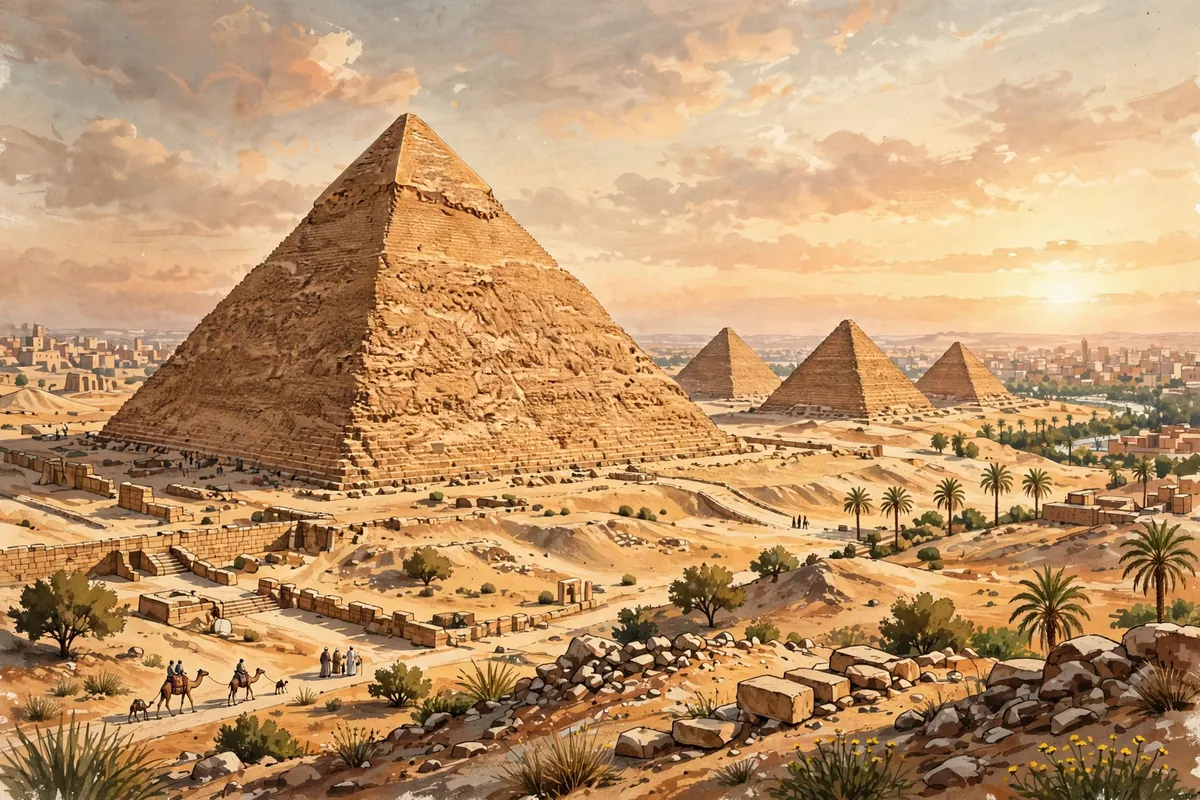
Today, skyscrapers lose their "world's tallest" titles every few decades. But one ancient structure held the record for so long that it's hard to wrap your head around. It was already ancient when Julius Caesar was born, and it was still the tallest thing people had ever built long after the fall of Rome.
That structure is the Great Pyramid of Giza in Egypt. Built around 2600 BC as the tomb of Pharaoh Khufu, it originally stood about 481 feet tall. It remained the world's tallest human-made structure for more than 3,700 years, a record that likely ended in the early 1300s, when Lincoln Cathedral in England reputedly topped it with a tall spire.
Built in About 26 Years
The Great Pyramid is the largest of Egypt's pyramids and the oldest of the Seven Wonders of the Ancient World. It's also the only one of those wonders still largely standing. Builders are thought to have finished it over a period of about 26 years.
The numbers are staggering. Workers quarried an estimated 2.3 million large blocks, weighing about 6 million metric tons in total. Each side of the base runs roughly 756 feet. Most of the stone was local limestone cut just south of the pyramid. Granite blocks weighing up to 80 metric tons were floated down the Nile from Aswan for the King's Chamber. The design called for a height of 280 royal cubits, an ancient Egyptian unit, with sides rising at a slope of almost 52 degrees.
Some believe the architect was Hemiunu, Khufu's vizier. Exactly how the pyramid was built is still debated, and there's no definite consensus.
It Used to Gleam White
What you see today isn't what the ancient Egyptians saw. The pyramid was once covered in smooth white limestone casing stones, brought by boat across the Nile from quarries at Tura. In the Middle Ages, amid earthquakes, workers stripped many of these stones away, and they were said to have been carted off for building in nearby Cairo in 1356.
Losing that casing lowered the pyramid's height to about 454 feet today. The rougher steps visible now are the core structure that used to be hidden underneath. Carefully shaped backing stones once held the casing in place, and they now give the pyramid much of its visible look.
A Diary From the Builders
In 2013, archaeologists found an extraordinary clue. Rolls of papyrus known as the Diary of Merer were discovered at Wadi al-Jarf. Written by a supervisor, they record deliveries of white limestone from Tura to Giza in the 27th year of Khufu's reign.
The diary mentions the pyramid dozens of times by its original name, Akhet Khufu, meaning Horizon of Khufu. It describes stones arriving at a pool or harbor near the site, supervised by Khufu's half brother.
How the Record Finally Fell
Between 1307 and 1311, the central tower of Lincoln Cathedral was raised to 271 feet. A tall, lead-covered wooden spire on top reputedly brought it to about 525 feet, which would have made it the tallest structure in the world. Some historians doubt that figure. The spire blew down in a storm in 1548.
So a stone tomb in the desert outlasted every challenger for thousands of years, and it took a medieval church to finally edge past it. Not bad for a pile of stone set in place some 4,600 years ago.