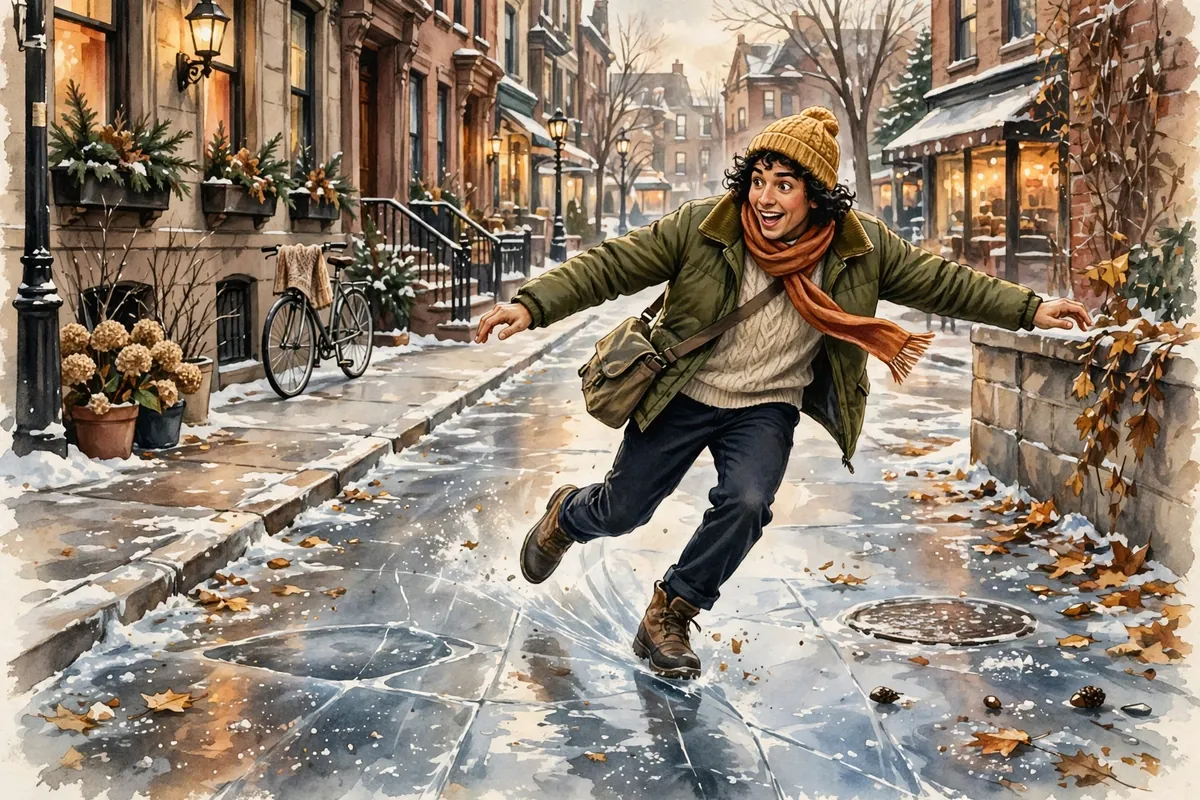
You step out the door on a winter morning, and suddenly your feet have a mind of their own. Ice is one of the most slippery things we deal with in everyday life. Yet if you ask why, you might be surprised to learn that scientists are still debating the answer.
Here's the short version. Ice has very low friction, and the leading explanation is that a thin, watery layer forms on its surface. That layer seems to come partly from friction heating the ice as something slides across it, and partly from molecules at the very surface that behave almost like a liquid. The old idea that pressure from your weight melts the ice turns out to be mostly wrong.
The Textbook Answer That Didn't Hold Up
Scientists first studied this in the 1800s. The favorite explanation for many years was pressure melting. The idea was that a skate blade presses down so hard that it melts a thin film of ice, and the skate glides on that water.
It sounds sensible, but the numbers don't work. In 1939, researchers Frank Bowden and T. P. Hughes found that if pressure melting were the whole story, skaters would feel a lot more friction than they do. Even more telling, the best temperature for figure skating is about 22 degrees Fahrenheit, and for hockey about 16. Under the pressure melting theory, skating below about 25 degrees would be impossible.
Friction Lends a Hand
Bowden and Hughes suggested a different idea. When something slides over ice, the rubbing creates heat, and that heat melts a very thin layer that acts as a lubricant. Research in 2014 suggested that this frictional heating is the most important process under most typical conditions.
But there's a catch. Friction can't explain why ice is slippery when you're simply standing still on it, even far below freezing. Anyone who has tried to stand on a frozen driveway knows that's a very real problem.
A Surface That's Almost Liquid
That's where an older idea comes back. As far back as the 1840s, the great scientist Michael Faraday suggested that ice has a thin film on its surface, even without any pressure. He also noticed that two blocks of ice pressed together can freeze into one.
Modern research supports a version of this. Water molecules at the very surface of ice can't bond properly with the solid ice below them, so they're freer to move around, a bit like liquid water. This semi-liquid layer could help make ice slippery no matter how hard you press. Still, some experiments have measured surprisingly high friction on ice, so the debate isn't over.
Most scientists now think a full explanation has to combine these ideas, and the answer may change with temperature and speed.
Watch Out for Black Ice
The sneakiest ice of all is black ice. It isn't actually black. It's a thin, clear coating that lets the dark pavement show through, so it's almost invisible to drivers and walkers. It can form when light rain or drizzle falls on a road that's below freezing.
So the next time you find yourself shuffling across a frozen parking lot, you're walking on a genuine scientific puzzle. Take it slow, hold onto the railing, and enjoy knowing something most people never think about.