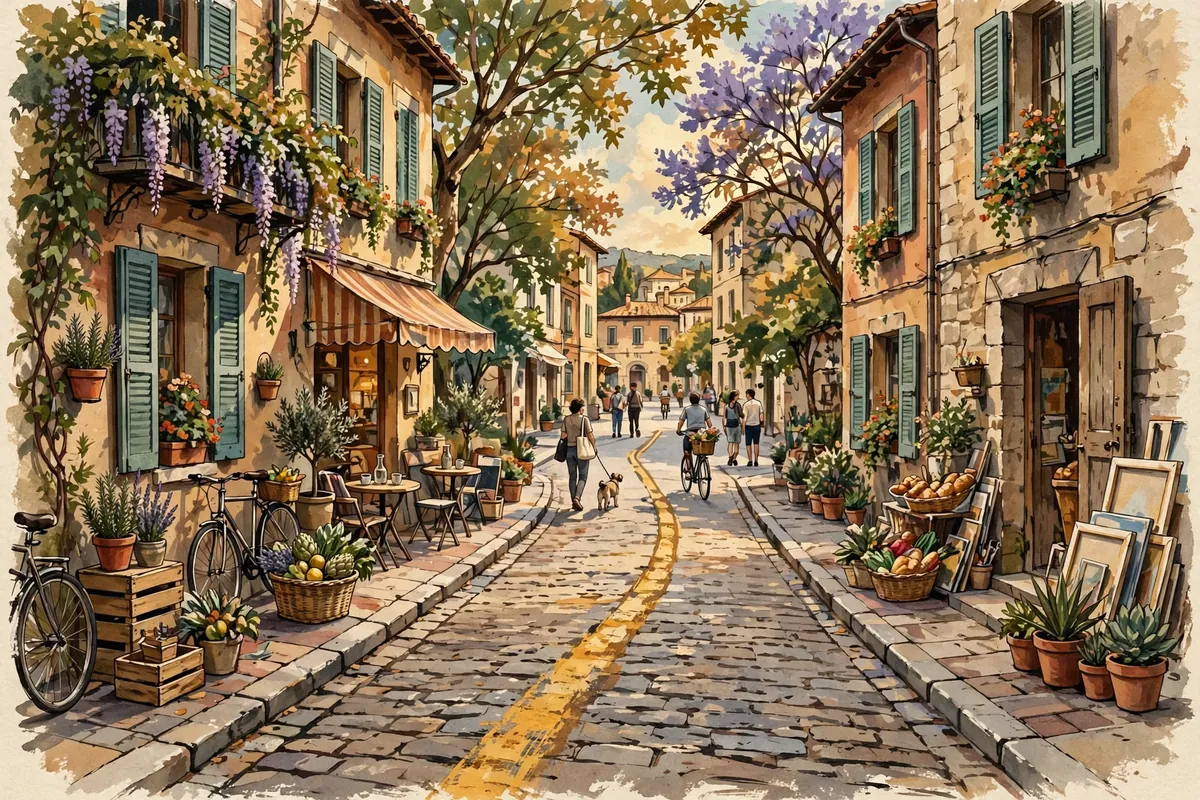
In most towns, the line painted down the middle of the road just keeps traffic in its lanes. But there's a little street on the edge of Vermont where that line means a whole lot more. Step over it, and you've technically left the country.
It's called Canusa Street. Along a stretch of about 0.38 miles, the road runs along the 45th parallel, which marks the border between Canada and the United States. There, the yellow center line is treated as the international border. Homes on the south side are in Beebe Plain, Vermont. Homes on the north side are in Stanstead, Quebec.
A Name Made From Two Countries
The street's name tells the story. 'Canusa' is a blend of 'Can,' short for Canada, and 'USA.' It's part of a road known as Quebec Route 247.
How the border ended up running through a village is a matter of local legend. One story claims a group of rather drunken surveyors, sent to mark the border at the 45th parallel, decided to run it right down the middle of the village. Whether or not that's true, it makes for a good tale.
There's an official twist, too. On the current property maps, the border is drawn along the southern edge of the street, which would put the road itself entirely in Canada. In practice, though, the road is treated as the dividing line.
A Post Office With Two Doors
At the western end of Canusa Street sits a solid granite building, built as a store in the 1820s. For a time, it was the world's only international post office. It had one postmaster but two doors and two postal counters, each serving customers from a different country.
Just about a mile east of the street stands another famous border building, the Haskell Free Library and Opera House. It was deliberately built across the border and has addresses in both countries. Its founders, American sawmill owner Carlos F. Haskell and his Canadian wife, Martha, wanted people on both sides of the line to be able to use it.
Neighbors, but Not Easily
For many years, crossing the street to visit a neighbor was a simple matter. Not anymore. As border security tightened in the 21st century, after events such as the September 11 attacks and the COVID-19 pandemic, the rules got much stricter.
Today, informally crossing the road is illegal and can lead to arrest. Anyone crossing must report to customs. That makes life complicated for the residents of the 14 houses that sit directly on the border section of the street.
The change shows up in the numbers. At the nearby Derby Line border crossing, pedestrian entries into the United States dropped from 16,474 in 2000 to just 273 in 2010. In 2021, during pandemic restrictions, there were only two.
The Friendliest Border
Even so, locals are proud of their unusual home. The people of Stanstead hold an annual celebration of what they call the 'friendliest border in the world,' complete with parades and processions of vehicles through town.
It's a reminder that borders can feel very different up close. On a map, the line between the U.S. and Canada stretches for thousands of miles. On Canusa Street, it's just a strip of yellow paint between neighbors, with a lot of history packed into a very small space.