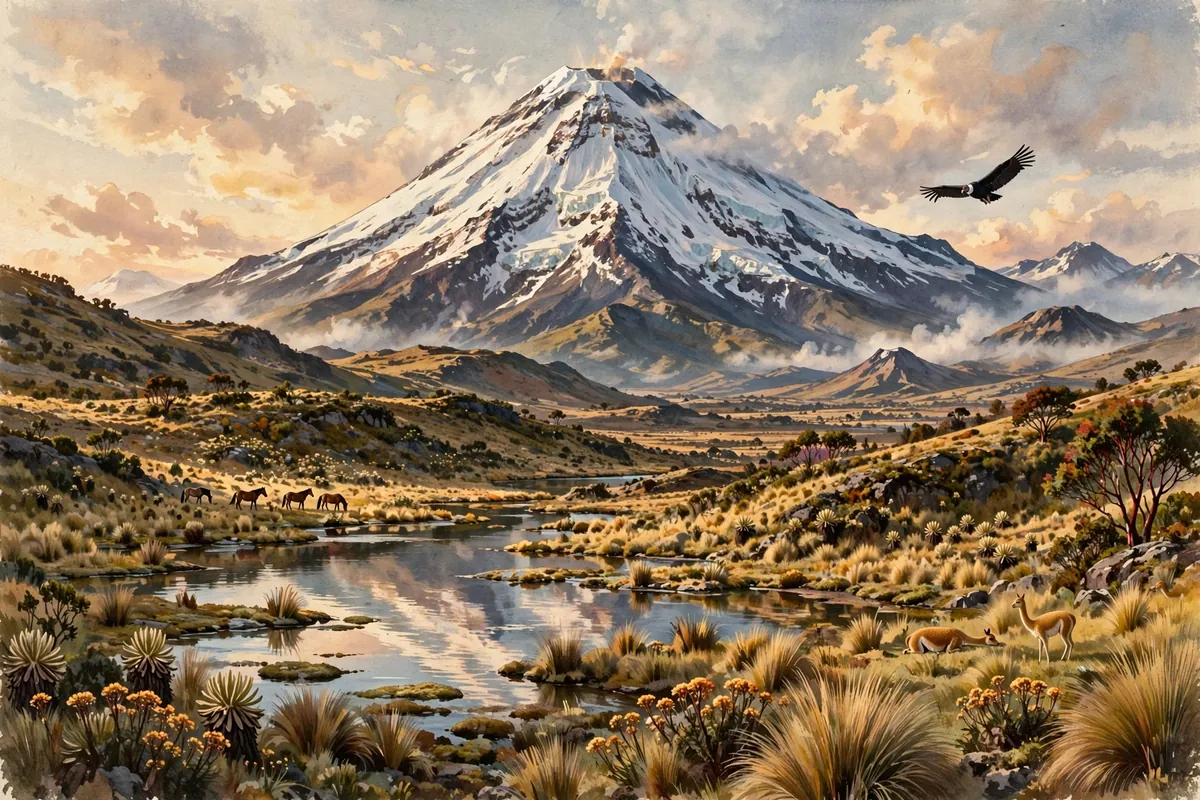
Mount Everest gets all the glory as the world's highest mountain, and rightly so if you're measuring from sea level. But there's another way to measure. If you ask which spot on Earth's surface is farthest from the center of the planet, the answer is a snowy volcano near the equator in Ecuador.
That mountain is Chimborazo. Its summit stands 20,548 feet above sea level, well below Everest's 29,032 feet. Yet because Earth bulges at the equator, Chimborazo's peak is about 3,967 miles from Earth's center, roughly 1.3 miles farther out than Everest's summit. One note, though: it's sometimes called the place closest to space, but since the edge of space is usually measured from sea level, that title depends on how you measure.
Blame the Bulge
Earth isn't a perfect ball. It's slightly squashed, a shape scientists call an oblate spheroid, so it's thicker around the equator than it is from pole to pole. Sea level itself sits a bit higher at the equator, too.
Chimborazo sits just one degree south of the equator, right on top of that bulge. Everest, meanwhile, is nearly 28 degrees north. So even though Chimborazo is about 8,500 feet lower in elevation, it's riding on a wider part of the planet. Peru's Huascarán is a very close second. It's a quirk of geography: the point farthest from Earth's center isn't the highest point above sea level.
An Ice-Capped Volcano
Chimborazo is the highest mountain in Ecuador, but only the 39th-highest peak in the Andes. It's an inactive stratovolcano, actually built as one volcano stacked on top of another. Its last known eruption is believed to have happened around the year 550.
The mountain has four summits, and its upper slopes are covered in glaciers. Those glaciers supply water to people living in the surrounding provinces, but they've been shrinking in recent decades, partly due to ash from the nearby Tungurahua volcano. Researchers now study Chimborazo to understand how tropical glaciers are changing.
The Climb That Made History
In June 1802, the famous explorer Alexander von Humboldt tried to reach the top. He and his companions turned back with altitude sickness, but they reached about 19,275 feet, higher than any European was known to have climbed. The Inca, however, had reached much greater heights on other mountains long before. In 1831, Jean-Baptiste Boussingault and a Colonel Hall pushed higher, to an estimated 19,700 feet, but still fell short. More failed attempts followed.
The summit was finally reached on January 4, 1880, by the English climber Edward Whymper. Some critics doubted him, so later that year he climbed it again by a different route, joined by two Ecuadorian climbers, David Beltrán and Francisco Campaña. The mountain's highest peak is now named for Whymper. His original path up the mountain is still called the Whymper route.
The Snow on the Other Side
There are several theories about the name. Local Quichua speakers say it comes from chimbarazu, meaning the snow on the other side. Another theory translates it as the ice throne of God. In local Indigenous tradition, Chimborazo is seen as Taita, or father, while the neighboring volcano Tungurahua is Mama.
So if you ever want to stand on the spot that reaches farthest from Earth's core, you don't need to go to Nepal. Head to Ecuador, and bring a warm coat.