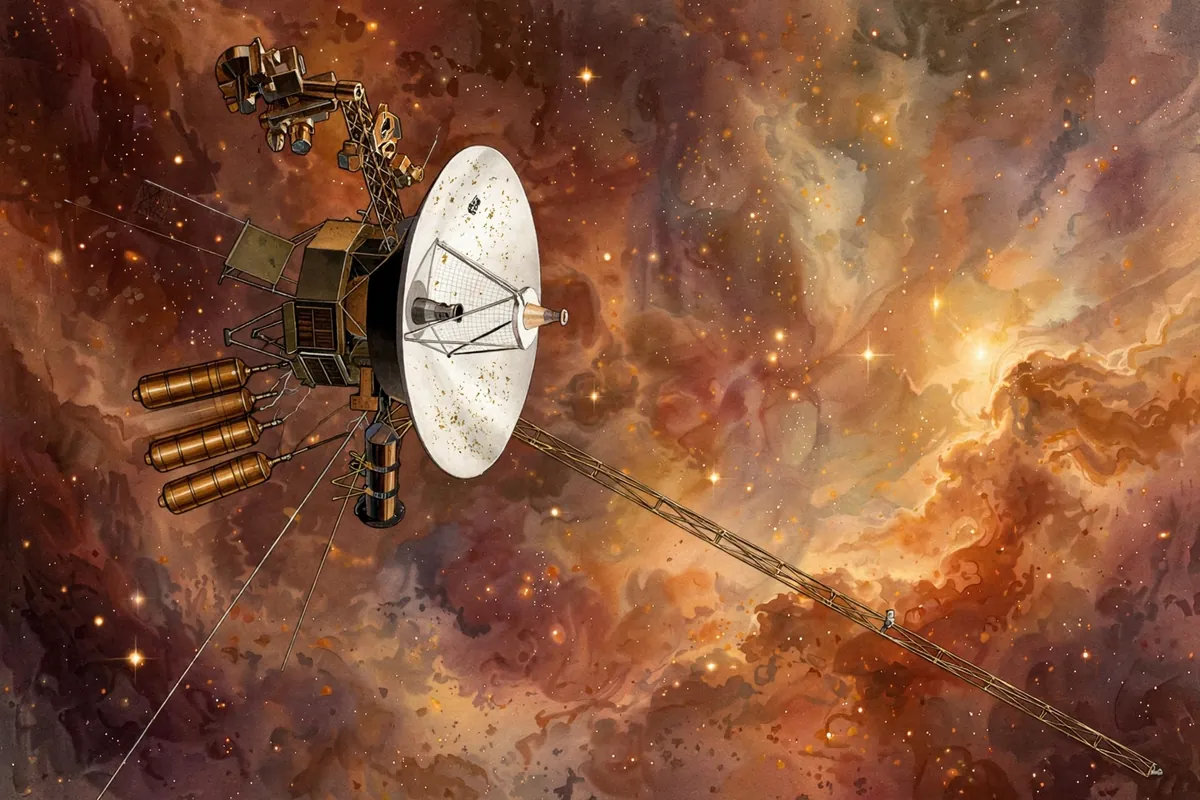
Think back to 1977. Gas was cheap, disco was everywhere, and a car-sized robot was strapped to a rocket in Florida. Nearly fifty years later, that robot is still out there, still talking to us, and still heading away at tremendous speed. It has traveled farther than anything else humans have ever built.
That spacecraft is NASA's Voyager 1. As of October 2026, it's about 16 billion miles from Earth, which makes it the most distant human-made object. It's so far away that it's projected to reach one full "light-day" from Earth on November 18, 2026, meaning a radio signal traveling at the speed of light takes a whole day to cover the distance.
A Grand Tour of the Giant Planets
Voyager 1 launched on September 5, 1977, just 16 days after its twin, Voyager 2. Its main job was to study the outer planets. It flew past Jupiter and Saturn, studying their weather, magnetic fields, and rings, and it was the first probe to send back detailed pictures of their moons.
Mission planners had to make a tough choice: visit Pluto or Saturn's largest moon, Titan. They chose Titan because it was known to have a thick atmosphere. That decision sent Voyager 1 on a path up and out of the plane of the planets, toward deep space.
Even back then, engineers improvised. Shortly before launch, strips of kitchen-grade aluminum foil were added to certain cables to give extra protection from Jupiter's intense radiation.
Into Interstellar Space
On February 17, 1998, Voyager 1 passed Pioneer 10 to become the most distant spacecraft from Earth. Then, on August 25, 2012, it crossed the edge of the Sun's bubble of solar wind, called the heliopause. It became the first spacecraft to enter interstellar space, the region between the stars.
It's moving at about 11 miles per second, faster than any other spacecraft is leaving the Sun. Thanks to gravity boosts from planets it passed, even the newer New Horizons probe will never catch it. Still, space is enormous. At this speed, it would take Voyager 1 about 17,565 years to travel a single light-year. Proxima Centauri, the closest star to the Sun, is about 4.2 light-years away.
The Pale Blue Dot
On February 14, 1990, Voyager 1 turned around and took the first "family portrait" of the Solar System from the outside. One of those images shows Earth as a tiny speck of light, a photo known as the Pale Blue Dot. Soon after, its cameras were switched off to save power, and they've never been used again.
A Message in a Bottle
Voyager 1 also carries a golden record, a kind of time capsule meant to tell any extraterrestrials who might find it about life on Earth. Astronomer Carl Sagan led the team that created it. He said it would only be found if advanced space-faring civilizations exist, but that launching such a "bottle" into the cosmic "ocean" says something very hopeful about life on this planet.
The old explorer is winding down. As of 2026, only two of its instruments are still working, and its nuclear power source may keep sending engineering data until about 2036. After that, it will go quiet but keep flying. As NASA puts it, the Voyagers are destined, perhaps eternally, to wander the Milky Way.