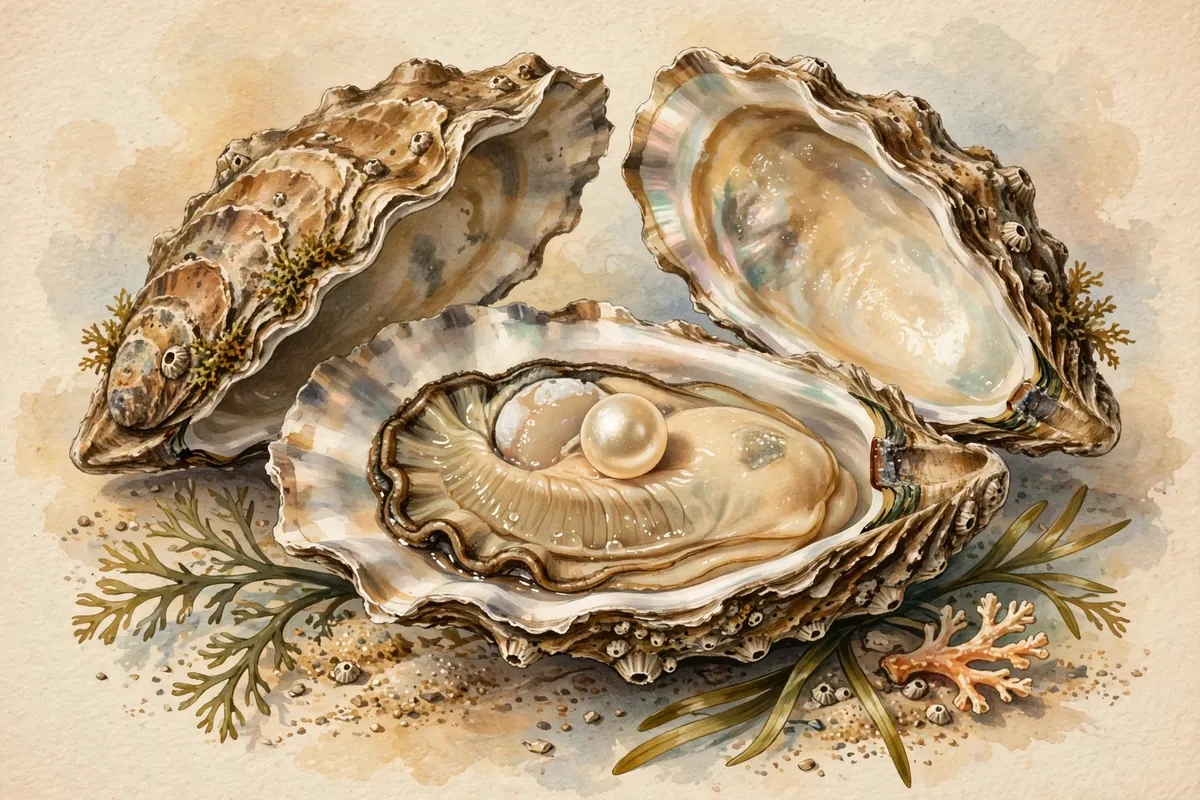
A pearl is one of the few gems made by a living animal. No mining, no cutting, no polishing needed. It comes out of the shell already shining. So how does a soft creature in the sea manage to make something so smooth and lovely?
Here's the short answer. When something gets inside a mollusk's shell and irritates it, the animal coats the intruder with layer after layer of the same material it uses to line its shell. That material, called nacre or mother-of-pearl, slowly builds up into a pearl. And despite the famous story, the irritant is rarely a grain of sand.
So What Starts a Pearl?
The usual troublemakers are bits of organic material, tiny parasites, or an injury to the animal's soft tissue. They can slip in when the shell is open for feeding or breathing. Crabs, other predators, and parasites like worm larvae can also damage the delicate edge of the mollusk's body.
When that happens, some of the cells that normally build the shell can end up in the wrong place. They form a little pocket called a pearl sac and keep doing their job, producing shell material inside the pocket. Over time, those layers build up around the center, and a pearl grows.
Built Layer by Layer
Nacre is made of calcium carbonate, mostly in a mineral form called aragonite, held together by a natural, horn-like substance called conchiolin. The mollusk lays it down in thin, translucent layers, again and again.
That layering is the secret to a pearl's glow. Light reflects and bends as it passes through the stacked layers. The thinner and more numerous they are, the finer the luster. The rainbow shimmer, or iridescence, comes from overlapping layers breaking up the light that falls on them.
Natural pearls come in many shapes. Perfectly round ones are comparatively rare, which helps explain why they've always been so prized.
Cultured Pearls: A Helping Hand
Most pearls sold today are cultured. Instead of waiting for an accident, pearl farmers place a small piece of mantle tissue inside the mollusk, sometimes along with a round bead. The animal then coats it with nacre just as it would in nature.
Kokichi Mikimoto of Japan is often credited with inventing the process, but that's a common misperception. The accepted method was developed by British biologist William Saville-Kent in Australia and brought to Japan by Tokichi Nishikawa and Tatsuhei Mise. Nishikawa received a patent in 1916 and married Mikimoto's daughter, and Mikimoto went on to use the technique and build a famous pearl business.
Pearls in Unexpected Places
Almost any shelled mollusk can make some kind of pearl. Most of them have no shine at all and are worth nothing except as curiosities. They sometimes turn up in edible mussels, oysters, and even escargot snails.
The fine ones, though, have been treasured for thousands of years. Divers gathered seawater pearls in the Persian Gulf and Red Sea for millennia. In 1917, the jeweler Pierre Cartier reportedly bought the Fifth Avenue mansion that became Cartier's New York store in exchange for a double strand of natural pearls valued at $1 million.
So the next time you see a string of pearls, think of the patient creature behind each one, quietly turning an irritation into something beautiful. There might be a little life lesson tucked in there too.