Every December, mailboxes fill up with snowmen, glittering trees, and family photos in matching sweaters. Sending Christmas cards feels like a tradition that has been around forever. But it actually has a clear starting point, a specific year, and one inventive Englishman behind it.
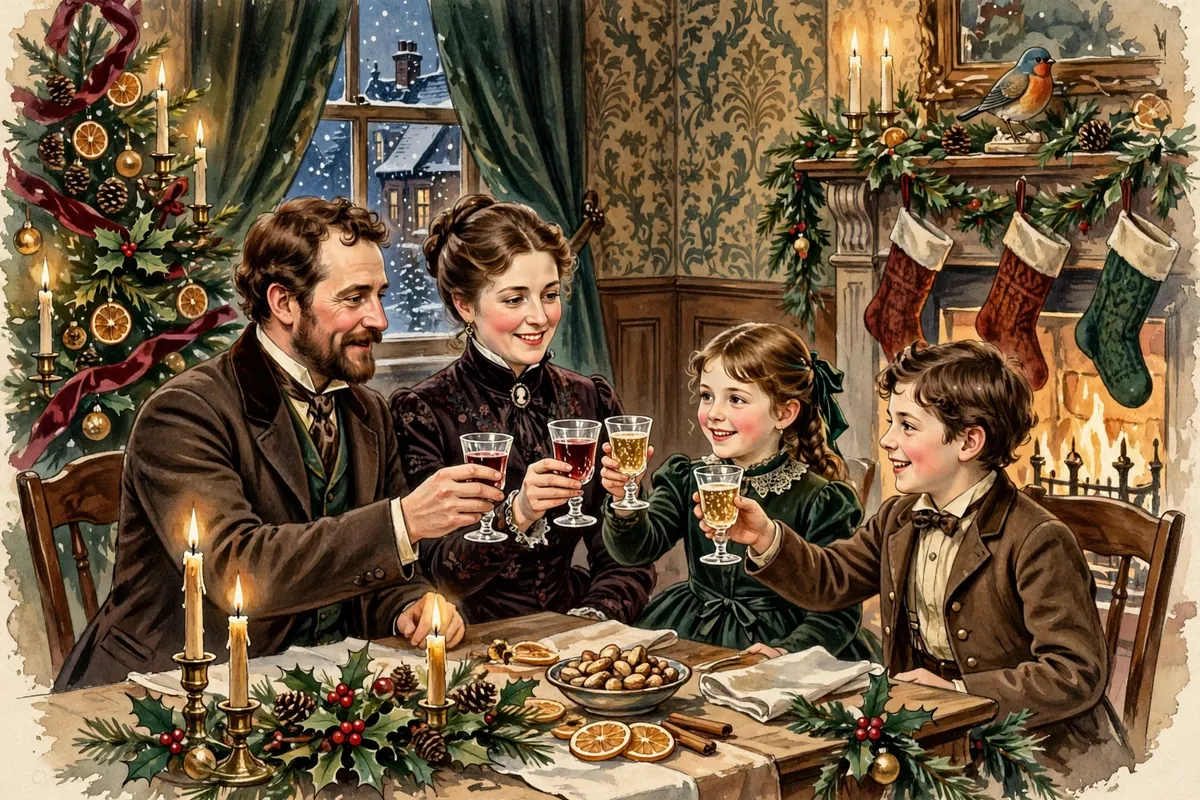
Here's the short answer: the first commercial Christmas card was created in London in 1843. It was commissioned by Sir Henry Cole, a civil servant, and designed by the artist John Callcott Horsley. It showed a family raising a toast and carried a greeting we still use today: "A Merry Christmas and A Happy New Year."
A Clever Idea at the Right Time
Henry Cole had a knack for new ideas. He helped introduce Britain's Penny Post just three years earlier, which made mailing a letter cheap and easy for ordinary people. Suddenly, sending holiday greetings by post was something nearly anyone could do.
Cole's printed card turned that new habit into a product. Two batches, totaling 2,050 cards, were printed and sold that year for a shilling each.
The Picture That Raised Eyebrows
Horsley's design showed three generations of a family gathered around a table, raising their glasses to whoever received the card. On either side were scenes of charity, with food and clothing being given to the poor.
According to the story often told, the image of a family drinking wine together stirred up some controversy. Whatever the grumbling, the idea caught on, and the Christmas card was here to stay.
Funny enough, many early British cards didn't show snow or nativity scenes at all. They favored flowers, fairies, and other fanciful designs meant to remind people that spring was on its way. Cute children and animals were popular too.
Crossing the Atlantic
The Christmas card came to the United States in 1874, thanks to a printing firm run by Louis Prang. He's sometimes called the "father of the American Christmas card." By the 1880s, Prang was turning out more than five million cards a year using a colorful printing method called chromolithography. Ironically, cheap imitations of his popular cards eventually drove him out of the business.
Fancy Victorian cards didn't rule forever. Cheap picture postcards nearly wiped out the elaborate old style, but by the 1920s, cards tucked inside envelopes had made a comeback.
In 1913, brothers Joyce and Rollie Hall began selling their own Christmas cards. Their company became Hallmark, and demand grew when World War I sent families looking for cards to mail to soldiers.
A Card Worth a Fortune
Those first 1843 cards are now treasures. One that Cole sent to his grandmother sold at auction in 2001 for more than £22,000, making it the most expensive Christmas card ever sold. Queen Mary was a collector too, and her large collection is now kept at the British Museum.
Collectors especially prize cards from the so-called golden age of printing, from the 1840s through the 1890s. Another of Horsley's original cards sold in December 2005 for nearly £9,000. Not bad for something that first sold for a shilling.
Even in the age of email, the tradition holds on. Americans sent about 1.9 billion Christmas cards in 2005 alone. So when you sit down to address your stack this year, you're carrying on a little gift from a clever Victorian who saw a good idea and ran with it.