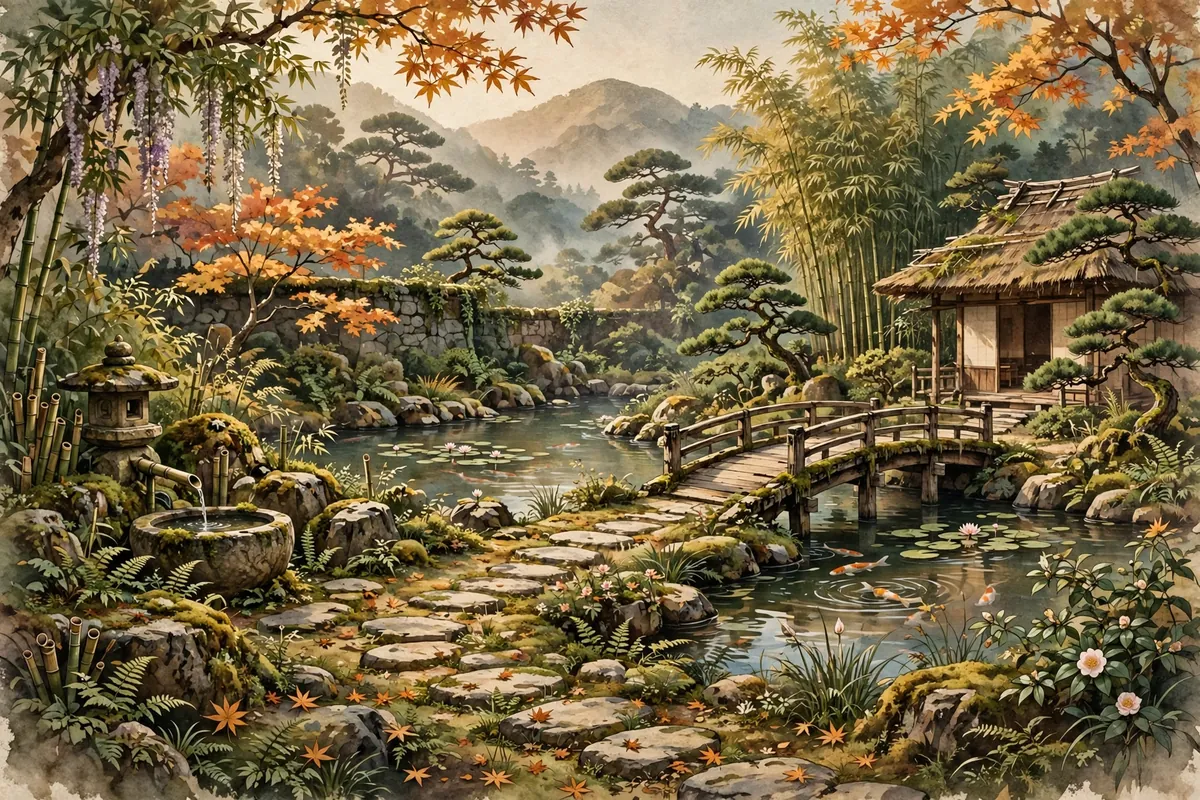
Plenty of gardens claim to be historic. But imagine a garden where emperors held banquets more than twelve centuries ago, and where the water still shimmers today. In Kyoto, Japan, you can still visit one.
Here's the short answer. Shinsen-en, a pond garden in central Kyoto, was laid out in 794 as part of the original Heian Palace. It's the oldest existing garden in Kyoto and the last surviving piece of that ancient palace. It's far smaller than it once was, but it has lasted well over 1,000 years.
An Emperor's Private Garden
When the city then called Heian-kyō was laid out in 794, a huge garden centered on a large pond was built next to the imperial palace. By some accounts, it stretched about 500 meters from north to south. It was a forbidden garden, meant for the emperor's private enjoyment.
Historical records show Emperor Kanmu visiting the garden in the year 800, and an elegant banquet was held there in 802. It became a favorite spot for emperors and courtiers to relax.
In 812, Emperor Saga held a Flower Banquet at Shinsen-en. It's the first known recorded instance of cherry blossom viewing, a tradition that's still beloved in Japan today.
A Pond That Never Dried Up
The garden's pond had a special reputation. It never dried up, whatever the season, even in times of drought. So it came to be seen as a holy site and a place for rainmaking rituals.
One famous story tells of a rainmaking contest in 824 between two priests, Morotoshi and the renowned monk Kūkai. Kūkai won, and the pond later came under the care of his temple, Tō-ji.
The garden even played a part in one of Japan's best-known festivals. After a plague swept the city in 863, rituals were held there to calm angry spirits. Over time, that ceremony grew into a local festival that's said to be the origin of the modern Gion Matsuri.
Storms, Ruins, and a Castle
Surviving for 1,200 years wasn't easy. A storm destroyed the garden in 1180. It was restored, abandoned, and restored again, and by the 1400s the area had fallen into ruin and was crowded with shacks.
Then, in 1602, Tokugawa Ieyasu built Nijō Castle. Most of the land north of Shinsen-en was swallowed up by the castle grounds, along with the garden's water source, which became part of the castle's inner moat. A monk later helped rebuild it as a temple, and in 1935 it was named a National Historic Site.
Another Ancient Pond Nearby
Kyoto has another remarkable survivor, on land that was once Emperor Saga's own residence. Ōsawa Pond, at the temple of Daikaku-ji, was created by Emperor Saga in the early 800s. It's one of the oldest Japanese garden ponds remaining from the Heian period, and it was designed to be enjoyed from a boat. Small rocky islets between its two islands were meant to look like Chinese ships at anchor. On a hillside nearby, an arrangement of stones suggests a waterfall without any water at all, an early example of a dry rock garden.
So if you ever stroll through Kyoto, look for these quiet ponds. Shinsen-en is about a 10-minute walk east of Nijō Station. They may seem simple, but they've been reflecting the sky for more than a thousand years.