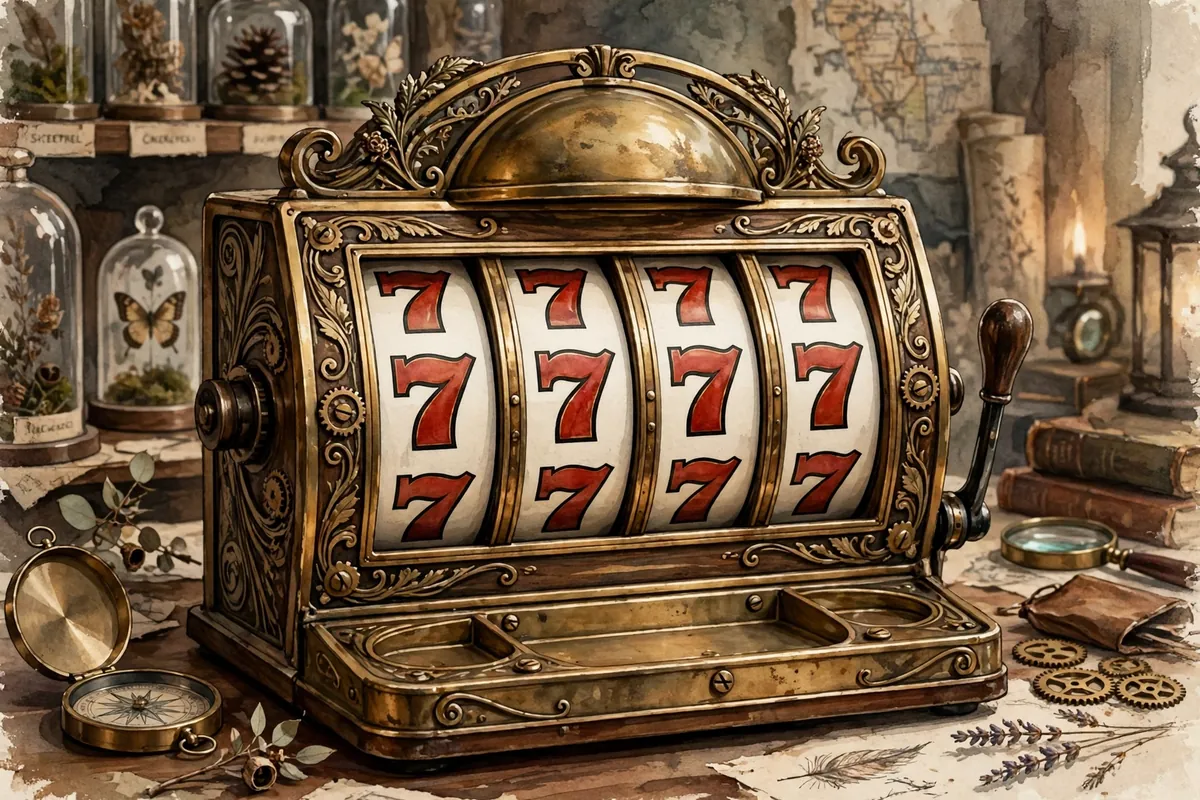
Hit three sevens on a slot machine and the lights start flashing. Roll a seven at the craps table and the crowd cheers. Even ballplayers talk about the seventh-inning stretch with a certain fondness. Somehow, of all the numbers, seven became the lucky one. How did that happen?
There's no single proven reason. Seven is often considered lucky in Western culture, and it has symbolic links to religion, mythology, superstition, and philosophy going back thousands of years. Some of the strongest clues come from the ancient sky, the seven-day week, and even the math of rolling dice.
Seven Lights in the Sky
Long before telescopes, people watched the heavens closely. They noticed seven bright objects that moved against the background of fixed stars: the Sun, the Moon, Venus, Jupiter, Mercury, Mars, and Saturn. These became known as the seven classical planets. Today, only five of those seven still count as planets. The Sun is a star, and the Moon is Earth's natural satellite. But to ancient eyes, all seven seemed to wander together across the sky.
The ancient Babylonians recognized these seven planets, and they carried enormous importance in many cultures. In fact, the seven classical planets are the reason we have seven days in a week. The Romans named their days after them, and many of those names survive. In English, Saturday still carries Saturn's name, and in French, Tuesday, mardi, is Mars's day.
A Number Full of Meaning
Seven turns up again and again in tradition. In the Bible's creation story, God rests on the seventh day. The famous Seven Wonders of the Ancient World included the Great Pyramid of Giza, the Colossus of Rhodes, and the Hanging Gardens of Babylon. Of those seven, only the Great Pyramid still stands.
With so many important things coming in sevens, from the days of the week to the wonders of the world, it's easy to see how the number came to feel special, complete, and a little magical.
The Dice Connection
Seven also has a mathematical edge. When you roll two ordinary six-sided dice, seven comes up more often than any other total, with a 1 in 6 chance. And on every standard die, the numbers on opposite sides always add up to seven.
That's one reason seven plays such a big role in the dice game craps. If the shooter rolls a seven or eleven on the first roll, called the come-out roll, it's a "natural," and bets on the pass line win. Later in the game, though, rolling a seven can mean losing, so even at the craps table, seven isn't always lucky.
Slot machines picked up on the number's good reputation, too. Classic slot symbols include fruits, bells, and stylized lucky sevens.
Everybody's Favorite
Seven's popularity isn't just about luck. In Western culture, seven is consistently listed as people's favorite number. Mathematicians love it as well. It's a prime number with a long list of special properties, and a seven-sided shape, the heptagon, is the first regular polygon that can't be drawn using only a compass and straightedge.
So is seven really lucky? Math says each number is just a number. But with the ancient sky, a weekly calendar, and a pair of dice all in its corner, seven has earned its reputation. Next time you spot one, go ahead and smile.