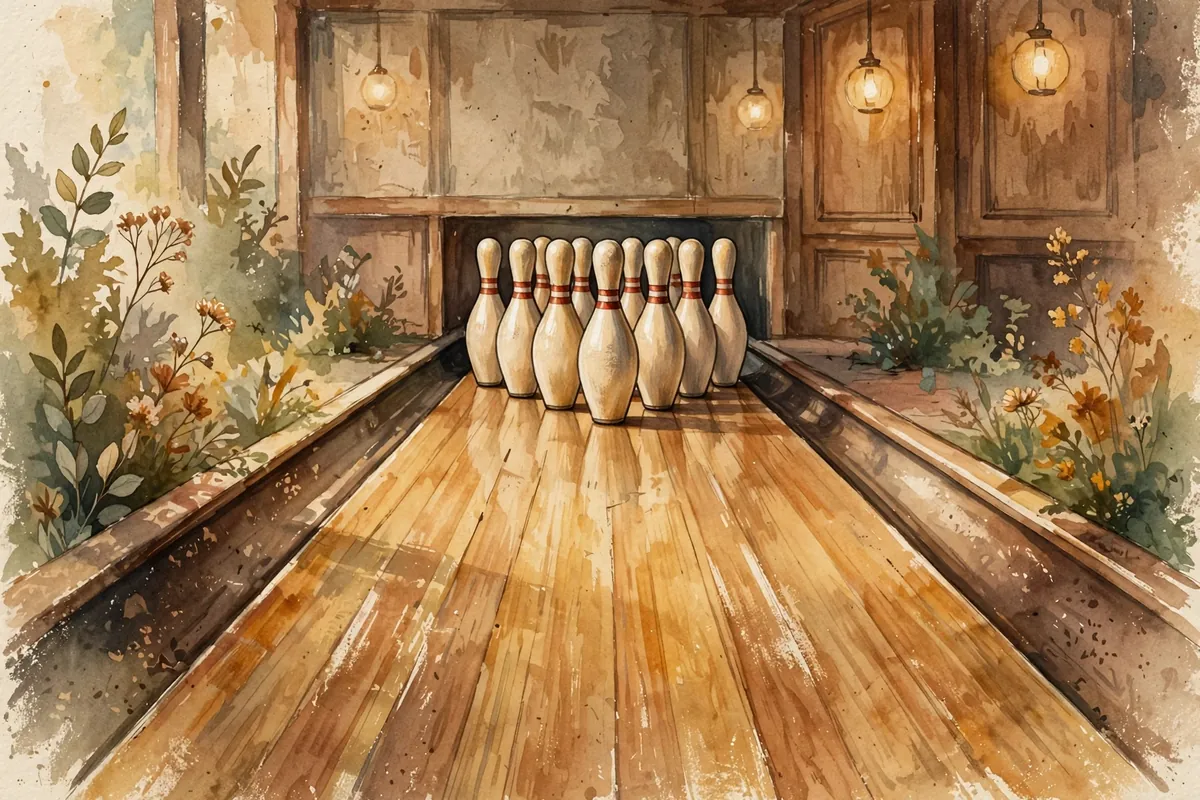
Picture a bowling pin and you can probably sketch it from memory: a round belly, a narrow neck, and a little rounded head, painted white with red stripes. It's one of the most recognizable shapes in sports. But why does it look like that, instead of a simple cylinder or cone?
The shape is mostly a story of tradition, refined into precise rules. Pins descend from old European games like skittles and kegeln, and vase-shaped game pieces have turned up in ancient Egypt. Today, the exact size, shape, and weight of a tenpin are set by the United States Bowling Congress, and some pins even have hollow spaces inside to fine-tune their weight and balance.
Built to Exact Specs
A regulation tenpin is 15 inches tall and 4.75 inches wide at its widest point, and it weighs 3 pounds 8 ounces, give or take 2 ounces. World Bowling, the international governing body, uses the same specifications.
Making one takes real craftsmanship. Blocks of rock maple are glued together into a rough shape, then turned on a lathe, much the way a woodworker shapes a table leg. The pin is coated with plastic, painted, and given a glossy finish.
Good maple is scarce, so approved synthetic pins exist, too. They usually sound different from wooden pins when the ball crashes into them.
The rules keep evolving. In 2023, the USBC certified string pinsetters, which handle pins attached to strings, with no change to scoring, while acknowledging that bowlers average slightly lower on them. They're cheaper and easier to maintain, so many bowling centers are switching.
Not Every Pin Looks the Same
Other bowling games use pins with very different shapes, which shows how much the design comes down to tradition. Candlepins, a New England favorite, are the tallest at 15¾ inches but only about 3 inches wide. They're nearly cylindrical, like candles, and because they're symmetrical, they can be set up on either end.
Duckpins are shorter and squatter than tenpins. Canadian fivepins fall in between and wear a thick rubber band around their widest part to increase the action when they're struck. Duckpin bowling is often said to have started in Baltimore around 1900, at a hall owned by baseball greats John McGraw and Wilbert Robinson, but references to duckpins turn up in New England in the early 1890s.
Rules came along to keep things consistent. In 1906, a national congress for duckpins and candlepins began regulating ball size, pin shape and size, and lane surfaces, which made leagues and competitions possible.
From Ancient Egypt to the Tenth Pin
Bowling games are ancient. The earliest known forms date to Egypt around 3200 BCE, with wall drawings of bowling in a royal tomb and miniature pins and balls in a child's grave. In 1895, at Naqada in Egypt, researchers found what's thought to be a child's game with stone balls and nine vase-shaped alabaster figures resembling modern skittles.
Skittles, played with nine wooden pins, is considered the forerunner of tenpin bowling, which is thought to have reached America with Dutch colonists. And there's a fun story about the tenth pin. An 1841 Connecticut law banned ninepin bowling over its links to gambling and crime, and people were said to get around it by adding one more pin.
So the next time a strike sends pins clattering, take a second look at those curvy shapes. They carry thousands of years of game history, polished up with modern rules and a fresh coat of glossy white paint.