It sounds like a tall tale someone made up at the pub. In 1932, the Australian Army sent soldiers armed with machine guns into the wheat fields of Western Australia. Their opponent wasn't a foreign army. It was a horde of big, flightless birds.
The short answer: yes, it really happened. The so-called Emu War was a military operation to cull emus that were damaging farmland. The army made two attempts, and both were largely ineffective. The emus scattered into small, alert, fast-moving groups, and the effort was eventually abandoned.
How Farmers Ended Up at War With Birds
After World War I, many veterans were given land to farm in Western Australia, often in areas where farming was tough. When the Great Depression hit in 1929, these farmers were encouraged to grow more wheat, with promises of government help that never arrived. Wheat prices kept falling.
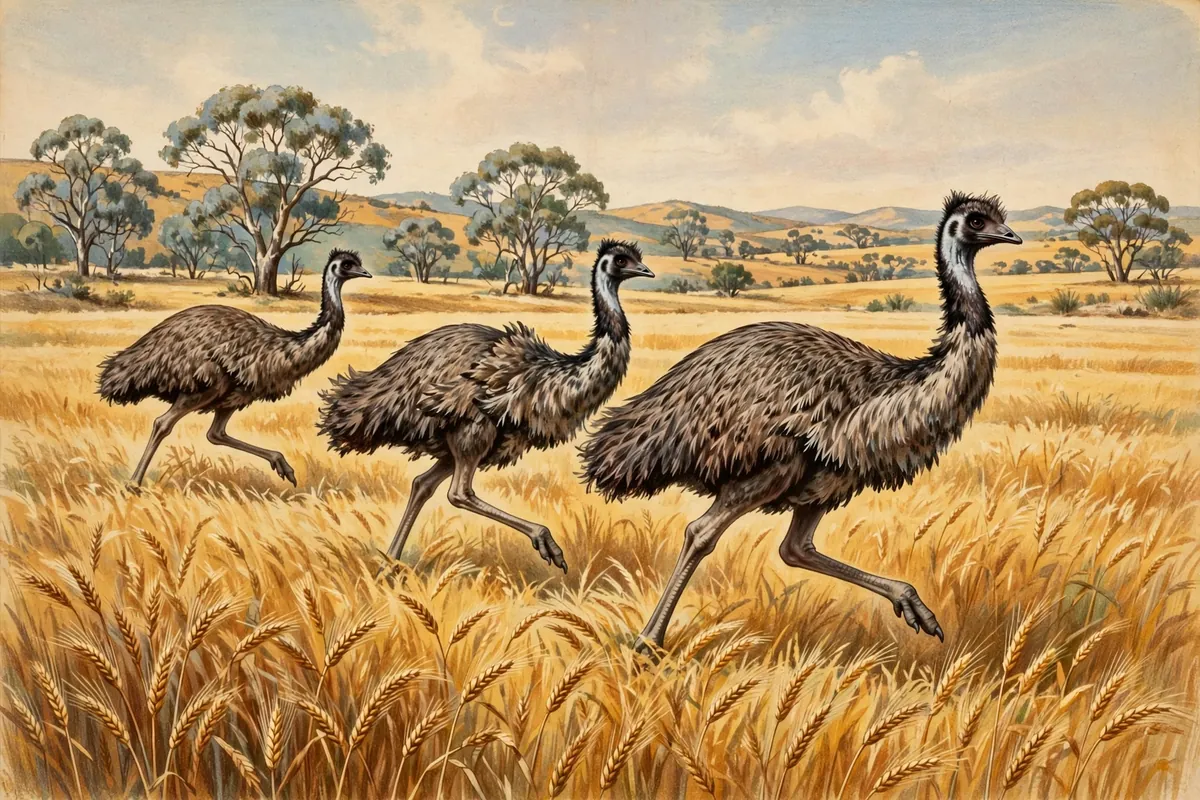
Then came the emus, around 20,000 of them. Emus migrate after their breeding season, and the cleared land and extra water set out for livestock made the farms very attractive. The birds ate and trampled crops and broke big gaps in fences, letting rabbits in too.
The farmers were ex-soldiers who knew what machine guns could do, so they asked the Minister of Defence, Sir George Pearce, to send some. He agreed. A cinematographer from Fox Movietone even came along to film it.
Round One Goes to the Emus
The operation was led by Major G. P. W. Meredith of the Royal Australian Artillery, with two soldiers, two Lewis guns, and 10,000 rounds of ammunition. Rain delayed the start, and the troops finally went into action on November 2, 1932.
It didn't go to plan. When settlers tried to herd the birds into an ambush, the emus split into small groups and ran, making them hard to hit. Observers noted that each flock seemed to have its own leader, a tall, black-feathered bird that kept watch and warned the others.
Meredith even mounted a gun on a truck. The truck couldn't keep up with the birds, and the ride was so bumpy that the gunner couldn't fire a single shot. By November 8, about 2,500 rounds had been fired. Estimates of birds killed ranged from about 50 to 500. Meredith reported no casualties among his men, except to their dignity.
Round Two and a Disputed Scorecard
The soldiers went back into the field on November 13, and this time they had more success, eventually killing about 100 emus a week. Meredith was recalled on December 10. He claimed 986 confirmed kills using 9,860 rounds, plus 2,500 wounded birds that later died. Historians consider those figures highly disputed and likely inflated.
Meredith was impressed by his opponents. He compared the birds to tanks, saying they could face machine guns with the invulnerability of tanks.
What Happened Next
The operation drew mockery of the military and sympathy for the emus. Word spread as far as Britain, where some conservationists protested. Farmers asked for military help again in 1934, 1943, and 1948, but the government said no.
Instead, Australia relied on a bounty system that had started in 1923, and it worked far better. In just six months of 1934, 57,034 bounties were claimed. Fences designed to keep pests out also became part of the solution.
A Story That Keeps Flying
Calling it a war that Australia lost is a bit of a joke, but it's a joke rooted in truth. A modern army showed up with machine guns, and a flock of determined birds outran, outmaneuvered, and outlasted it.
More than 90 years later, the Emu War still makes people laugh. It's a reminder that nature doesn't always follow the battle plan.