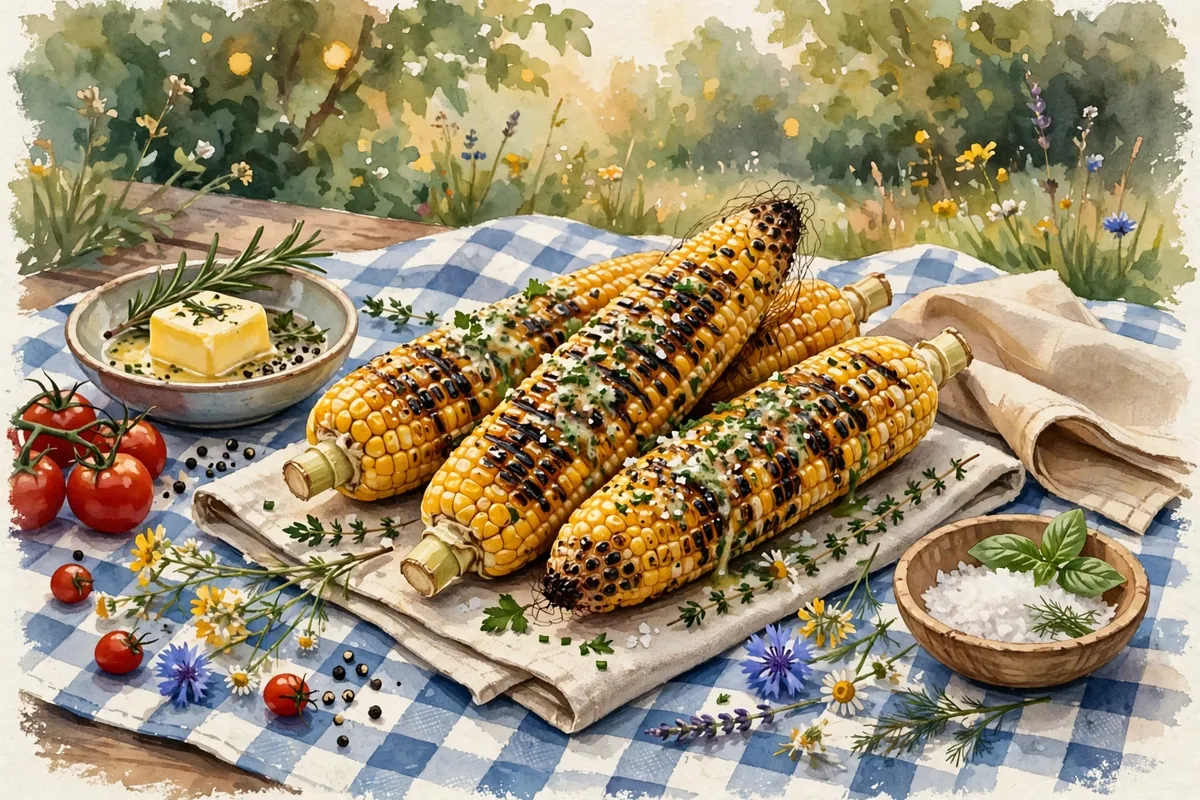
Few things taste more like summer than a hot ear of corn dripping with butter. We pick it up, spin it, and nibble our way down the rows like a typewriter. But that golden cob is the product of thousands of years of patient work by farmers who never saw a grocery store.
Here's the short answer. Corn, or maize, was domesticated by Indigenous peoples in southern Mexico about 9,000 years ago from a wild grass called teosinte. Sweet corn, the kind we eat off the cob, came from a natural mutation and was grown by several Native American tribes. The first recorded sweet corn given to European settlers came from the Iroquois in 1779.
A Wild Grass Gets a Makeover
If you saw teosinte growing by the road, you'd never guess it was corn's ancestor. Maize grows as a single tall stalk, while teosinte is a short, bushy plant. Remarkably, much of the difference between them comes down to just two genes.
Scientists have traced corn's closest wild relative to the Balsas River valley in southwestern Mexico, the likely birthplace of early farming. Stone milling tools with maize residue have been found there in a site about 8,700 years old.
Native Americans often planted corn alongside beans and squash, a system known as the Three Sisters. The three crops grew together in the same field.
How Sweet Corn Was Born
Most corn grown in fields is harvested when the kernels are dry and hard. Sweet corn is different. It comes from a natural mutation that slows the plant's conversion of sugar into starch inside the kernel.
Christopher Columbus brought corn seeds back to Europe in 1493, though early efforts there struggled because people didn't yet know how to grow it well. But sweet corn entered European settlers' gardens when Iroquois growers provided the first recorded sweet corn, called Papoon, in 1779. It soon became a popular food in the southern and central United States.
Why Fresh Corn Tastes Best
Corn on the cob is picked while the kernels are in the "milk stage," still soft and juicy. After picking, the sugar in the kernels starts turning into starch. In just one day, an ear can lose up to 25% of its sweetness. That's why farm-stand corn eaten the same day it's picked tastes so good.
Modern breeders found a way to stretch that sweetness. University of Illinois professor John Laughnan studied a gene that made kernels store less starch and 4 to 10 times more sugar. His work led to supersweet corn varieties.
The Messy Etiquette Question
Corn on the cob has long troubled etiquette experts. In a 1921 etiquette book, Lillian Eichler Watson called it "without a doubt one of the most difficult foods to eat gracefully." She said it was entirely acceptable to use your fingers, holding the ear lightly at each end.
Some etiquette books suggest buttering and salting one section at a time to keep the mess down. Others recommend little skewers pushed into the ends of the cob so you never touch the hot kernels.
Around the world, people enjoy their own versions: elote in Latin America, masala bhutta in India, and yaki-tōmorokoshi in Japan. However you eat it, every ear carries a 9,000-year-old story. Not bad for something you hold with two little forks.