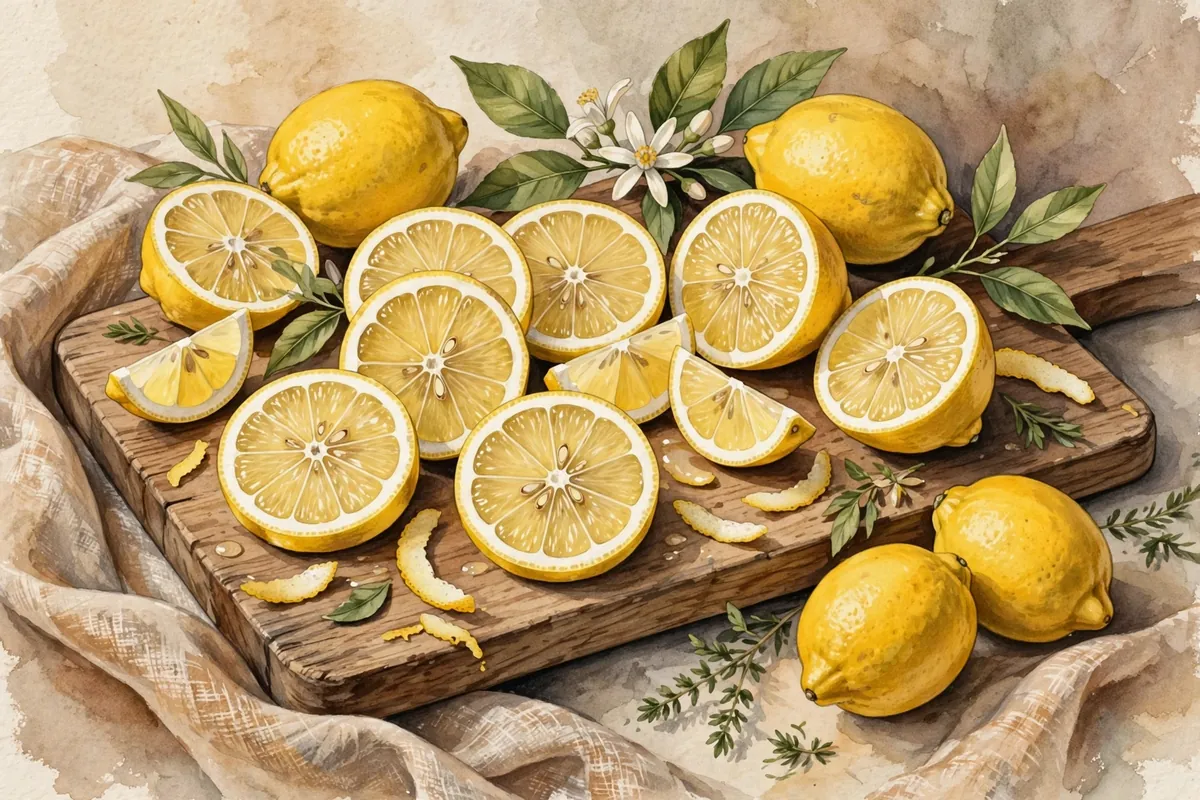
There's a reason people film babies tasting lemons for the first time. One lick, and their little faces scrunch into the most dramatic expression imaginable. Grown-ups aren't much better. Even thinking about biting into a lemon wedge can make your mouth tingle.
Lemons pack a double punch. First, they're loaded with acid. Lemon juice is about 5 to 6 percent citric acid, and acid is exactly what your sour taste cells are built to detect. Second, lemons are somewhat astringent, meaning they contain compounds that leave your mouth feeling dry and puckered. Together, those two effects create that famous lemon face.
How Your Tongue Detects Sour
Sour is one of the five basic tastes, along with sweet, salty, bitter, and savory, also called umami. Sourness is simply the taste of acidity. Besides lemons, you'll find it in limes, grapes, oranges, and tamarind, and in fermented foods like vinegar and yogurt.
Acidic foods are full of tiny charged particles called hydrogen ions. A small group of cells found in all your taste buds can detect them. The ions slip directly into these cells through a special channel, identified in 2018 and called OTOP1. That flow of charge sets off an electrical signal, and your brain registers "sour."
Your mouth also responds by making saliva, which acts as a buffer and helps reduce the acidity of what you're eating. That's one reason sour foods can leave your mouth watering.
The Puckering Part
The tight, dry feeling has its own name: astringency. The word comes from a Latin term meaning "to bind fast." Astringent compounds called tannins grab onto proteins in your saliva and make them clump together, which leaves a rough, sandpapery, puckering feeling in your mouth.
Lemons contain tannins, along with many other natural plant compounds, and they're described as somewhat astringent. You've felt stronger astringency from strong tea, red wine, or an unripe banana. In unripe fruit, it seems to serve a purpose: the unpleasant feel discourages animals from eating the fruit before it's ready.
Just How Sour Is a Lemon?
Lemons are among the sourest common fruits, which is why recipes usually call for just a squeeze. Their juice contains slightly more citric acid than lime juice, nearly twice as much as grapefruit juice, and about five times as much as orange juice. That explains why a glass of orange juice is pleasant to sip while straight lemon juice is a challenge.
Lemons have so much citric acid that, before modern fermentation methods were developed, they were the main commercial source of it. Scientists even rank sourness on a scale using dilute hydrochloric acid as the benchmark, and citric acid scores about half as sour.
A Berry That Flips the Script
Here's a fun oddity. A small African berry called miracle fruit contains a molecule called miraculin. After you eat one, sour foods like lemons and limes taste sweet for a while, because the molecule switches on your sweet receptors when it meets acid.
Lemons have been around a long time too. They reached Europe near southern Italy no later than the second century, during the days of ancient Rome. These days, the juice gives us lemonade and lemon meringue pie, while the zest adds flavor to baked goods.
So the next time a lemon wedge scrunches up your face, you'll know your taste cells and your saliva are both hard at work. It's one of the most dramatic reactions a single fruit can produce.