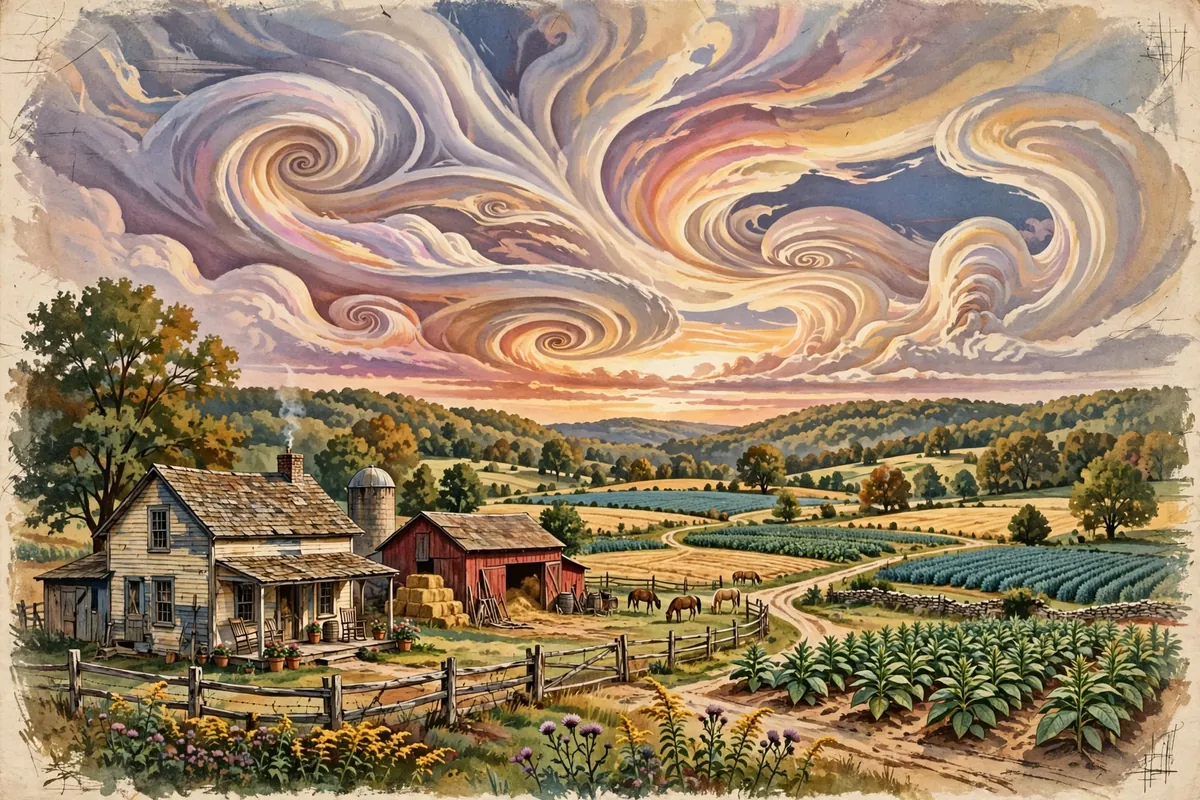
Most of us have heard the old saying about it raining cats and dogs. But on one March morning in 1876, a Kentucky family saw something even stranger fall from the sky. It wasn't rain, hail, or snow. It was meat.
The event is known as the Kentucky meat shower. On March 3, 1876, for several minutes between 11 a.m. and noon, chunks of what looked like red meat fell over an area about 100 yards by 50 yards near Olympia Springs in Bath County. The exact cause has never been proven, but the explanation most locals favored was a flock of vultures throwing up their meals.
"Snowing Meat"
The main witness was a farmer's wife, Mrs. Crouch. She was making soap on her porch when she saw a piece of meat drop from the sky. She later said it was "snowing meat" and that the pieces fell "with a snapping-like noise" when they hit the ground. She and her husband believed it was a sign from God.
Most of the pieces were about 2 inches square, and at least one was about 4 inches square. A local grocer said the smell was extremely offensive. Remarkably, two men tasted the meat. According to the first report in Scientific American, they guessed it might be lamb or venison. The story spread fast, with coverage in Scientific American, The New York Times, and other publications.
Scientists Take a Look
Samples were sent off for study, and the results only added to the mystery. One writer claimed the substance was Nostoc, a kind of cyanobacteria that swells into a jelly-like blob when it gets wet. But writer Charles Fort later pointed out a big problem with that idea: there had been no rain that day.
Further analysis found the samples were real animal tissue. One doctor identified a sample as lung tissue from either a horse or a human infant, noting the two look almost identical under study. Later examination identified two samples as lung tissue, three as muscle, and two as cartilage. Suggestions for what kind of animal it came from ranged from beef and lamb to deer, bear, or horse, but the meat was never firmly identified.
The Vulture Theory
So where did it come from? A humorist at The New York Times joked that it was "cosmic meat" from an exploding planet. Locals had a more down-to-earth answer: vultures. Black vultures and turkey vultures are common in Kentucky, and they're known to vomit, both to lighten up for a quick escape and to defend themselves when threatened.
The idea was that one vulture threw up its meal and the others followed suit. A doctor writing in the Louisville Medical News at the time presented this as the best explanation for the mix of meat types. It's unappetizing, but it fits the evidence better than most. Still, the exact cause remains a matter of speculation.
A Piece Survives Today
Incredibly, a bit of the meat still exists. In 2004, an art professor at Transylvania University in Lexington, Kentucky, found a sample while clearing out old collections. It sits in alcohol inside a small glass vial with a faded label reading "Olympia Springs." It's widely believed to be the last surviving sample, and it's kept at the university's Moosnick Medical and Science Museum.
Almost 150 years later, the Kentucky meat shower is still one of the oddest weather reports in American history. If you ever find yourself in Bath County on a clear spring day, it might not hurt to glance up, just in case.