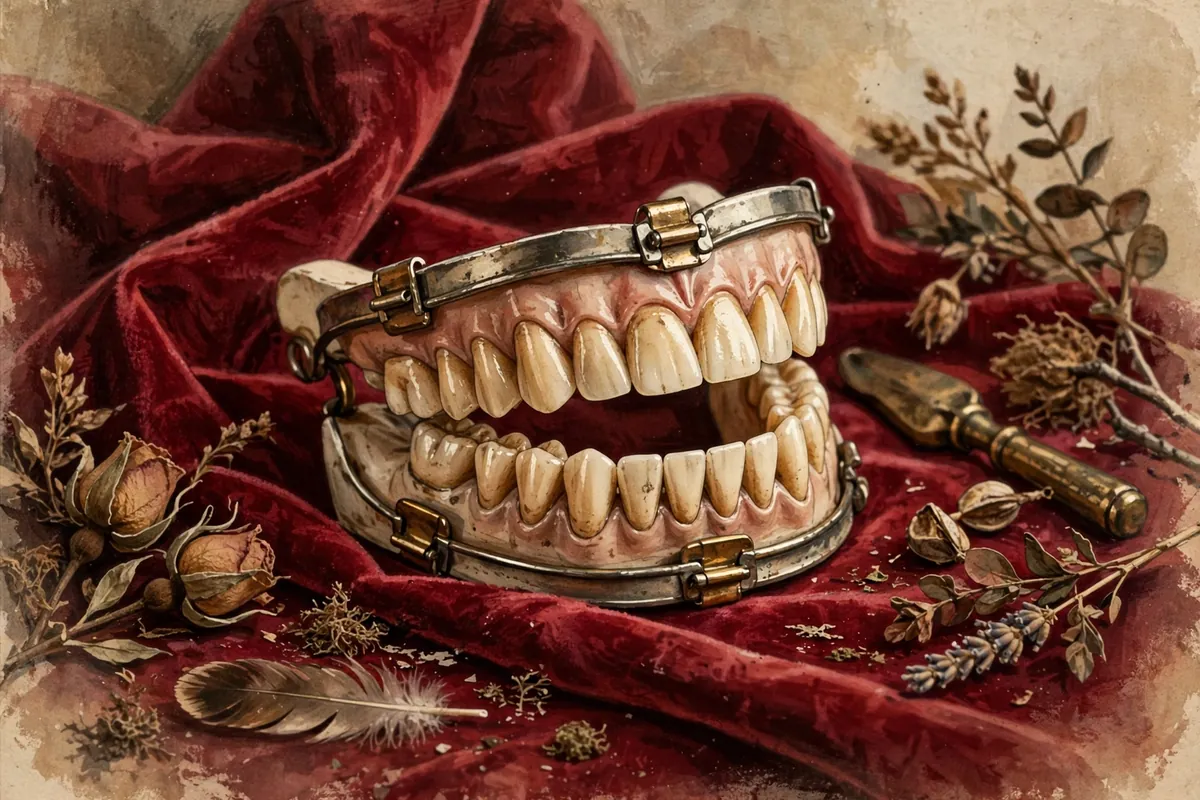
It's one of the most famous stories about America's first president. George Washington, the man who crossed the Delaware and led a new nation, supposedly had a mouth full of wooden teeth. For many of us, it's one of the first things we ever learned about him. But was it true?
Not at all. Washington really did struggle with his teeth, and he really did wear dentures, but they contained no wood. His dentures were made from materials such as hippopotamus ivory, brass, gold, lead, animal teeth, and human teeth. By the time he became president in 1789, he had lost all but one of his own teeth.
A Lifetime of Tooth Trouble
Washington's dental problems started early. He was already wearing partial dentures by 1781, during the Revolutionary War. Over his life, he had at least four sets of dentures, and he spent constant effort keeping them in working order.
These weren't the comfortable dentures of today. They had metal fasteners, springs to force them open, and bolts to hold them together. According to his diaries, they disfigured his mouth and often caused him pain, for which he took laudanum, a common painkiller of the era.
He took the oath of office wearing a special set made of ivory, brass, and gold, built by his dentist, John Greenwood of New York City. Washington trusted Greenwood so much that he gave him his very last natural tooth as a keepsake.
Look Closely at Your Dollar Bill
Washington knew the dentures changed his appearance. He once wrote that his lips would bulge in an unnatural way. In a letter to Greenwood, he asked him to avoid any change that would force his lips out more than they already were.
You can see that effect for yourself. The portrait on the one-dollar bill comes from an unfinished 1796 painting by Gilbert Stuart, known as the Athenaeum Portrait. The slightly puffed look around Washington's mouth is thought to reflect his dentures. Some historians think discomfort from his teeth may show in other portraits from his time in office, too.
So Where Did the Wood Come From?
The wooden teeth story was widely accepted by historians in the 1800s, and it appeared as fact in school textbooks well into the 20th century. Yet nobody has ever found evidence that his dentures contained wood.
One likely explanation is staining. Ivory teeth discolor quickly, and to people looking at them, they may have looked like wood. A 1798 letter from Greenwood even scolded Washington about cleaning. He said a set sent from Philadelphia was very black, and blamed port wine for taking off all the polish.
A Darker Part of the Story
There's an uncomfortable chapter here, too. Records at Mount Vernon show that in May 1784, Washington paid several enslaved people 122 shillings for nine teeth, to be implanted by a French dentist named Jean-Pierre Le Mayeur, who was a frequent guest at the plantation.
It's unknown how much of that money the enslaved people actually received, or whether they were pressured to sell. Historians also disagree about whether the teeth were for Washington himself or for Le Mayeur's dental practice. Selling teeth was an old practice; poor people in the Western world had done it since the Middle Ages, and the teeth went to wealthier buyers.
Today, the only complete surviving set of Washington's dentures belongs to the Mount Vernon Ladies' Association, which runs his Virginia estate. Another original lower denture from 1795 is at the National Museum of Dentistry in Baltimore.
So the next time someone mentions Washington's wooden teeth, you'll know better. The real story is less tidy and more human: a powerful man in constant pain, doing his best with the strange, clunky dentures of his day.