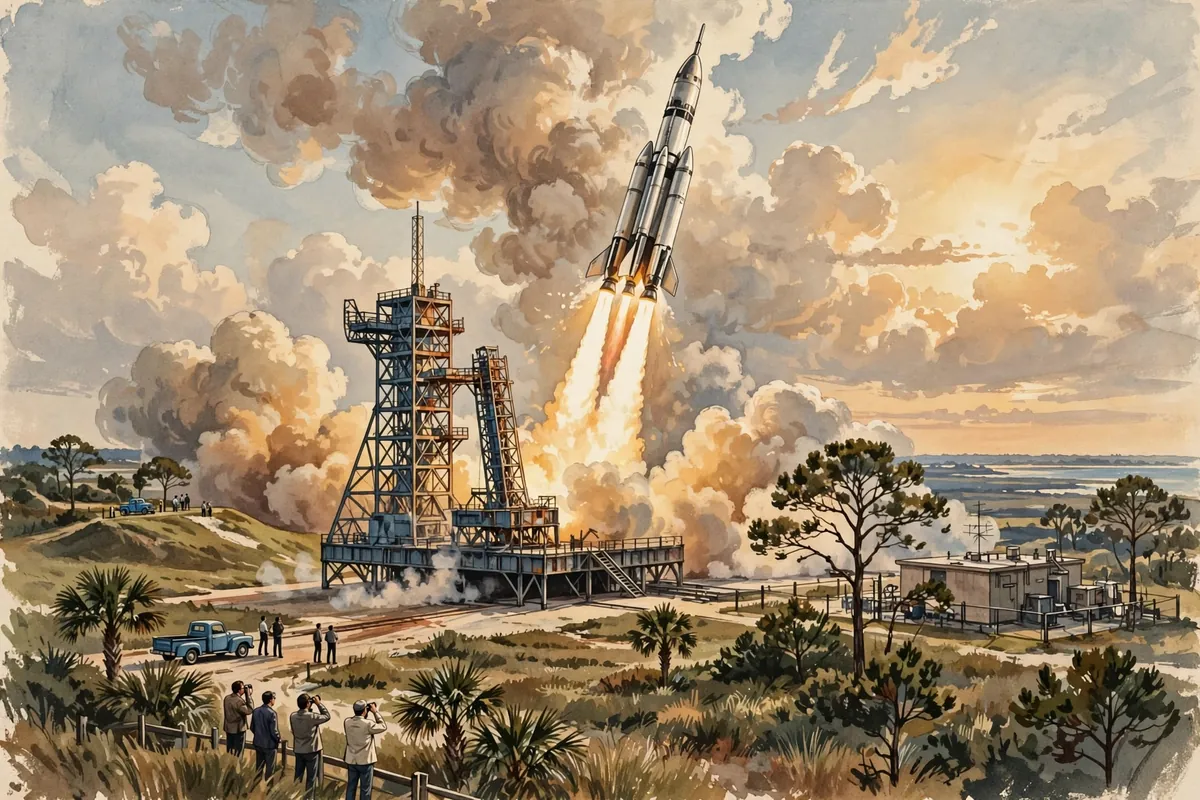
On the morning of July 22, 1962, an Atlas-Agena rocket rose from Cape Canaveral carrying Mariner 1, a spacecraft meant to make America's first flyby of Venus. A few minutes later, it was gone, blown up on purpose over the Atlantic. What went wrong?
The short answer: a tiny mistake in the math. A small bar symbol was left out of the hand-written guidance equations, and that error made its way into the computer program that steered the rocket from the ground. When a hardware problem hit during the flight, the faulty program overreacted, sent the rocket off course, and forced safety officers to destroy it.
Five Minutes of Trouble
The launch went exactly to plan at first. Then the guidance system began sending bad steering commands, making the rocket fishtail left and right. Its path started pointing downward and to the left, raising the risk that it could come down in busy Atlantic shipping lanes.
At 9:26 a.m., about five minutes after liftoff, a range safety officer ordered the rocket to self-destruct. It was just six seconds before the upper stage would have separated, after which destroying it would no longer have been possible. The spacecraft kept sending signals for another minute and a half.
The Missing Bar
After five days of analysis, engineers found the cause: an error in the guidance computer's logic combined with a hardware failure. The equations used a value written with a bar over it, a mark that meant the computer should use a smoothed, averaged reading. Without that bar, the program used raw, jumpy numbers instead.
That mistake had been hiding in plain sight. The same logic had worked fine on earlier launches, because the equipment it relied on had never failed before. On Mariner 1, the rocket briefly lost its guidance connection with the ground, which was fairly common. When the link came back, the flawed program decided the speed was swinging wildly and tried to correct it, which created the very wild swings it was worried about.
The Most Expensive Hyphen?
Newspapers loved the story. The New York Times ran the headline “For Want of Hyphen, Venus Rocket Is Lost,” and science fiction writer Arthur C. Clarke called it “the most expensive hyphen in history.”
It made a great line, but it wasn't quite right. The missing mark wasn't a hyphen at all. It was a short line drawn over a symbol in the equations, known as an overline. Still, the lesson stuck: one tiny slip could bring down an entire mission. The accident is often cited as an example of why careful checking of computer code matters so much, and it helped shape the field of software engineering.
A Happy Ending for the Twin
Luckily, NASA had a backup, and timing was everything. Earth and Venus line up for the most fuel-efficient trip only about every 19 months, so waiting wasn't a good option. Mariner 2, an exact copy of Mariner 1, launched on August 27, 1962. That December it passed within about 21,600 miles of Venus and became the first robotic probe to successfully report back from a visit to another planet.
So one missing mark cost NASA a rocket, but not the race to Venus. And somewhere, every proofreader who has ever caught a typo can feel just a little bit vindicated.