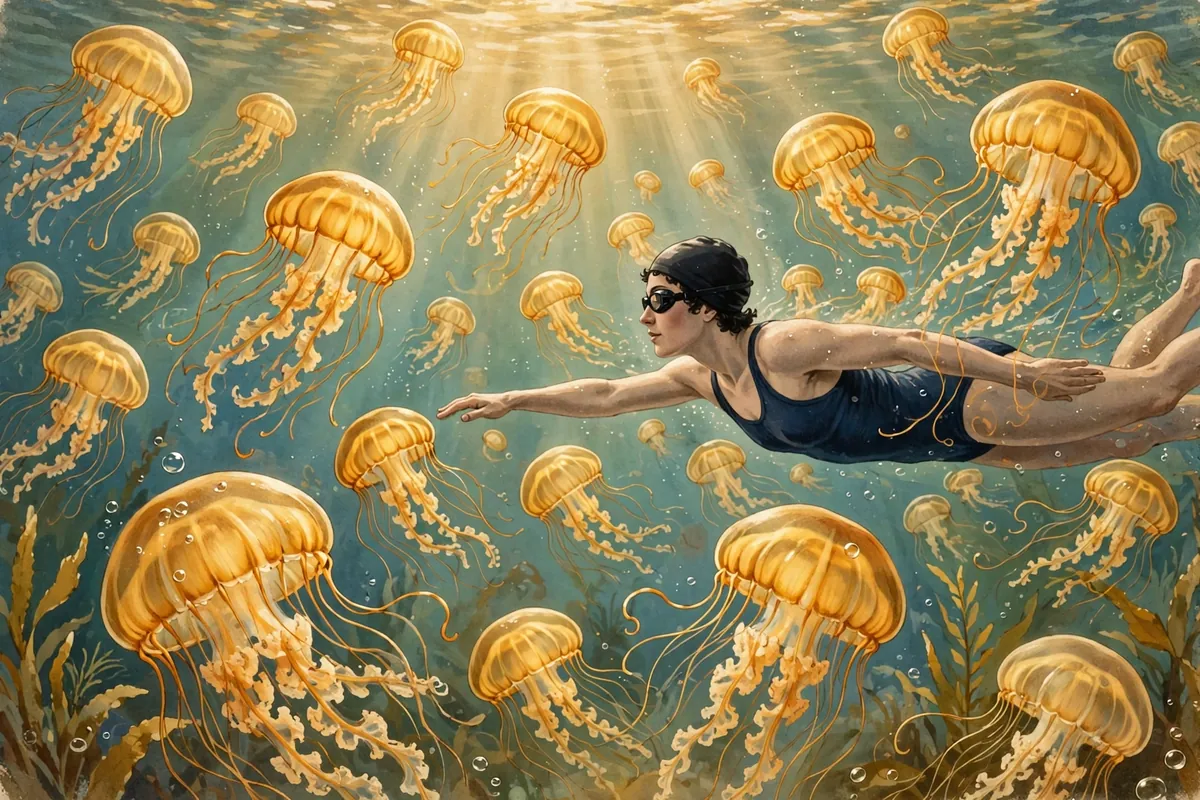
For most beachgoers, the word jellyfish means one thing: get out of the water. But on a small island in the Pacific nation of Palau, people pay to swim right into the middle of a jellyfish swarm. Millions of golden jellies drift around them like living lanterns.
You'll often hear that the jellyfish in Jellyfish Lake don't sting. That's not quite right. Both kinds of jellyfish in the lake, golden jellyfish and moon jellyfish, do have stinging cells. Their stings just aren't, in general, powerful enough to harm humans, though some people report feeling them on sensitive spots like around the mouth.
A Lake Cut Off From the Sea
Jellyfish Lake sits on Eil Malk, one of Palau's Rock Islands, a group of small, rocky and mostly uninhabited islands. It's a marine lake, meaning it holds salt water, and it's connected to the ocean only through cracks and tunnels in ancient limestone reef.
The lake is about 12,000 years old and roughly 100 feet deep. Around that time, rising sea levels at the end of the last ice age began filling its basin with seawater. Cut off from the open lagoon for so long, its golden jellyfish evolved to look and behave noticeably differently from their spotted cousins living nearby. The lake's moon jellyfish are special too. Genetic testing suggests they belong to a hidden species shared with a few other Palau lakes, one that hasn't interbred with its relatives for millions of years.
Jellyfish That Farm Their Own Food
Golden jellyfish get part of their nutrition from tiny algae living inside their bodies. Like plants, the algae need sunlight. So the jellyfish spend their days chasing it.
Every day, millions of them migrate across the lake, following a regular schedule. As they swim near the surface, they rotate counterclockwise, which scientists think gives their algae even exposure to the sun. At night, they repeatedly dive down and back up, possibly to collect nutrients for their algae.
Their route may also be a matter of survival. Jellyfish-eating sea anemones live along the eastern part of the lake. The jellies instinctively avoid shadows, and researchers think their timing helps them steer clear of the anemones' shady hunting grounds.
Why Divers Stay Near the Surface
Jellyfish Lake has a hidden danger, and it isn't the jellyfish. The lake is split into two layers that never mix. The top layer has oxygen, but below about 49 feet, the water has none.
That deep layer contains hydrogen sulfide, a highly toxic gas that can be absorbed through the skin. That's why scuba diving into the depths is a serious risk. Snorkelers who stay in the upper layer, where hydrogen sulfide levels are reported to be zero, aren't at risk from it.
The Year the Jellyfish Vanished
In late 1998, the golden jellyfish suddenly disappeared. By December, the population of adult jellies had dropped to zero. Researchers concluded the most likely cause was an El Niño weather event that warmed the water so much that the algae the jellyfish depend on could not survive.
The jellyfish eventually returned, and snorkeling in the lake remains a popular trip from Palau's main town of Koror, about a 45-minute boat ride away. It's a gentle reminder that even a jellyfish that barely stings still deserves a little respect.