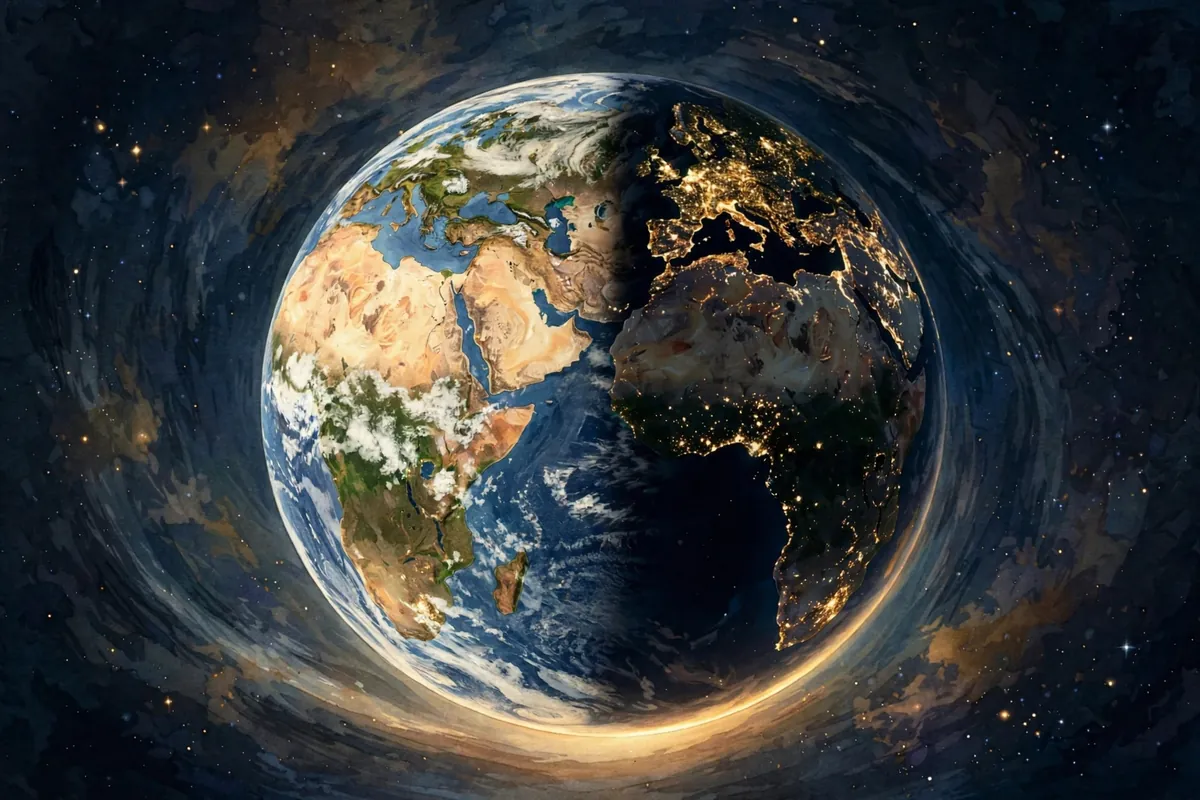
Right now, you might be sitting quietly with a cup of coffee. It certainly doesn't feel like you're going anywhere. But the ground under your feet is moving fast, because the whole planet is spinning, and it's carrying you along for the ride.
Here's the answer. At the equator, Earth's spin moves the surface at about 1,040 miles per hour. The farther you go toward the North or South Pole, the slower you go, until the speed drops to essentially zero at the poles themselves. In the lower 48 states, the speed ranges from roughly 680 to 940 miles per hour.
Why Your Speed Depends on Where You Live
Earth makes one full turn in about a day. Strictly speaking, one spin measured against the distant stars takes 23 hours, 56 minutes, and 4 seconds; the extra few minutes in our 24-hour day come from Earth moving along its path around the Sun. Someone on the equator travels the planet's full waistline, about 24,900 miles, in that time. That's how you get a speed of more than 1,000 mph.
As you move north or south, the circle you travel each day gets smaller, so you don't have to move as fast to keep up. At 45 degrees latitude, which runs through places like Minnesota and Oregon, the speed is about 736 mph. At Kennedy Space Center in Florida, it's about 914 mph.
That extra speed near the equator is so useful that it's a consideration when choosing where to build spaceports. A rocket launched eastward gets a little head start from the planet's spin.
Why Don't We Feel It?
If we're moving that fast, why isn't the wind howling in our ears? The answer is that everything is moving together: you, the air, the oceans, your house, and your coffee cup. And the speed is steady.
Think of a smooth airplane flight. Once the plane is cruising at a steady speed, you can pour a drink without spilling it. You only feel motion when speed or direction changes quickly, and Earth's spin is about as smooth as it gets.
How We Proved It
People argued about Earth's motion for thousands of years. Some Greek thinkers in the fourth century BCE suggested the Earth rotates. But a famous demonstration came in 1851, when French physicist Léon Foucault hung a heavy brass ball from the top of the Panthéon in Paris on a wire about 220 feet long.
As the pendulum swung, the direction of its swing seemed to slowly turn, about 11 degrees an hour in Paris. In reality, the pendulum kept swinging the same way while the Earth turned beneath it. Foucault pendulums now swing in museums around the world.
Our Days Are Getting Longer
Earth's spin isn't perfectly constant. It's slowing down very gradually, mostly because of the Moon's tidal pull. Atomic clocks show the day growing longer by about 1.7 thousandths of a second per century. You'll never notice it, but over millions of years it adds up.
Way back in Earth's early history, days were much shorter. If a leading theory about how the Moon formed is correct, Earth may once have spun so fast that a day lasted about five hours.
So the next time someone says you've been sitting around all day, you can tell them the truth. You've actually traveled thousands of miles without leaving your chair.