Most of us picture flowers as delicate things: a rose on the table, daisies in the yard. Then there's Rafflesia arnoldii. Its single bloom can stretch about 3 feet across and weigh up to 24 pounds, and it greets visitors with a powerful stench. So what is this thing?
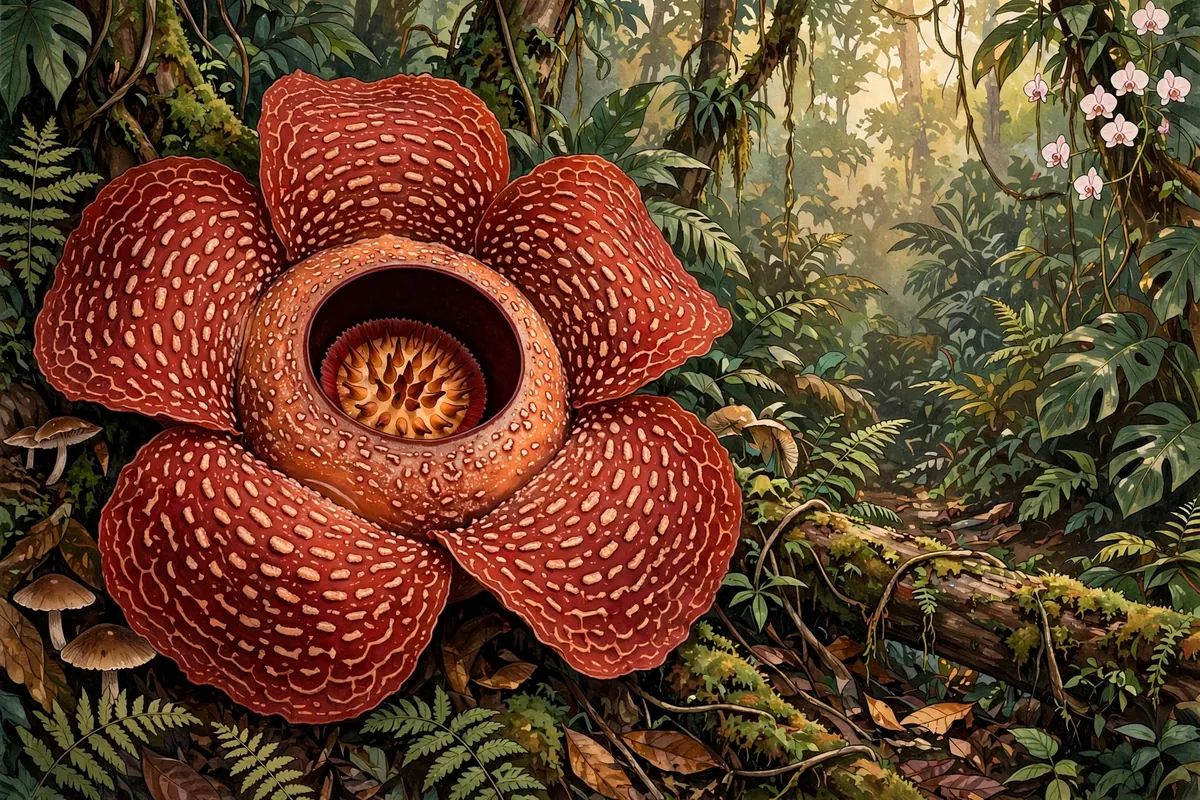
Rafflesia arnoldii produces the largest individual flower on Earth. It grows in the rainforests of Sumatra and Borneo, and it's often called the corpse flower because it smells like decaying flesh. Stranger still, it's a parasite. It has no leaves, stems, or roots of its own and lives hidden inside a host vine until it's ready to bloom.
How Big Is It, Really?
A typical Rafflesia arnoldii flower grows to about 3 feet 3 inches across. The largest one measured reached about 3 feet 9 inches. The flowers are reddish-brown with white spots, and they emerge from big, cabbage-like buds, usually about a foot wide.
You may have heard that another plant, the titan arum, has a bigger flower. It does have a larger flowering structure, but that's actually a cluster of many small flowers. For a single flower, Rafflesia holds the title.
A Plant That Lives Inside Another Plant
Rafflesia is about as unusual as plants get. It has no chlorophyll, the green substance most plants use to make food from sunlight. Instead, it lives as a parasite inside vines of the genus Tetrastigma.
Much like a fungus, it grows as a mass of thread-like strands woven through the host vine's tissue, taking water and nutrients from it. You can't see it at all until it's ready to reproduce. Then a tiny bud pushes out of the vine and develops over many months before opening. One observer even reported that the flower opens with a hissing sound.
Why It Smells So Bad
That awful smell has a purpose. It attracts carrion flies, which normally lay eggs on dead animals. Scientists have found the odor comes from sulfur compounds that are also found in decomposing matter.
The flies are fooled by the smell and the meaty color of the flower. As they visit, they carry pollen from bloom to bloom. There's a catch, though: each flower is either male or female, so a fly has to visit a male flower and then a female one. After all those months of growing, a flower lasts only a few days.
A Tangled Discovery Story
The flower is named after Stamford Raffles, the British official who led the 1818 expedition in Sumatra where it was collected, and Joseph Arnold, the surgeon who collected the specimen. Arnold caught a fever and died soon after.
But a Frenchman may have gotten there first. Explorer Louis Auguste Deschamps collected a Rafflesia on Java in 1797, probably a related species. His notes were seized by the British during a war, lost, and not rediscovered until 1954.
Even the name caused a squabble. Another British naturalist, William Jack, actually published a name for the plant first, Rafflesia titan, in 1820, possibly rushing so the French couldn't beat him. The name chosen by the more famous botanist Robert Brown, arnoldii, is the one that stuck.
Today, Rafflesia arnoldii is one of Indonesia's three national flowers. It's proof that nature doesn't always aim for pretty. Sometimes it goes for huge, rare, and unforgettable, especially to anyone standing downwind.