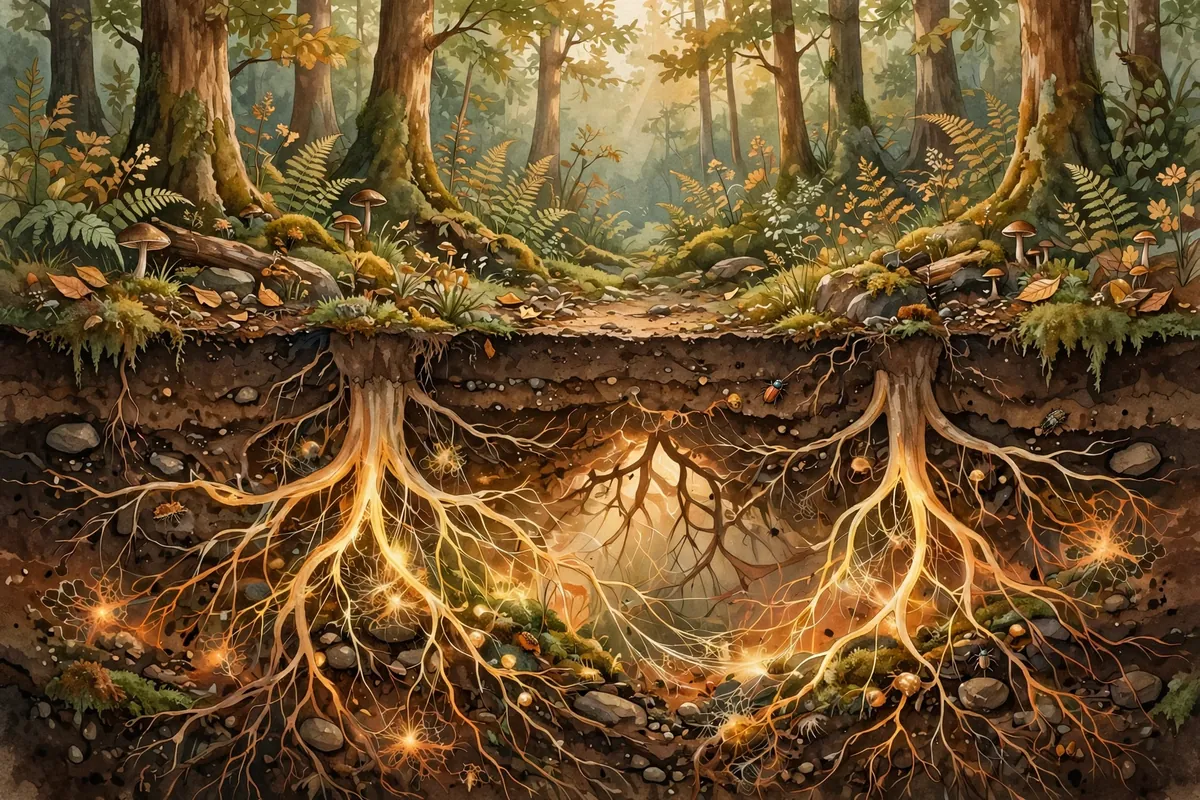
It's one of the most charming nature stories of recent years. Beneath every forest, the story goes, trees are linked by a vast underground web of fungi. Through it, big 'mother trees' feed their young, and trees under attack warn their neighbors. Some call it the Wood Wide Web.
So is it true? Partly. The fungal networks are real. Fungi really do link up with plant roots, trading water and nutrients for sugar, and they can connect neighboring plants. But many of the bigger claims, that these networks are everywhere in forests, that trees routinely share food through them, and that they pass along warnings, have been criticized by scientists as not strongly supported by evidence. The truth is fascinating, just a little less tidy.
The Real Partnership Underground
Most plants team up with fungi in a relationship called mycorrhiza, from Greek words for fungus and root. Thread-like fungal filaments called hyphae grow into or around plant roots. The plant supplies the fungus with sugars or fats it makes through photosynthesis. In return, the fungus gathers water and minerals like phosphorus and nitrogen from the soil.
This partnership is ancient and widespread. There's fossil evidence that early land plants, which didn't even have true roots, formed these associations. The most common type is found in about 70 percent of plant species, including many crops like grains and beans.
The Scientist Behind the Big Idea
The idea of a forest-wide network was made famous by Suzanne Simard, a forest ecology professor at the University of British Columbia in Canada. Her family had worked as foresters for generations. In 1997, her research showed that trees could be linked by underground fungal networks.
In one study, Simard watched as a Douglas fir injured by insects appeared to send chemical warning signals to a nearby ponderosa pine, which then produced defense enzymes. Her 2016 TED Talk and her 2021 book Finding the Mother Tree brought the idea to millions of people.
Why Some Scientists Push Back
In 2023, three publications by experts in the field argued that some popular claims had gone beyond what researchers had actually observed in real forests. These included the ideas that the networks are widespread, that they help seedlings, and that older trees favor younger ones. The authors also suggested that scientists citing each other's positive results may have helped overstate the case. Simard responded to the criticism in 2025.
Part of the problem is that this is genuinely hard to study. A real forest has many species of plants and fungi all interacting at once, which makes it difficult to prove what flows where. Simple lab experiments, meanwhile, don't match anything found in nature. And the relationships themselves can shift, sometimes helping a plant and sometimes harming it.
Plants Do 'Talk' Through the Air
Here's something on firmer ground. Many plants release airborne chemicals called volatile organic compounds. In one study, when caterpillars chewed on tomato plants, the plants released chemicals that triggered responses in neighboring tomato plants within seconds.
Another experiment showed that a parasitic plant called dodder grows toward the scent of tomato plants and can even tell tomato from wheat by smell. So plants do send and sense signals, just not always in the dramatic way the stories suggest.
So the next time you walk through the woods, you can still marvel at what's happening beneath your feet. Roots and fungi really are working together down there. Exactly how much the trees are 'talking' is one of the forest's best open questions.