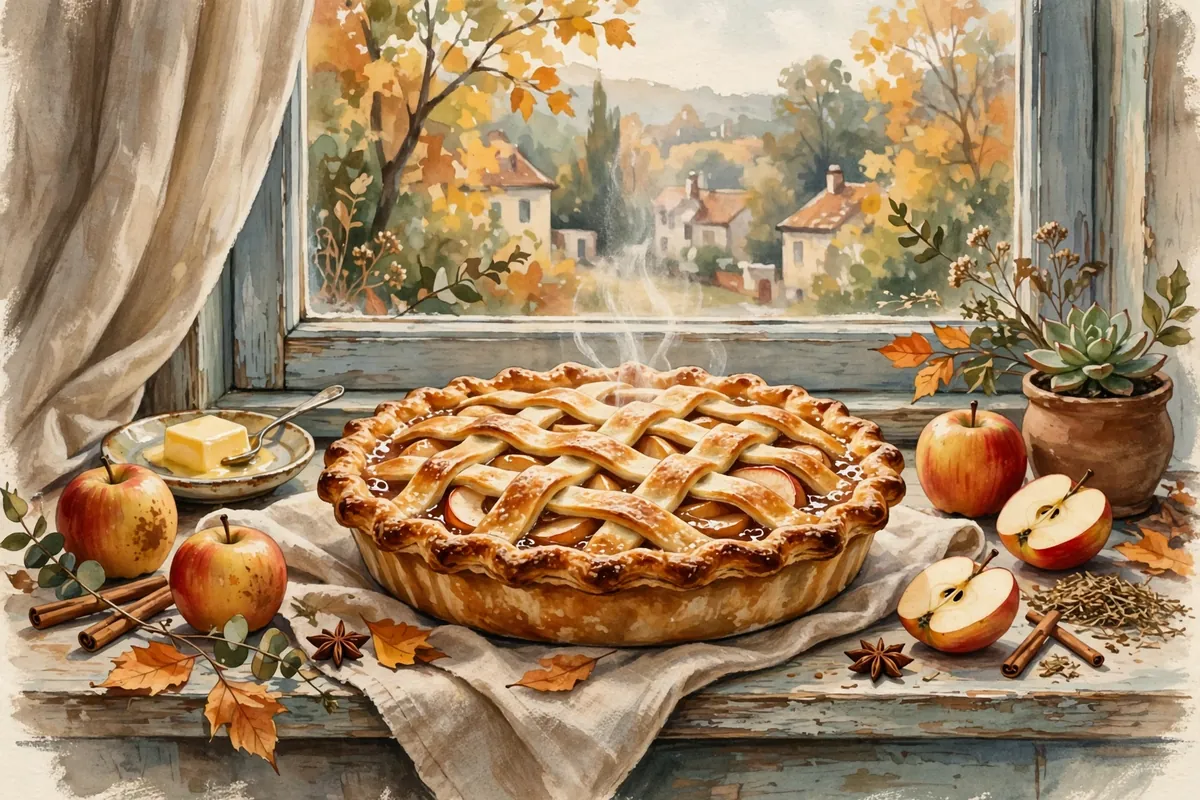
Few foods carry as much meaning as apple pie. It's on Thanksgiving tables, at county fairs, and in that old saying about anything truly typical of the U.S.: "as American as apple pie." So it may come as a surprise that apple pie was being baked long before America existed.
Here's the short answer: apple pie was first recorded in 14th-century England. English, Dutch, and Swedish settlers brought it to the American colonies in the 1600s and 1700s. Over the next two centuries, Americans made it their own, and by the 1900s it had become a symbol of national pride.
A Medieval Pie With Figs and Saffron
One of the earliest recipes appears in a 14th-century English cookbook called The Forme of Cury. It called for good apples, good spices, figs, raisins, and pears, all baked in a pastry case known as a cofyn. Saffron gave the filling a golden color.
The Dutch were baking apple pie early too. A Dutch cookbook printed in 1514 includes a recipe for appeltaerten. After baking, the cook cut open the top crust, stirred in spices like cinnamon, ginger, nutmeg, and cloves, mixed in cream, and slid it back into the oven.
A Slow Start in the New World
When colonists arrived in North America, there was one big problem: there were no native apples except small, sour crabapples. Settlers had to plant European apple varieties and wait for the trees to grow and bear fruit.
Even then, early colonists were more likely to bake meat pies, and many of the first apples went into cider. American apple pie recipes do show up in the 1700s, though. America's first cookbook, American Cookery by Amelia Simmons, published in 1796, included two of them.
Apples also behaved differently in America. They are usually grown by grafting, creating copies of a known variety. In the New World, planting from seeds worked better, and that led to hundreds of new native apple varieties.
How It Became All-American
During the Civil War, Rhode Island officers celebrated the Fourth of July with apple pie during the Siege of Petersburg. In the 19th and 20th centuries, it became a symbol of American prosperity. A newspaper in 1902 declared that "No pie-eating people can be permanently vanquished."
"Mom and apple pie" became shorthand for Americana, and soldiers in both world wars loved it. By the 1970s, advertisers had locked in its place in American culture. In 1968, McDonald's introduced a deep-fried apple pie inspired by a dessert from the American South, later switching to a baked version in 1992.
Pie Traditions Old and New
American apple pies tend to be sweeter than European ones, thanks to more sugar in the recipe. Some old habits have stuck around, too. Serving a slice with sharp cheddar cheese on top dates back to 17th-century England, and it's still popular in parts of the U.S. and Canada with lots of dairy farms, such as New England. Canada has its own twists, including Dutch apple pie and an apple maple pie made with maple syrup.
So apple pie may not have been born in America, but Americans have loved it so long and so well that it truly earned its place. Next time you take a slice, you're enjoying a recipe with more than 600 years of history baked right in.