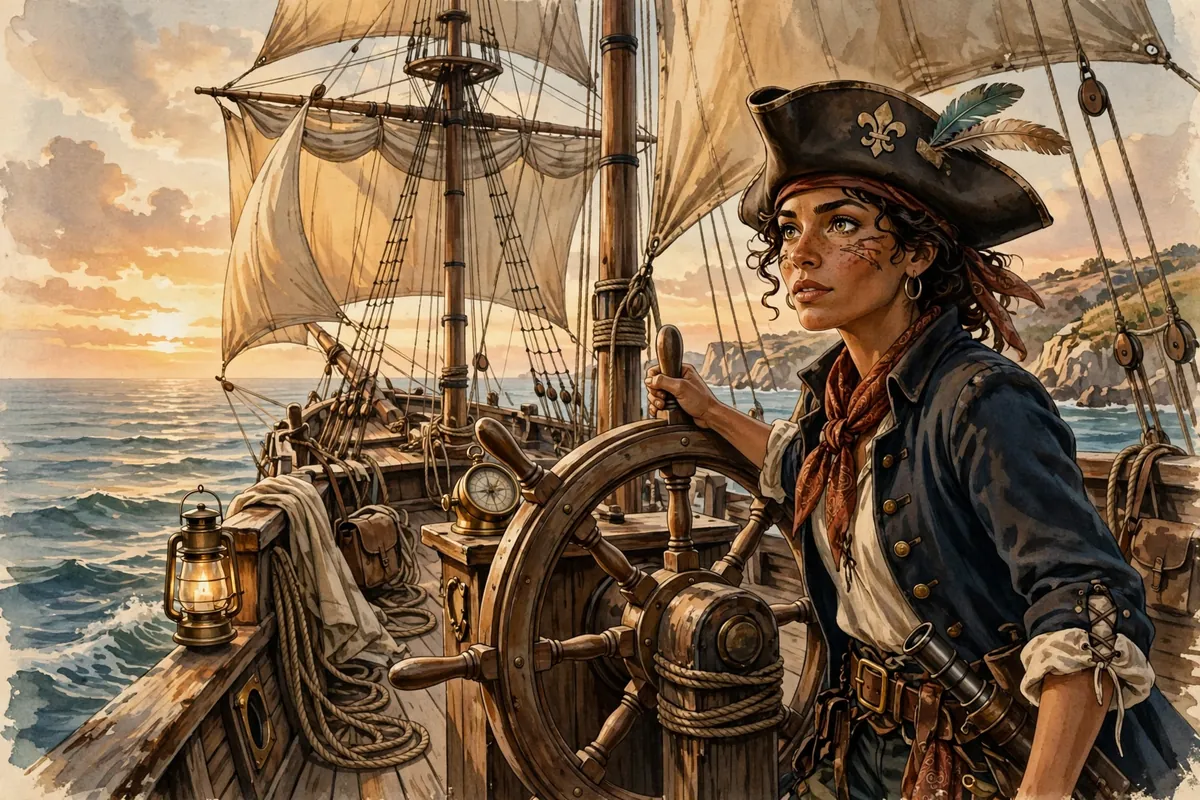
Pirate stories are usually full of bearded captains and rough-talking men. But one of the most famous pirates of the Golden Age of Piracy was a woman named Anne Bonny. Nearly 300 years later, she's still one of the best-known pirates in history.
The short answer: Anne Bonny was real, and she really was a pirate. In 1720 she sailed with the pirate captain John Rackham, along with another woman, Mary Read. But much of what people "know" about her, from her childhood to her later life, comes from unreliable books and even a novel. The confirmed facts are fewer, though still remarkable.
What the Records Show
Anne Bonny was among the few recorded female pirates of her era. At some point she went to the Bahamas, where she met Rackham. In August 1720 she joined his crew, and on August 22 the crew stole a sloop called the William from the harbor at Nassau.
Rackham's crew attacked a number of merchant ships in the West Indies. Their run ended on October 22, 1720, when a sloop captained by former privateer Jonathan Barnet found them near Negril Point in Jamaica. The pirates briefly resisted, then surrendered.
Dressed for Battle
Were Bonny and Read in disguise? A pirate victim named Dorothy Thomas described them at the trial. She said the two women wore men's jackets, long trousers, and handkerchiefs tied around their heads, and each carried a machete and a pistol.
But Thomas also said she could tell they were women. So while they dressed like the men aboard, the records don't show them fooling everyone into thinking they were male.
A Trial and a Narrow Escape
Rackham and the male crew members were tried, convicted, and executed. Bonny and Read were tried together in Spanish Town, Jamaica, on November 28, 1720. After four witnesses and a brief discussion, the governor found them guilty and sentenced both to hang.
Then came a twist. Both women said they were pregnant, and their executions were put on hold. Mary Read died in jail around April 1721. Bonny was probably released at some unknown point.
A burial register in Jamaica lists an "Ann Bonny" buried on December 29, 1733, with no family noted and no tombstone. If that's her, she may have lived out a quiet life in Jamaica after her pirate days.
Where the Legend Came From
Most of the colorful details about Bonny trace back to a 1724 book called A General History of the Pyrates by Captain Charles Johnson, which historians consider greatly unreliable. It claimed she was born in Ireland, the daughter of an attorney and his servant, but there is little evidence to support that.
Other popular details came later still. The names often given for her parents first appeared in a 1964 romance novel. Claims that she was rescued by family and lived on in the American colonies until 1782 relied on supposed family papers that were later shown to be false. Even the famous story that she and Read fought alone during the capture isn't supported by the trial record.
Still a Legend Worth Telling
Strip away the inventions and Anne Bonny is still an extraordinary figure. She was a woman who joined a pirate crew, sailed the Caribbean, stood trial, and walked away from a death sentence.
The real story may be shorter than the legend, but it doesn't need much decoration to be unforgettable.