Today we take hundreds of photos without thinking twice. But somebody had to be first, and the very first person known to appear in a surviving photograph didn't pose, smile, or even know he was in it. He was simply standing on a Paris street corner at the right moment.
The picture is called Boulevard du Temple, taken by French inventor Louis Daguerre in 1838, or possibly 1837. It shows what looks like an empty street. But in the lower left corner, you can make out a man having his boots polished. He and the boot shiner are widely considered the first people ever captured in a photograph that still survives.
Why the Busy Street Looks Empty
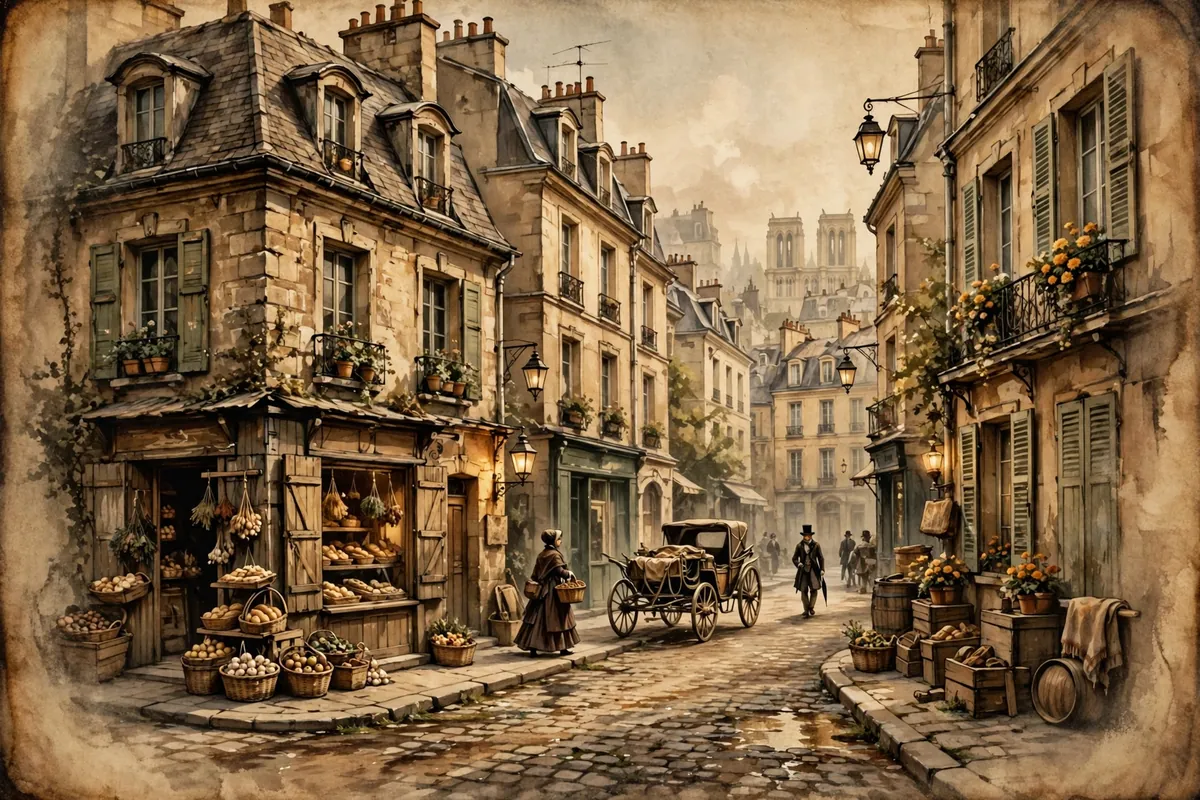
The Boulevard du Temple would have been crowded with people and horse-drawn traffic. So where did everyone go? The answer is exposure time. Daguerre's process needed about four to five minutes to record an image.
Anything that moved during that time simply blurred into nothing. Walkers, carriages, and horses passed through without leaving a trace. The man getting his boots shined, though, stood in one spot long enough for the plate to catch him. Some have suggested the second figure might actually be a water pump, but the man with his raised foot is clear.
That was actually fast for the time. The oldest surviving photograph of any kind, taken by Nicéphore Niépce in 1827, is traditionally thought to have needed about eight hours of exposure. With that method, only buildings and other still objects could be recorded.
Taken From a Studio Window
Daguerre took the shot at 8 o'clock in the morning from a window of his studio in Paris. He made other plates of the same view that day, one at midday that survives and one in the evening that has been lost. The plate is only about 5 by 6 inches, and like all of Daguerre's plates, the image is a mirror image of the real scene.
People have studied it closely for other hidden figures. There may be faint traces of other people, a horse, and possibly a child looking out of a window.
A Picture With a Rough Life
Daguerre announced his invention to the French Academy of Sciences in January 1839. That March, he showed this very image to Samuel Morse, the American inventor of Morse code, who described it in a letter published in a New York newspaper.
Later in 1839, Daguerre gave a framed set of three of his pictures, including this one, to King Ludwig I of Bavaria. A German magazine at the time marveled at the man having his boots polished, who "must have been standing extremely still."
The original plates slowly deteriorated in storage. An American photography historian, Beaumont Newhall, rediscovered them in the 1930s and made copies. That was lucky, because a restoration attempt in the 1970s went badly and damaged the originals even further. Today's reproductions come from Newhall's copies.
The First Selfie
The man on the boulevard was photographed by accident. The first person to deliberately photograph himself may have been an American, Robert Cornelius of Philadelphia. In 1839 he made a self-portrait outside his family's store, holding still for 10 to 15 minutes. It's generally accepted as the oldest surviving photographic portrait of a person taken in the United States.
So the next time you snap a quick picture of your grandkids, think of that patient gentleman in Paris. He never knew it, but by standing still for a shoeshine, he became the first face in the long family album of photography.