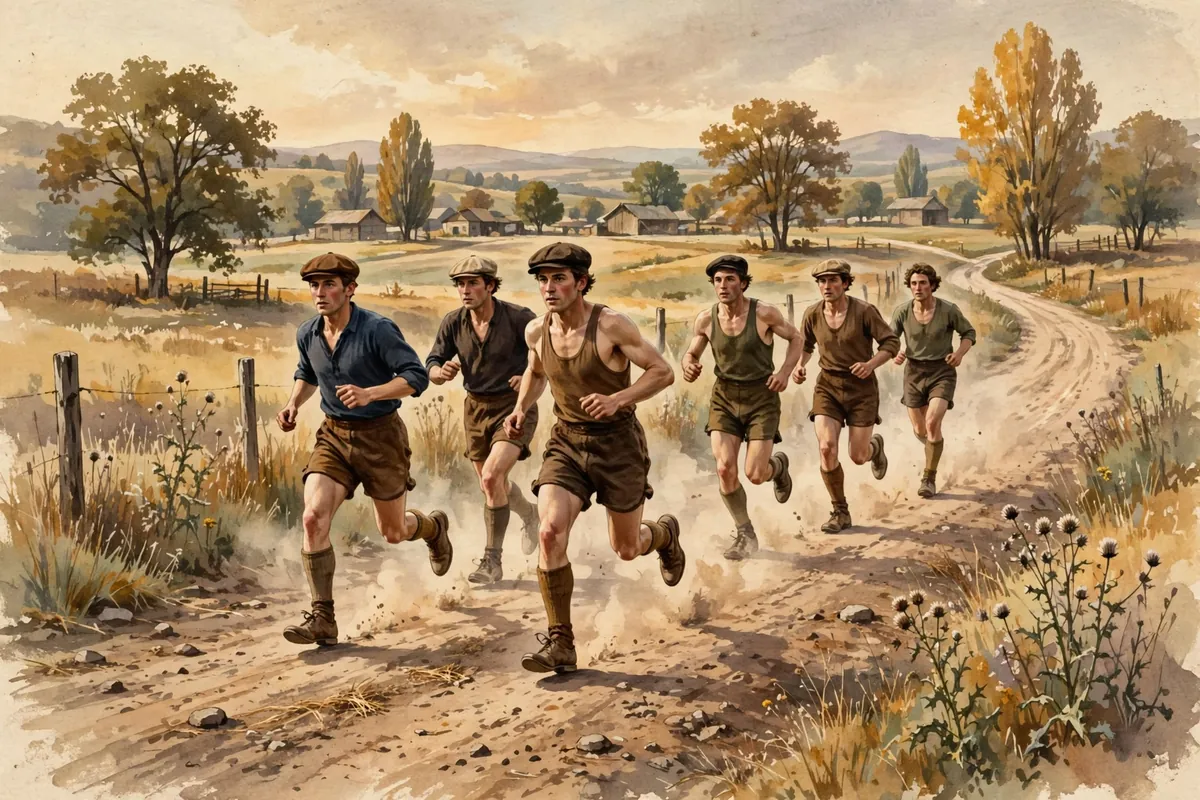
Picture an Olympic marathon run in the heat of a Missouri afternoon, on dirt roads, with cars kicking up dust in the runners' faces. Now add a fake winner, a real winner who was barely conscious, and a man who stopped for a nap. That was the men's marathon at the 1904 Olympics in St. Louis.
Here's why it's called the strangest race ever. It was badly organized from start to finish. The first man to cross the line had ridden part of the way in a car. The official winner, Thomas Hicks, was hallucinating by the end after his trainers gave him strychnine, a rat poison, mixed with brandy and egg. Of 32 starters, only 14 finished.
A Course Designed for Misery
The race took place on August 30, 1904, and started at 3:00 in the afternoon, the hottest part of the day. It was around 90°F at the start. Most modern marathons start early in the morning for exactly this reason.
After five laps around the stadium track, runners headed out onto dusty country roads. Officials rode in cars ahead of and behind them, kicking up clouds of dust. The course wasn't cleared, either. Runners had to dodge traffic, delivery wagons, trains, trolley cars, and people walking their dogs.
Worst of all, there was almost no water. The only official water source was a well around the halfway mark. Organizer James Sullivan said he wanted to study “purposeful dehydration.”
The Winner Who Wasn't
The first runner into the stadium was Frederick Lorz, after about three hours and 13 minutes. He was hailed as the winner and had his picture taken with Alice Roosevelt, the president's daughter, who placed a wreath on his head.
Then spectators spoke up. Lorz had dropped out with cramps after nine miles and hitched a ride in a car, waving to people as he went. When the car broke down around mile 19, he hopped out and jogged the rest of the way. He admitted it and said it was a practical joke. He was banned for life, but the ban was later cut to six months, and he went on to win the 1905 Boston Marathon.
The Winner Who Barely Made It
Thomas Hicks was declared the true winner, but his finish was frightening. With 10 miles to go, his trainers had to stop him from lying down. They gave him several doses of strychnine mixed with brandy and egg white, the earliest recorded use of performance-enhancing drugs at the modern Olympics.
Hicks hallucinated and could barely walk. His team carried him over the finish line while he shuffled his feet as if still running. He was taken off on a stretcher, needed four doctors, and lost 8 pounds during the race. His winning time of 3 hours, 28 minutes, and 53 seconds remains the slowest in Olympic marathon history.
Stolen Peaches and Rotten Apples
Then there was Andarín Carvajal, a Cuban mail carrier. He'd lost all his money gambling in New Orleans, hitchhiked to St. Louis, and ran in street clothes cut into shorts. He hadn't eaten in 40 hours, so he snatched two peaches from a spectator.
Later he ate some apples from an orchard that turned out to be rotten. Stomach cramps forced him to lie down for a nap. He still finished fourth.
The race also featured the first two Black athletes to compete in the Olympics, Len Taunyane and Jan Mashiani of South Africa. Taunyane finished ninth, even after being chased about a mile off course by a dog.
Today's marathoners get water tables, cleared roads, and early starts. After reading about 1904, it's easy to see why.