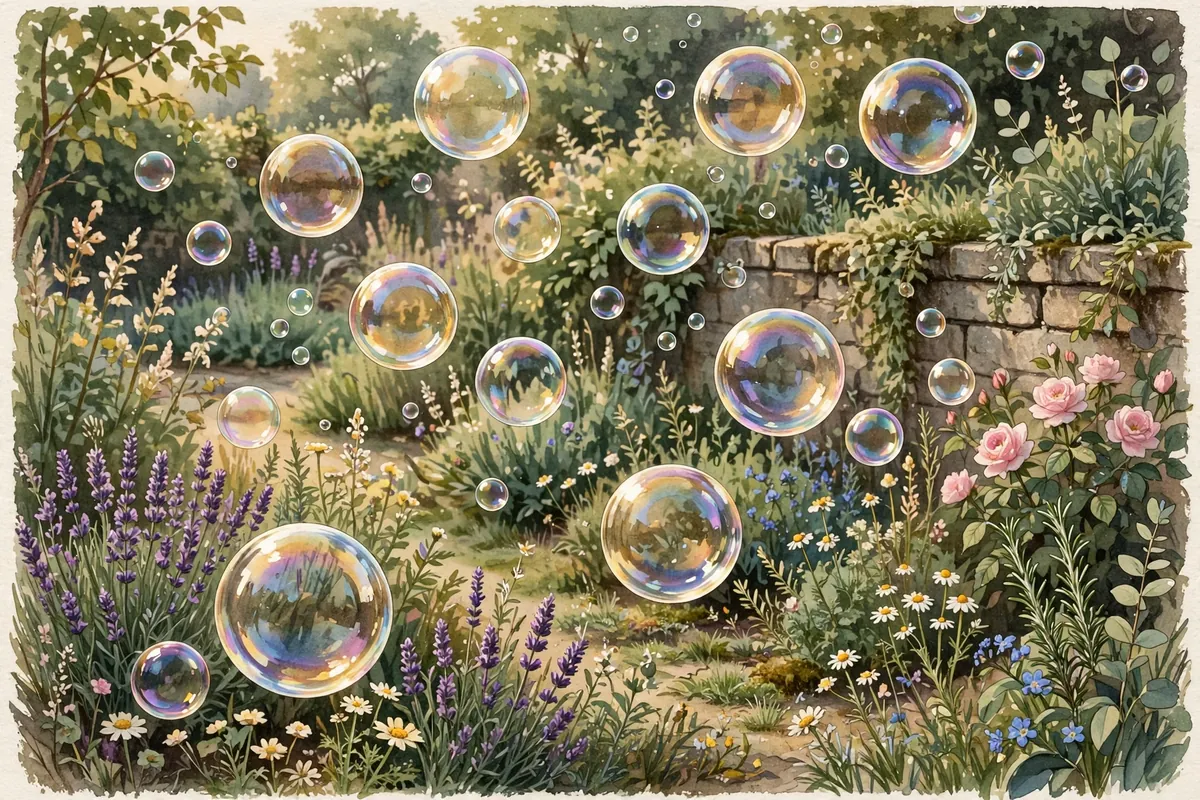
There's something timeless about blowing bubbles on a summer afternoon. Kids chase them across the yard, and grown-ups secretly enjoy it just as much. And no matter what shape of wand you use, round, square, or shaped like a star, the bubbles that float away are always round.
That's because a bubble always settles into the shape with the smallest possible surface for the amount of air inside it, and that shape is a sphere. Surface tension in the thin soapy film pulls it as tight as it can go, like a stretchy skin trying to shrink. Squeezing a given amount of air into the least possible surface leaves only one answer: a ball.
The Tug of Surface Tension
A soap bubble is an extremely thin film of soapy water wrapped around a pocket of air. The molecules on the surface of a liquid are pulled inward by their neighbors, creating what scientists call surface tension. To get into its lowest-energy state, a liquid surface tries to make itself as small as possible.
The same force explains why raindrops and drips from a faucet tend toward a round shape. In fact, without other forces acting on them, drops of almost any liquid would be roughly spherical.
A bubble is a little different from a drop, because it has air pushing out from inside. The slightly higher pressure inside balances the film's inward pull. The result is a perfectly smooth surface that curves the same amount everywhere, which is exactly what a sphere is.
Nature's Math Problem
Mathematicians have a name for this: the minimal surface problem. Soap films are real-life examples of it. In fact, soap films stretched across wire frames can form all kinds of complex shapes, and it's sometimes easier to make one physically than to calculate it on a computer.
When bubbles crowd together into foam, they follow strict rules too. Only three bubble walls ever meet along a line, always at equal angles of 120 degrees. These rules are called Plateau's laws, after Belgian scientist Joseph Plateau.
Why Bubbles Shimmer
Bubbles are made of clear water and clear air, so where do the swirling colors come from? The soap film is about as thin as a wavelength of light. Light bounces off both the outer and inner surfaces of the film, and those reflections interfere with each other.
Depending on how thick the film is at each spot, some colors are strengthened and others canceled out. That's why the colors swirl and shift as the film drains and thins. Interestingly, adding regular dye to bubble solution doesn't make colored bubbles, because the dye sticks to the water rather than the soap.
Bubbles Through History
People have been blowing bubbles for fun for at least 400 years. Flemish paintings from the 1600s show children blowing them with clay pipes. In 1886, Pears soap used a painting by John Everett Millais of a child with bubbles in a famous ad campaign, and bubble solution has been sold in stores since the 1940s.
So the next time you blow a bubble and watch it drift away, you're seeing a little lesson in physics float by. Nature is simply finding the neatest, most efficient way to hold a breath of air, and it gets the answer right every single time.