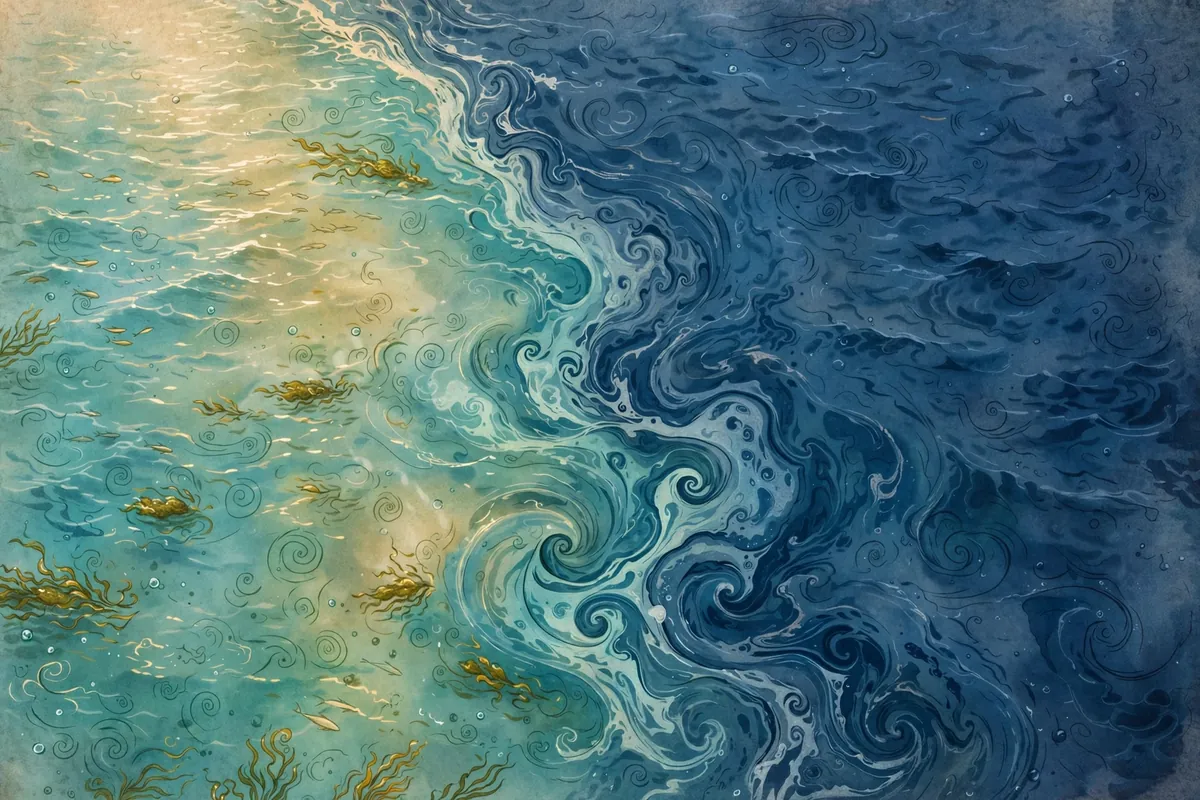
You may have seen the pictures: two shades of water meeting in a sharp line, as if an invisible wall were keeping them apart. The captions often claim these are two oceans that refuse to mix. It's a striking sight, and it really happens. But the explanation isn't quite what the captions say.
Bodies of water with different saltiness, temperature, or amounts of sediment can sit side by side and form a visible boundary for a while. But they do mix eventually. The line is a slow, messy blending zone, not a permanent wall. And many famous examples involve seas or rivers rather than two whole oceans.
The Line at the Top of Denmark
The most famous spot is Grenen, a long sandy spit at Skagen, the northernmost point of mainland Denmark. Here the Skagerrak, part of the North Sea, meets the Kattegat, the sea leading toward the Baltic. Because the waters have different densities, a clear dividing line can often be seen as waves roll in from both sides.
It's a wild place, and it inspired a whole colony of painters in the late 1800s. The colliding waves have built a sandbar about 2.5 miles long, and it's still growing toward Sweden. The currents are so strong that swimming there is banned. About 2 million visitors come each year to stand with one foot in each sea.
Why Salty and Fresh Water Separate
The key is density. Salt water is heavier than fresh water. The Baltic Sea, fed by around 200 rivers, is far less salty than the ocean, with surface water that's nearly fresh in places. When it flows out toward the North Sea, the lighter Baltic water tends to ride on top while saltier water slides underneath in the opposite direction.
Scientists call that kind of boundary a halocline. You can make one in a drinking glass by gently pouring fresh water over salt water with a spoon. A hazy layer forms where they meet. Stir it, though, and they blend. Waves, wind, and currents do the same thing in the sea, just more slowly.
Rivers That Run Side by Side
Some of the most dramatic examples involve rivers. Near Manaus, Brazil, the dark Rio Negro meets the pale, sandy-colored Amazon. For about 4 miles, the two run side by side without mixing.
The differences are huge. The Rio Negro flows slowly and is about 82 degrees Fahrenheit, while the Amazon branch flows faster at about 72 degrees and carries heavy sediment from the Andes. Even so, the waters fully blend about 37 miles downstream.
Where Two Oceans Really Meet
The traditional dividing line between the Atlantic and Indian oceans begins at Cape Agulhas, the southern tip of Africa. Far from refusing to mix, the two oceans trade water there constantly.
The warm Agulhas Current flows south along Africa's east coast, then turns back toward the Indian Ocean. As it turns, it pinches off giant swirling rings of water that drift into the Atlantic, carrying huge amounts of heat and salt. That exchange is an important part of the global circulation that moves heat around the planet.
So the line between two seas is real, and it's beautiful to see. But the oceans aren't keeping secrets from each other. Given a little time and a few good waves, all that water ends up sharing.