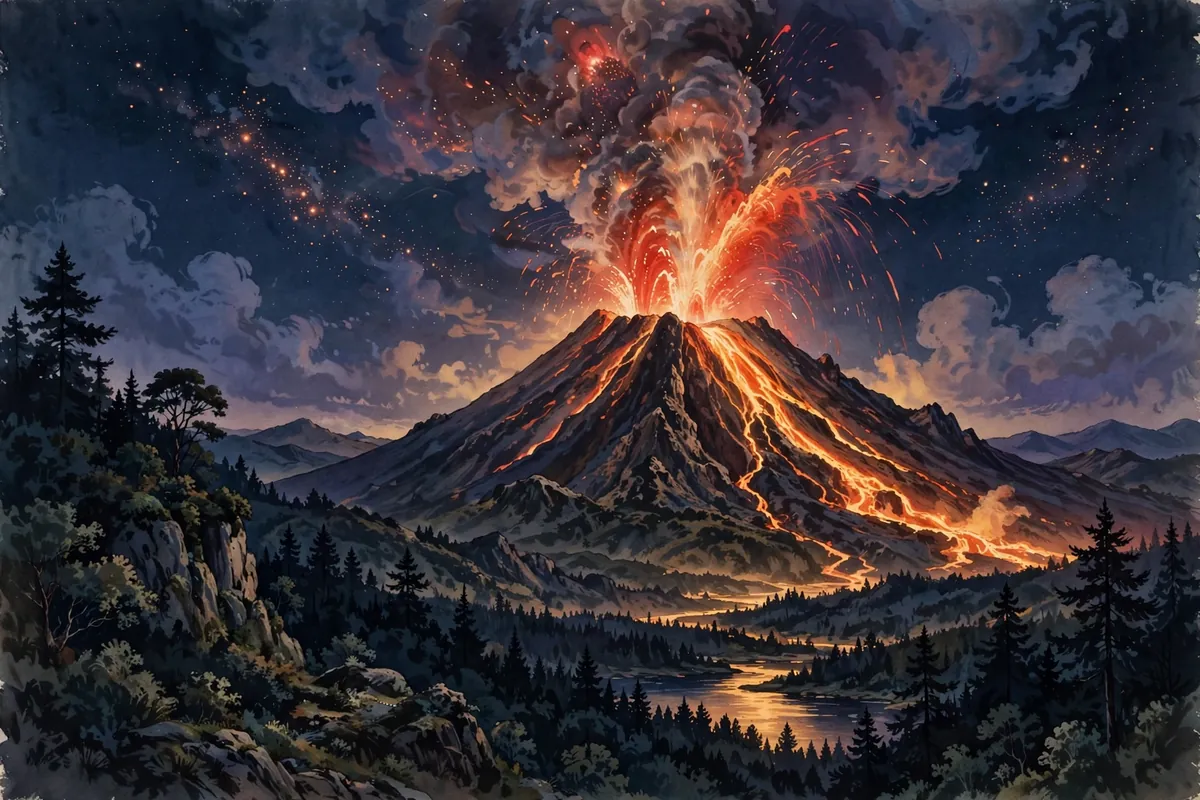
Volcanic eruptions tend to make the news only when they're big and dramatic. So it's easy to think of them as rare events that happen once in a long while. In reality, somewhere on the planet, a volcano is almost certainly erupting at this very moment.
The honest answer to how many are erupting right now is that the number changes all the time, and scientists keep a close watch on it. The Smithsonian Institution and the U.S. Geological Survey publish a Weekly Volcanic Activity Report to track it. What we know for sure is that the world has about 1,650 potentially active volcanoes, and a handful have been erupting almost nonstop for decades or longer.
What Counts as Erupting?
Part of the challenge is defining the word. The USGS calls a volcano erupting whenever magma can be seen coming out of any part of it, including glowing magma still inside the summit crater.
The bigger category, active volcanoes, is broader. Scientists usually count any volcano that has erupted in the last 11,700 years or so, since the start of the current geologic epoch. About 500 of the world's 1,650 potentially active volcanoes have erupted in recorded history, and in 2021 the Smithsonian recognized 560 volcanoes with confirmed historical eruptions.
Even the experts admit these labels don't always fit neatly. Volcanologists don't all define erupting, active, dormant and extinct the same way, and many volcanoes fall somewhere in between. Some erupt several times a year, while others go tens of thousands of years between eruptions.
The Volcanoes That Never Seem to Stop
Some volcanoes are busy almost all the time. Italy's Stromboli has been in nearly continuous eruption for the past 2,000 to 5,000 years, tossing out glowing lava bombs every few minutes to hours.
Erta Ale in Ethiopia has kept a lake of molten lava since at least 1906. Mount Erebus in Antarctica has held one since at least 1972. Indonesia's Mount Ibu has erupted constantly since 2012. Hawaii's Kīlauea erupted nearly continuously from 1983 to 2018, sending lava steadily flowing across the ground. New Zealand's Whakaari, also called White Island, has been releasing volcanic gas continuously since before Europeans first saw it in 1769.
Hidden Under the Sea
Here's the twist. Most of Earth's volcanoes are underwater, because most of the boundaries between tectonic plates lie beneath the ocean. Scientists have documented recent activity at only 119 submarine volcanoes, but there may be more than a million geologically young ones on the sea floor.
In the deep ocean, the crushing weight of water keeps eruptions from exploding, so many go completely unnoticed at the surface. Researchers sometimes detect them by listening with underwater microphones called hydrophones. That means the real number of eruptions happening right now is probably higher than any list can show.
Where the Action Is
Many active volcanoes sit along the Pacific Ring of Fire, which circles the Pacific Ocean. Counting volcanoes active since 1960, Indonesia leads with 55, followed by Japan with 40 and the United States with 39, mostly in Hawaii, Alaska and the Pacific Northwest.
The United States actually has the most volcanoes active in the past 11,700 years, with 165. An estimated 500 million people worldwide live near active volcanoes. So the next time you hear about an eruption on the news, remember that it's just one voice in a planet that's always rumbling somewhere.