On a clear, dark night, the sky looks endless. But how big is the universe, really? It's one of the oldest questions people have ever asked, and modern astronomers have a surprisingly precise answer for part of it, and an honest shrug for the rest.
Here's the short answer. The part of the universe we can see, called the observable universe, stretches about 46.5 billion light-years in every direction from Earth. That makes it roughly 93 billion light-years across. What lies beyond that is a mystery. The full universe's size is unknown, and it may even be infinite.
What the Observable Universe Means
The observable universe is the region whose light has had time to reach us since the universe began expanding. Light travels fast, but not infinitely fast. Some parts of the universe are so far away that their light simply hasn't arrived yet. Those regions are out there, but we can't see them.
Think of it like standing in a thick fog. You can see a certain distance in every direction, and that circle of view is centered on you. The fog doesn't mean the world ends at the edge of what you see. It just means that's as far as your view reaches.
The Puzzle of the Numbers
Here's a head-scratcher. The universe is about 13.8 billion years old. So how can we see things 46.5 billion light-years away? Shouldn't light only have had time to travel about 13.8 billion light-years?
The answer is that space itself has been expanding the whole time. The 46.5 billion figure describes where those distant objects are now, not where they were when their light set out. For example, the faint glow left over from the early universe, called the cosmic microwave background, was released about 380,000 years after the Big Bang. The matter that gave off that light has mostly gathered into galaxies, which are now calculated to be about 46 billion light-years away.
Even stranger, very distant regions are moving away from us faster than the speed of light because of this expansion. And that expansion appears to be speeding up, something scientists have proposed is driven by a mysterious force called dark energy.
Counting the Galaxies
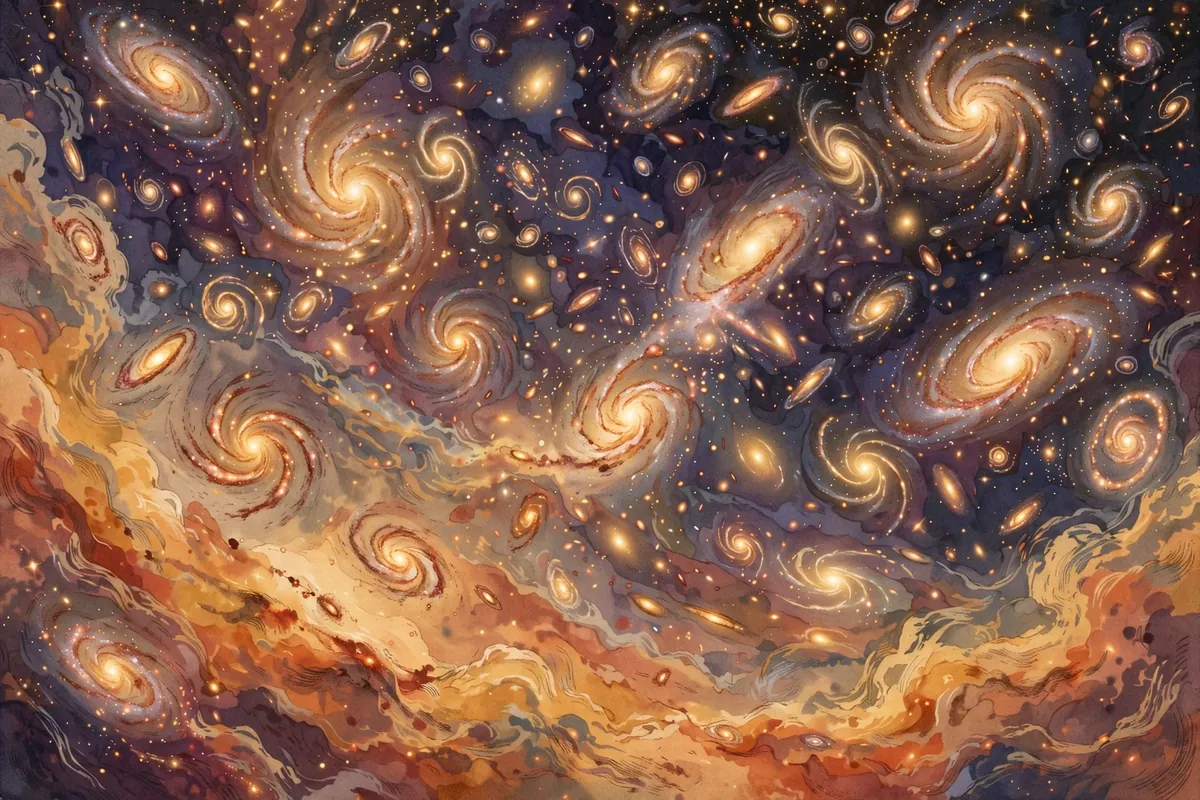
So what's inside our cosmic bubble? Estimates vary, but the observable universe may contain as many as 2 trillion galaxies. Other estimates put the number in the hundreds of billions instead. Either way, it's a staggering crowd.
The number of stars is even harder to picture. One estimate puts it at as many as a trillion trillion, a 1 followed by 24 zeros. That's more stars than there are grains of sand on all of Earth's beaches.
A View That Won't Last Forever
You might expect that, given more time, we'd see farther and farther. In principle, more galaxies will come into view. But because the expansion keeps stretching their light, many distant galaxies will become so faint and reddened that they'll effectively fade from view.
If the expansion keeps accelerating, there's a limit beyond which light can never reach us at all, no matter how long we wait. Scientists estimate that the number of galaxies we could ever observe is only about 2.36 times the number we can see today.
So the next time you look up at the night sky, remember that what you're seeing is just a tiny corner of a tiny slice. The universe we can see is almost unimaginably huge, and it may be only a small part of the whole.