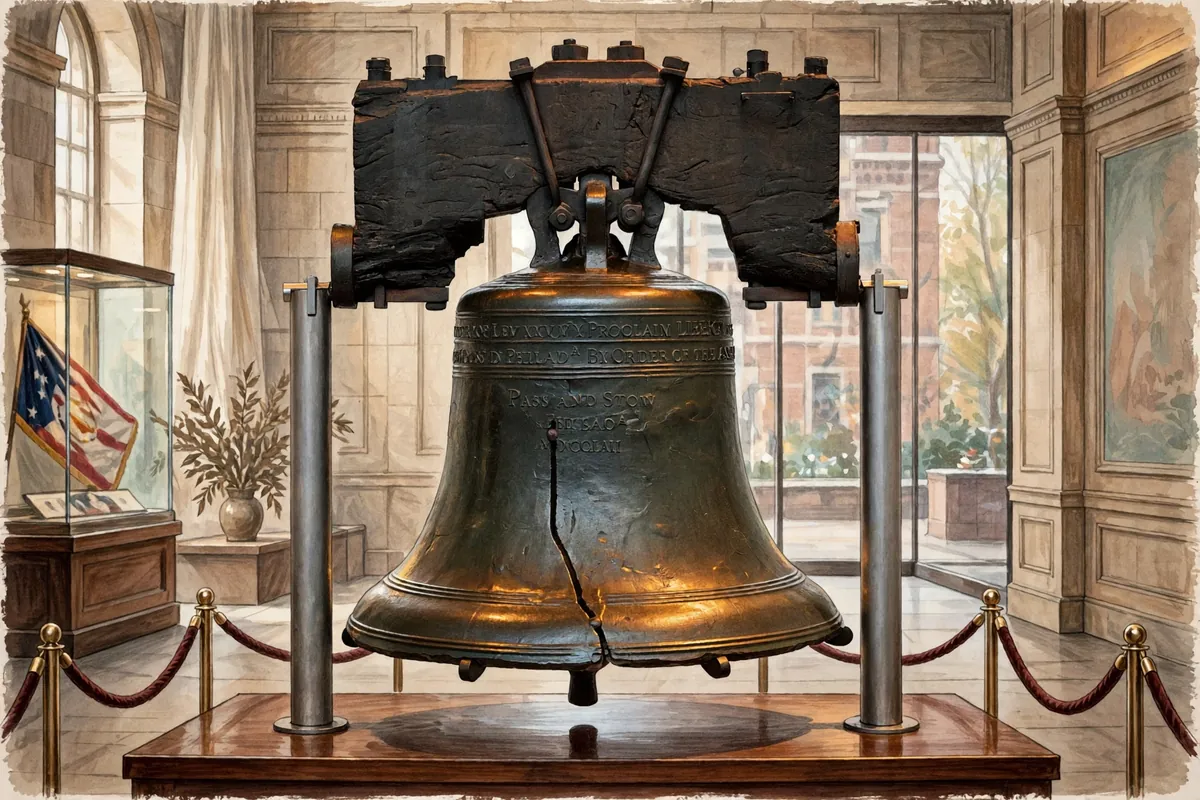
It's one of the most recognizable objects in America: a big bronze-colored bell with a jagged crack running up its side. Generations of schoolchildren have heard a dramatic tale about how that crack got there. But how much of that tale is true?
Here's the short answer: nobody knows exactly when or how the famous crack appeared. What historians do know is that it happened sometime between 1817 and 1846, most likely toward the end of that stretch. The popular story that it cracked while tolling for Chief Justice John Marshall in 1835 has little evidence behind it. And the bell had cracked once before, the very first time it was rung.
A Bad Start From Day One
The bell was ordered in 1752 by the Pennsylvania Provincial Assembly from a London foundry. When it arrived in Philadelphia, it was mounted on a stand to test the sound. At the first strike of the clapper, the rim cracked.
Two local men, John Pass and John Stow, offered to recast it, even though neither had experience making bells. They broke it into pieces, melted it down, and added extra copper because they thought the metal was too brittle. When the new bell was struck at a public celebration, it held together, but one listener compared the sound to two coal scuttles being banged together.
Mocked by the crowd, Pass and Stow took it back and recast it again. By June 1753 the sound was deemed acceptable, and the bell was hung in the steeple of the State House, now known as Independence Hall. Their names are still on it today.
The Mystery of the Big Crack
The tale about John Marshall's death in 1835 first appeared in 1876, when the volunteer curator of Independence Hall announced he had learned the truth. There was little evidence for his claim, but it was widely accepted and taught for years. Other stories blamed a welcome ceremony for Lafayette in 1824, or some boys who were invited to ring the bell.
The clues point later. An anti-slavery publication pictured the bell in 1837 with no visible crack. Then, in February 1846, a Philadelphia newspaper reported that the bell had long been cracked but had been repaired by filing the sides of the crack. When it was rung for Washington's Birthday that year, the crack spread, leaving the old bell, as the paper put it, forever dumb.
A book written for the National Park Service suggests it most likely cracked between 1841 and 1845, while ringing on either Independence Day or Washington's Birthday.
Why the Bell Was So Fragile
In 1975, a museum analysis found that a series of errors in making and remaking the bell left it very brittle. The original metal had an unusually high level of tin. On the second recasting, Pass and Stow apparently added cheap, lead-heavy pewter and didn't mix it in completely.
Here's a surprising detail: the wide gap you see is not the crack itself. It's the crack filed open in the 1800s so the bell could ring. A thin hairline crack keeps going from there, winding up toward the top of the bell.
How It Became the Liberty Bell
For decades it was just the State House bell. Abolitionists in the 1830s adopted it as a symbol and gave it the name Liberty Bell, inspired by its inscription: Proclaim Liberty throughout all the Land unto all the Inhabitants thereof.
So the crack that made the bell famous is a bit of a mystery, and that suits it. Officials once decided against fixing it, concluding the crack had become part of the bell's character. Most visitors would agree.