You may have heard that women weren't allowed to run marathons until 1972. It's a striking claim, and it contains a real injustice. But the full story is more interesting, because women had been running the 26.2-mile distance for decades. What they couldn't do was run it officially.
Here's the accurate version. In the United States, the rules of amateur sport kept women out of sanctioned marathons until late 1971, when the Amateur Athletic Union finally changed its rules. In 1972, women were officially allowed to enter the Boston Marathon for the first time. Long before that, though, determined women had already proved they could go the distance.
Women Were Running All Along
As far back as 1896, a Greek woman named Stamata Revithi ran the marathon distance, though she wasn't included in any official results. Marie-Louise Ledru of France has been credited as the first woman to complete a marathon, in 1918. Violet Piercy of Britain is credited as the first woman officially timed in one, in 1926.
In the U.S., Arlene Pieper became the first woman to officially finish a marathon in 1959, at the Pikes Peak Marathon in Colorado. So the barrier wasn't women's ability. It was the rulebook.
The Woman in the Bushes
In February 1966, a young runner named Bobbi Gibb wrote away for an application to the Boston Marathon. The race director wrote back that women weren't physically capable of running that far, and that under amateur rules, women weren't allowed to race more than a mile and a half.
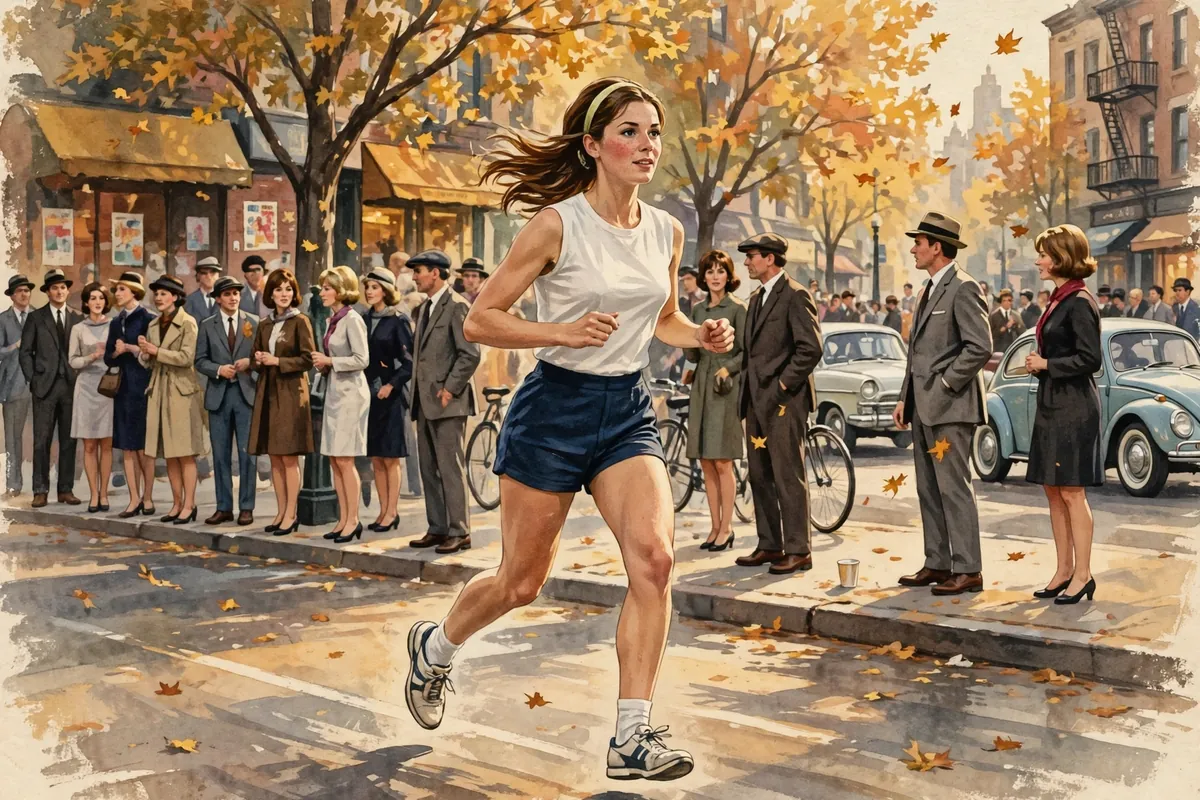
She ran anyway. On race morning, her mother dropped her at the start in Hopkinton. Wearing her brother's Bermuda shorts and a hooded sweatshirt, Gibb hid in the bushes, waited until about half the pack had started, and jumped in. She finished in 3 hours, 21 minutes, and 40 seconds, ahead of about two-thirds of the runners. The governor of Massachusetts was at the finish to shake her hand.
The Famous Shove
A year later, Kathrine Switzer entered Boston as "K.V. Switzer" and got an official race number. Her entry was later described as slipping through by "oversight." During the race, co-director Jock Semple charged at her and tried to rip the number off. Her boyfriend, running beside her, knocked Semple to the ground, and Switzer finished.
Photos of the attack were seen around the world. In response, the AAU banned women from racing against men, something that hadn't been spelled out before. Women kept running Boston unofficially, and Gibb was the first woman to finish in 1966, 1967, and 1968.
What Changed in 1972
A runner named Nina Kuscsik pushed the AAU to raise the maximum distance for sanctioned women's races. In late 1971, the rules changed. At Boston in 1972, women ran officially for the first time, and Kuscsik won. Switzer finished third, and in a fitting twist, Semple handed her the trophy.
Even then, the world's biggest stage took longer. The women's marathon wasn't added to the Olympics until 1984 in Los Angeles, where American Joan Benoit won the gold. Today, Boston organizers recognize Gibb as the women's winner for 1966 through 1968.
So the next time you see a crowd of women crossing a marathon finish line, remember the runners who went first without permission. They didn't wait for the rules to catch up. They simply laced up and ran.