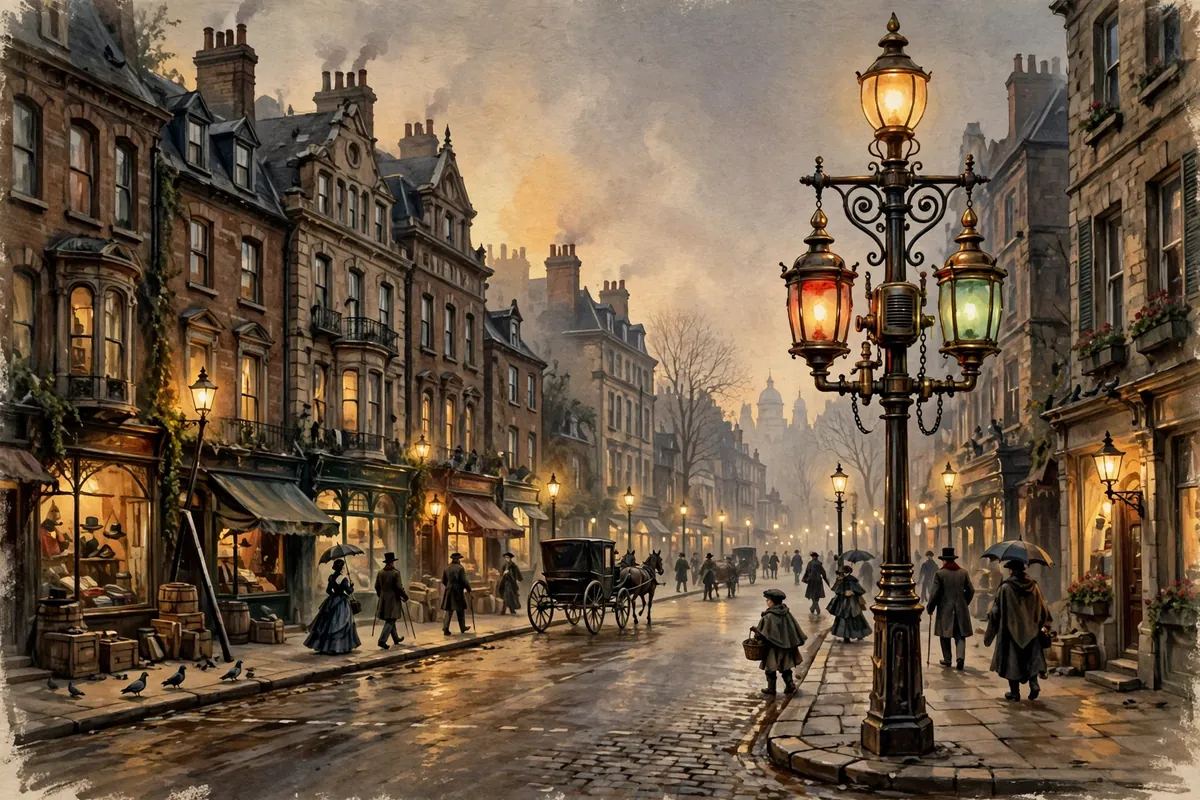
Today we barely notice traffic lights. They blink away on nearly every corner, quietly keeping us safe. But the very first one ever installed had a short and dramatic life. It went up in Victorian London, years before the first automobile hit the road.
Here's what happened. In December 1868, a signal invented by railway manager John Peake Knight was installed near the Houses of Parliament in London. A police officer worked it by hand, and at night it showed red and green gas-powered lamps. In early January 1869, less than a month later, a gas leak caused it to explode, badly injuring the policeman operating it. The signal was taken down, and London didn't get traffic lights again for decades.
Why London Needed It
Victorian London's streets were packed with horse-drawn carriages, carts, and people on foot, and it was dangerous. In 1866, 1,102 people were killed and 1,334 injured on London's roads. Knight proposed a signal system to bring order to the chaos and cut down on accidents.
Knight knew a thing or two about signals. Born in Nottingham, he had left school at 12 to work in the parcel room of a railway station, and he rose to become a railway superintendent. His idea borrowed directly from railway signaling.
How It Worked
By day, the signal used semaphore arms, like those on railway lines. A police constable raised or lowered the arms to tell traffic when to stop and go. At night, when the arms were hard to see, he worked a lever to show red and green lamps, lit by gas.
The world's first traffic light was installed on December 9, 1868, at the corner of Great George Street and Bridge Street, near Westminster Bridge. It was the right idea. The trouble was the gas.
A Short, Explosive Career
Gas lamps need a steady fuel supply, and leaks are dangerous. In January 1869, a gas leak caused one of the lights to explode. The policeman operating it was badly injured. After that, the system fell out of favor and was removed. The world's first traffic light had lasted less than a month, a short run for an idea that would one day be found at nearly every busy corner on Earth.
London took a long break from traffic signals. They didn't return to the United Kingdom until 1929, when the first electric signals were introduced in London. Knight, meanwhile, kept improving railway travel. As a railway manager he introduced air brakes, safer carriages with communication cords, electric lighting, and Pullman cars.
America Takes Over
Knight's idea still caught on. In the early 1900s, semaphore signals worked by traffic officers were used all over the United States. Then electricity changed everything.
In 1912, a Salt Lake City policeman named Lester Wire developed the first electric traffic light. In August 1914, an electric signal was installed at East 105th Street and Euclid Avenue in Cleveland, Ohio. In 1920, Detroit police official William Potts created the first four-way, three-color traffic light, adding an amber caution light to red and green. Automatic timers soon followed, saving cities money by freeing up traffic officers.
Today, a plaque marks the spot near where Knight's signal once stood, at 12 Bridge Street in Westminster. It was unveiled in 1998. So the next time you're waiting at a red light, remember the brave constable who ran the very first one, and be glad that today's lights run on electricity, not gas.