On a clear winter night, one star outshines all the rest. It's Sirius, nicknamed the Dog Star, and it's so bright it seems to sparkle and flash near the horizon. People have watched it for thousands of years. Yet for almost all that time, nobody knew it had a secret.
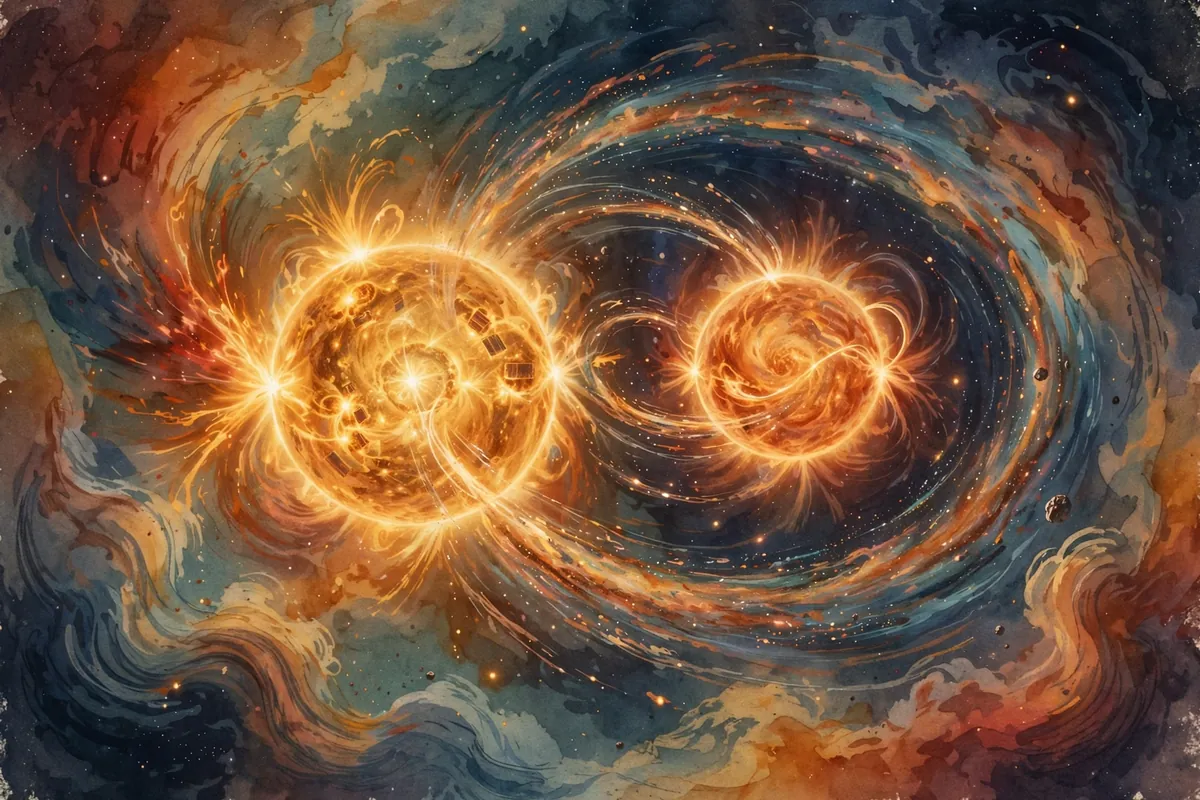
Here's the short answer: Sirius is actually two stars. The one we see, called Sirius A, is a big, bright star about twice the mass of our Sun. Circling with it is Sirius B, a faint white dwarf about the size of Earth. The two orbit each other once every 50 years.
Found by a Wobble
The first clue came from motion, not sight. In 1844, the German astronomer Friedrich Wilhelm Bessel studied how Sirius drifts across the sky and noticed changes in its path. He concluded it must have an unseen companion pulling on it.
Seeing that companion took another 18 years. On January 31, 1862, American telescope maker Alvan Graham Clark was testing a new lens for a large telescope, which became the largest telescope in the United States at the time. He pointed it at Sirius and spotted the faint partner. Astronomers confirmed the sighting that March using smaller telescopes.
A Star the Size of Earth
Sirius B turned out to be something strange. In 1915, astronomer Walter Adams studied its light at Mount Wilson Observatory and found it was a faint, whitish star. That led to the conclusion that it was a white dwarf, only the second one ever discovered.
A white dwarf is what remains after a star like the Sun runs out of fuel. In 2005, the Hubble Space Telescope helped astronomers measure Sirius B. It's nearly the diameter of Earth, about 7,500 miles across, yet it holds slightly more mass than the entire Sun. Picture the Sun squeezed down to the size of our planet.
A Pair With a Past
The Sirius system is between 200 and 300 million years old. It began as two bright bluish stars. The one that started out heavier, now Sirius B, burned through its fuel faster, swelled into a red giant, shed its outer layers, and collapsed into a white dwarf around 120 million years ago.
The two stars never stay the same distance apart. Over their 50-year orbit, the gap between them ranges from about 8 to 31 times the distance between Earth and the Sun. Since 1894, some astronomers have suspected a third, much smaller companion, but searches have never confirmed one.
Why Sirius Shines So Bright
Sirius A gives off about 25 times as much light as the Sun. That's impressive, but bright stars such as Canopus, Betelgeuse, and Rigel are far more powerful. Sirius looks so bright mainly because it's close, only about 8.6 light-years away, making it one of our nearest neighbors.
It's slowly getting closer, too, and should brighten slightly over the next 60,000 years. Astronomers expect it to stay the brightest star in our night sky for roughly the next 210,000 years. Fittingly, its name comes from an Ancient Greek word meaning glowing or scorching.
Pairs like this are common in space. In 1803, William Herschel noticed that some double stars he'd tracked for 25 years were circling each other. So the next time you spot Sirius, give a nod to its little partner. It's been there all along, quietly sharing the dance.