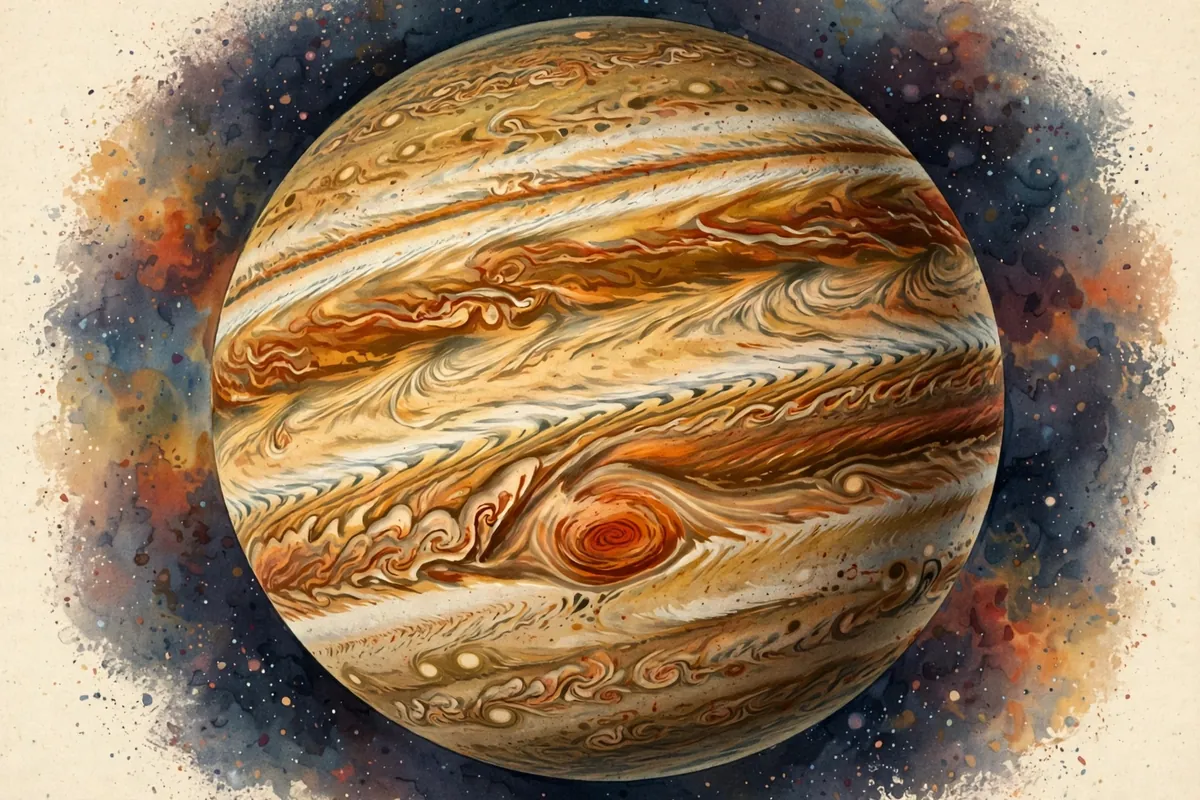
Jupiter's Great Red Spot is one of the most famous sights in the solar system. It's a storm, spinning on the largest planet we have, and it has been watched by astronomers for nearly two centuries. But lately, something has changed. The giant spot is getting smaller.
Here's the honest answer: nobody knows for sure why it's shrinking. Astronomers have tracked the change for about a century, but they're still debating the cause. It may be part of a natural cycle, or the storm may be losing strength. Some even think the shrinking is partly an illusion of the clouds on top.
How Much Smaller Is It?
About a century before 2004, the spot stretched around 25,000 miles from end to end, roughly three times the width of Earth. By 2004, its length was about half that. In April 2017, it measured about 10,160 miles across, still about 1.3 times the width of Earth, but far from its old self.
It's also changing shape. The storm is an oval, and it has been getting rounder. At the current rate, it would become a circle by about 2040.
The Great Debate: Is It Dying?
In 2019, the spot began "flaking" at its edges, with pieces of the storm spinning off and fading away. Together with the shrinking, that led some astronomers to wonder if the spot could disappear within decades.
Others aren't worried. They argue that what we see is mostly the cloud cover on top, not the size of the spinning storm underneath. They also think the flaking can be explained by the storm bumping into other, smaller storms and partly absorbing them. If they're right, the Great Red Spot isn't in danger at all. It's also possible the changes are simply part of a long-term ups-and-downs pattern.
Why the Storm Has Lasted So Long
On Earth, hurricanes fall apart when they move over land, because friction with the ground slows them down. Jupiter has no solid surface for the storm to run into, just a deep layer of hydrogen. With nothing to slow its spin, the storm can keep going for a very long time.
And it's powerful. Winds reach up to 308 miles per hour, and the storm turns counterclockwise once every four and a half Earth days or so. NASA's Juno spacecraft, which flew over the spot in July 2017, found that it reaches roughly 150 to 190 miles below the clouds.
How Old Is It, Really?
The current storm has been observed since September 1831 and watched continuously since 1878. In the 1600s, the astronomer Giovanni Cassini described a permanent spot on Jupiter that kept returning in the same place, and it was seen until 1713.
For a long time, people assumed that was the same storm, which would make it more than 350 years old. But a 2024 study suggested the old spot faded away and a new one formed later. If so, today's storm is "only" about two centuries old.
Even the red color has an explanation. It comes from a kind of sunburn, as chemicals high in the storm get blasted by the Sun's radiation. So whether the Great Red Spot fades out in our lifetime or keeps spinning for centuries more, it's worth a look through a backyard telescope while it's still putting on a show.