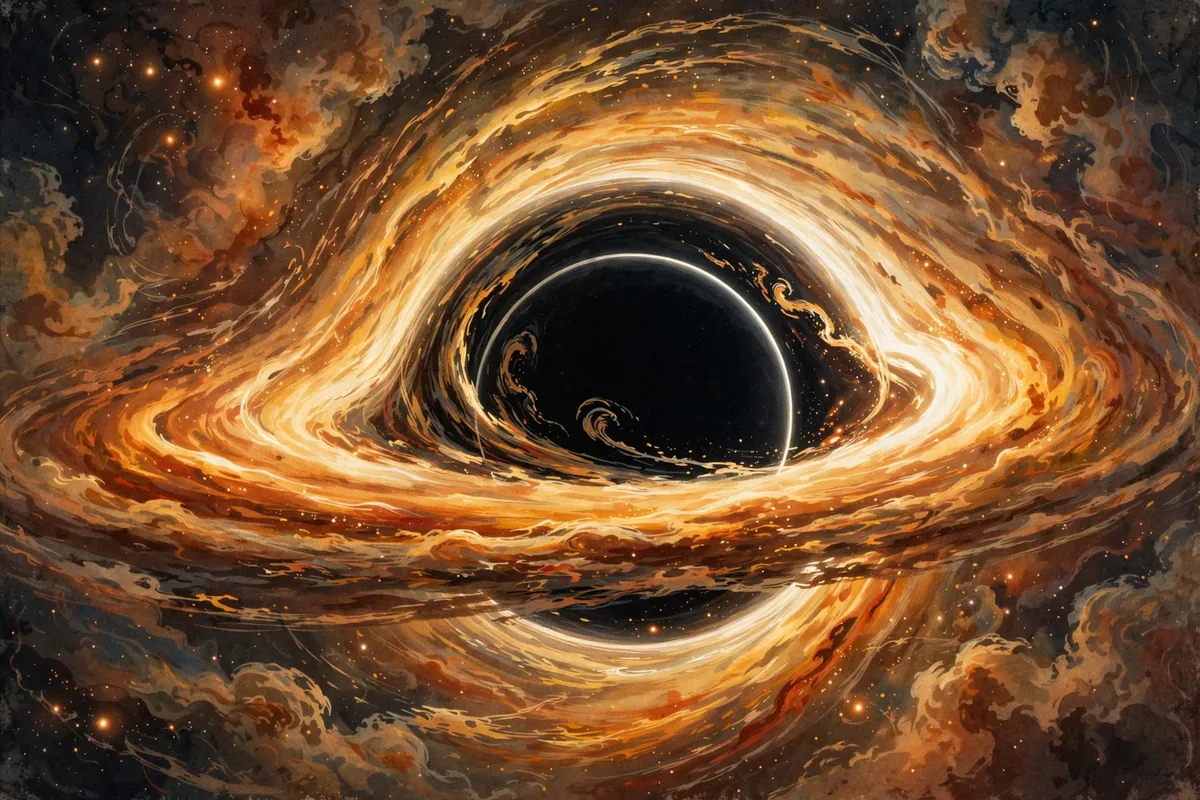
Black holes are the ultimate cosmic trap. Their gravity is so strong that nothing, not even light, can escape once it gets too close. It's a question that has fascinated stargazers for decades: what would actually happen to a person who fell into one?
The short answer is that it depends on the size of the black hole and on who's watching. Near a smaller black hole, gravity would pull much harder on your feet than your head, stretching you out long and thin before you even crossed the point of no return. Physicists jokingly call it spaghettification. Near a giant black hole, you might drift across that boundary without feeling anything unusual at first. But either way, there'd be no coming back.
The Point of No Return
Every black hole has a boundary called the event horizon. Outside it, light and matter can still escape if they're moving fast enough. Inside, everything can only go one way: inward.
What surprises many people is that the event horizon isn't a wall. According to Einstein's general theory of relativity, crossing it produces no change you could detect on the spot. There's no bump, no flash, no warning sign. You'd simply pass through, and from that moment on, falling toward the center would be unavoidable.
Stretched Like Spaghetti
The real danger comes from what scientists call tidal forces. Gravity gets stronger the closer you are to something massive. Near a black hole, that difference becomes enormous, even across the length of a human body.
If you fell in feet first, the pull on your feet would be much stronger than the pull on your head, stretching you vertically. At the same time, your sides would be squeezed inward. The term spaghettification was popularized by Stephen Hawking, who described a fictional astronaut being 'stretched like spaghetti.'
Here's the twist. Smaller black holes, the kind formed from collapsed stars, have the most intense stretching right near their edge. A falling astronaut would be torn apart before reaching the event horizon. But for a supermassive black hole, like those at the centers of galaxies, the deadly stretching happens only after you're inside. You could cross the horizon without noticing any significant tidal forces at all.
What Your Friend Would See
Now picture a friend watching from a safe distance. To them, the scene would unfold in a very strange way. Clocks near a black hole appear to tick more slowly to a distant observer, an effect called gravitational time dilation.
So your friend would see you slow down as you approached the event horizon, never quite reaching it. Your image would grow redder and dimmer, then fade from view entirely. You would also appear to flatten onto the black hole, along with everything else that had ever fallen in. For you, meanwhile, your own watch would keep ticking normally.
Real Black Holes, Real Pictures
Black holes aren't just theory. In 2019, scientists using the Event Horizon Telescope, a network of radio telescopes around the world working together as one Earth-sized instrument, released the first direct image of a black hole's surroundings, in the galaxy Messier 87. In 2022, they released an image of Sagittarius A*, the black hole at the center of our own Milky Way, which has about 4.3 million times the mass of the Sun.
Those famous pictures show a glowing ring around a dark center. The dark part is the black hole's shadow, not the event horizon itself, since no light can come from inside.
The good news is that the nearest black holes are very far away, so nobody is falling into one anytime soon. That leaves us free to enjoy them the best way possible: from a very safe distance, with a little wonder and a cup of coffee.