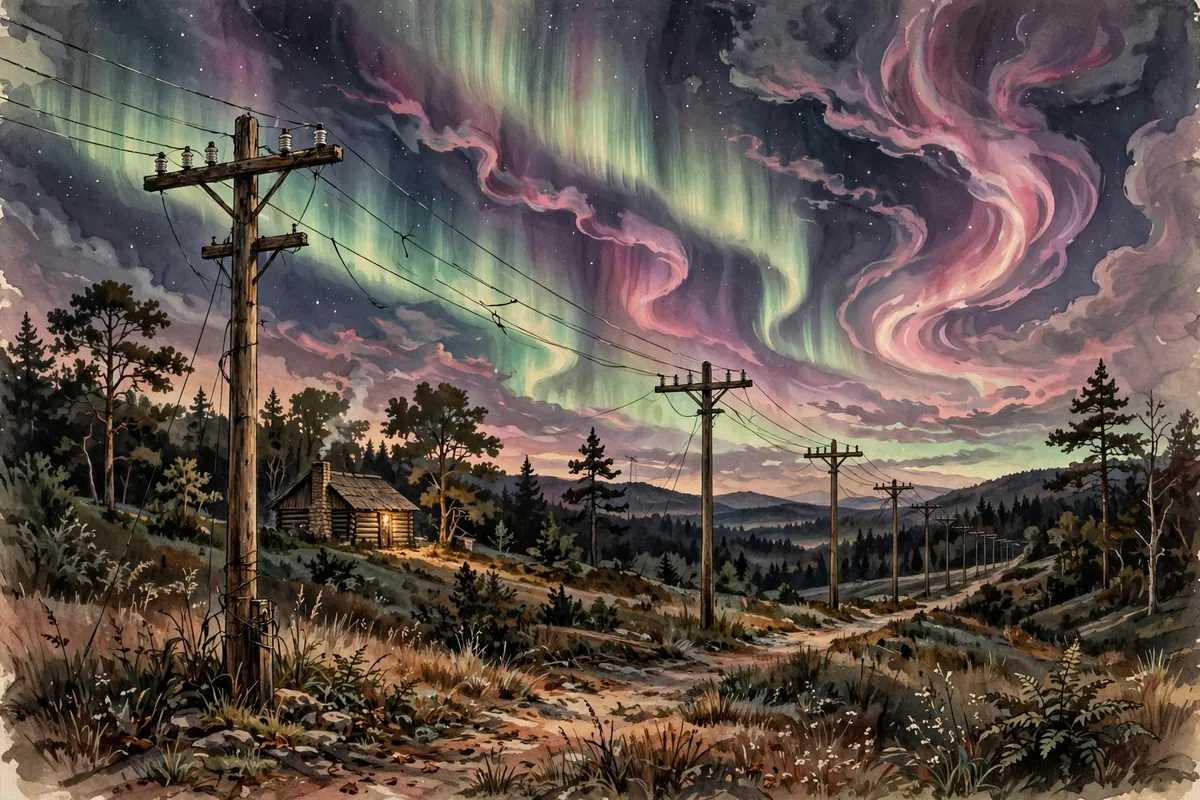
Picture a quiet night in the summer of 1859. You step outside and the whole sky is glowing with shifting colors, so bright that the familiar stars have faded into a soft haze. Down the road, the local telegraph office is throwing sparks. People wondered whether the world was ending.
It wasn't the end of the world. It was the Carrington Event, the most intense geomagnetic storm in recorded history, peaking on September 1 and 2, 1859. A huge burst of material from the Sun, called a coronal mass ejection, most likely slammed into Earth's magnetic field. The result was spectacular auroras around the globe and chaos on the telegraph lines.
Two Astronomers Saw It Start
Just before noon on September 1, two English astronomers, Richard Carrington and Richard Hodgson, were separately watching the Sun. Each spotted a very bright flash on its surface. Their reports were the first records ever made of a solar flare, and the storm that followed now carries Carrington's name.
The cloud of solar material that followed traveled to Earth in just 17.6 hours, covering about 93 million miles. Most of these eruptions take several days to arrive. Scientists think an earlier eruption may have cleared a path, letting this one race ahead.
A Sky Bright Enough to Read By
The auroras were seen in both the northern and southern hemispheres. Over the Rocky Mountains, the glow was so bright that it woke up gold miners, who reportedly started making breakfast because they thought it was morning. People in the northeastern United States said they could read a newspaper by the light.
The lights reached places that almost never see an aurora, including Cuba, Hawaii, southern Japan, and even Colombia, close to the equator. One newspaper account described a light brighter than the full moon covering the whole sky like a glowing cloud, with only the brightest stars dimly shining through it.
When the Telegraph Went Haywire
In 1859, the telegraph was the high-tech network of the day, and the storm hit it hard. Electrical currents created by the storm caused telegraph systems all over Europe and North America to fail. Some operators got electric shocks, telegraph poles threw sparks, and some stations even caught fire.
Strangest of all, some operators kept working with their batteries disconnected. On the line between Boston and Portland, Maine, two operators unplugged their power and sent messages using only the current from the aurora itself. As one put it, the aurora seemed to boost and cancel out their batteries by turns.
Could It Happen Again?
Solar storms haven't gone away. A storm in March 1989 knocked out power across large parts of Quebec. In July 2012, a Carrington-class eruption blasted off the Sun but missed Earth, with a margin of roughly nine days in its path. During the May 2024 storms, an aurora was spotted as far south as Puerto Rico.
A storm as strong as Carrington's today could cause widespread blackouts and damage power grids and satellites. That's why scientists keep a close eye on the Sun.
Still, there's something lovely about the stories from that night in 1859. For a few hours, people from Australia to the Rockies stood outside together, staring up at a sky that seemed to be on fire, and saw one of the most beautiful shows nature has ever put on.